Last updated on Nov. 22, 2025 at 03:13 p.m.
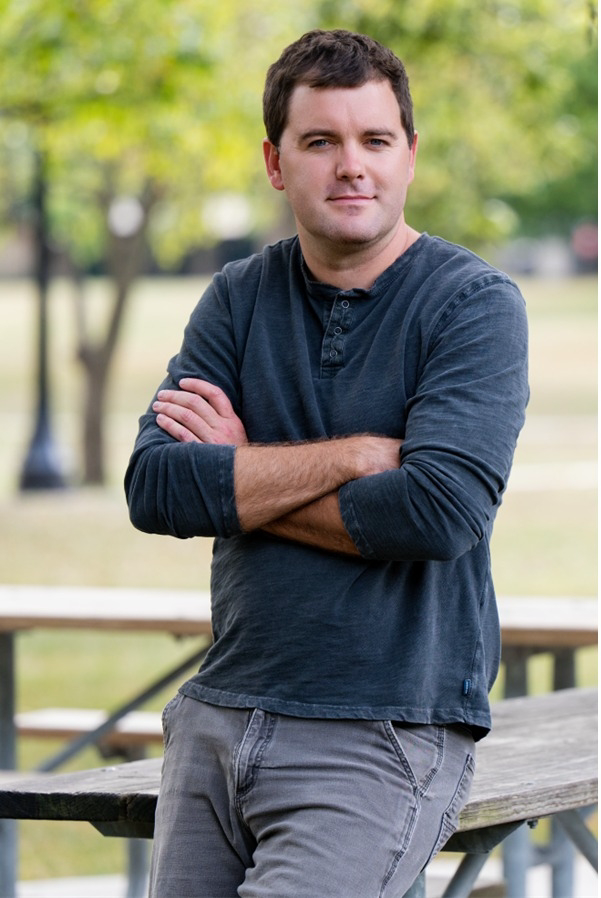
Bryan Maxwell, an assistant research scientist and project engineer for the University, is one of the 22 candidates running for Dick Durbin’s soon-to-be vacant seat in the U.S Senate. Maxwell’s platform has three core agenda points: anti-war, Medicare for all and taxing the billionaires.
Maxwell grew up in Charlotte, North Carolina, and obtained his doctorate at North Carolina State University in agricultural engineering. He moved to the Champaign-Urbana area in 2020 for a job at the University doing postdoctoral work in the Department of Crop Sciences.
When his postdoctoral work concluded, he began working at the University’s Prairie Research Institute, where he currently tests new technologies for producing renewable energy from wastewater.
While Maxwell does not have a political background, he has been involved in volunteer work for a significant amount of time. Unimpressed with the federal government and Democrats at large, Maxwell saw the Senate seat opening as an opportunity to act on his frustrations and expand on one of his core passions: helping underprivileged communities.
Get The Daily Illini in your inbox!
The primary elections are set for March 17. Maxwell’s campaign kick-off will be Saturday from 2-4 p.m. at Cloud Mountain Kombucha in Urbana.
To gain insight into Maxwell’s upcoming campaign and his policies, The Daily Illini conducted a Q&A style interview with Senate candidate Maxwell. (The interview has been edited for brevity and clarity).
General and introductory questions
The DI: It seems like politics was never your “Plan A.” What led you to where you are right now, and what was that process like?
Maxwell: A lot of my background has been more volunteerism. For a lot of my life, even before I moved up here, I’ve really been active in efforts for providing housing, for taking care of the unhoused community. That’s a core passion of mine because it’s a core necessity of people. But also because, during college, I experienced housing insecurity for about a year when I didn’t have enough money to provide stable housing.
I’ve always paid attention to politics. I’ve always had my ear to the ground with politics – paying attention to what both parties are doing, what’s going on, the federal government and local government. And after this last election, I had hoped that after the national Democratic leadership lost to (President Donald Trump) for a second time … that they would have some kind of introspection, some kind of reflection on what they did wrong and what they need to be doing differently. And I didn’t see that happen at all. And that was why I decided to get into politics.
The DI: In your interview with The Intelligencer, you describe yourself as “disillusioned with the Democratic establishment (Party). Could you expand a bit on some of the positions the Democratic Party has or takes which you believe are morally indefensible?
Maxwell: The two biggest ones at the moment are: continued U.S. military support for Israel. Almost every international human rights organization has called it a genocide.
You have what’s likely hundreds of thousands of people, men, women and children killed, and the U.S. Democratic Party establishment continues to support that policy. And it’s not just morally indefensible that we’re still sending military weapons to Israel; it’s politically indefensible.
It’s a policy that’s cost us $40 billion over the last three years. And the fact that the two top candidates in this race, Lt. Gov. Juliana Stratton (and) Rep. Raja Krishnamoorthy, D-Ill, had both said in an interview that they would continue that policy, to me, is just bonkers.
(Editor’s note: The United Nations, Amnesty International, Human Rights Watch, Doctors Without Borders and Oxfam as well as Israeli human rights organizations B’Tselem and Physicians for Human Rights-Israel have accused Israel’s government of committing genocide in Gaza. Israel and the U.S. deny the charge. The U.S. has given Israel at least $21.7 billion in military aid since October 2023. On Oct. 7, the Palestinian Ministry of Health reported a total of 67,173 killed since the war broke out after Hamas’ attack on Oct. 7, 2023. Researchers at Brown University’s Cost of War project estimate the death toll is an undercount.)
The other position is how — I wouldn’t say this is necessarily the core of the Democratic Party — we’ve had a lot of Democratic candidates basically grant (U.S. Immigrations and Customs Enforcement) these sweeping powers that Trump is now using to deploy federal agents to our cities.
The DI: You are a downstate, non-establishment candidate. How do you convince democratic voters to vote for you against an established upstate candidate like Krishnamoorthi?
Maxwell: In order for this party to turn a new page past the current establishment leadership that’s now lost twice to Trump, (it needs) to regain voters, young voters … Any party that’s losing young voters is a party in decline.
The Democratic Party continuing to support military support for Israel is not going to get the young voters back in the numbers that we need to keep growing and win elections. And the two leading candidates — Krishnamoorthi and Stratton — both support that policy.
Establishment career politicians have twice let us lose to the most corrupt, inexperienced person ever to hold the White House. And I think voters in this country want to see some real change, and not just another status quo politician.
The DI: A phrase that is thrown around a lot is that “X” politician will actually listen to their voters, but voters often feel like they don’t. What would you say to voters in reference to yourself and your campaign who are worried that it will just be the same old story once again?
Maxwell: I don’t have political ambitions beyond trying to fight for things that make people’s lives better. I’m not a careerist. I’m not chasing my own illusions for wealth and fame. I’m not doing this for status. I’m doing this because of the real struggle I see in our communities, and that’s something that I’ve been working in my whole life. I’m doing this to put the most vulnerable and marginalized communities first, that need the federal resources that our federal government has.
I refuse to take any corporate money. I refuse to take any (America-Israel Public Affairs Committee) money. And in particular, I’m not afraid to call out the establishment; we need politicians who are going to be honest about even their own party.
Voters aren’t dumb. They see the difference between what the party is saying and what they actually see on the ground … we need people in the party who are willing to say hard truths about the party and not prioritize party unity over what people need and what their voters are saying.
Medicare for all
One of the focal points of Maxwell’s campaign is Medicare for all. Maxwell believes it is absurd that the United States, as the richest country in the world, does not offer universal healthcare to its citizens.
The DI: What do you mean by Medicare for all?
Maxwell: I’m advocating for a system that no longer includes privatized health insurance. Essentially, that there’s a single payer, and that’s the federal government. … It looks like a universal payer system where the government directly pays people’s medical costs.
I’m someone who’s in favor of more state control of a lot of social programs, because you see our federal government go back and forth so much and be so inconsistent that I think that really needs to be managed and guaranteed at the state level.
The DI: How do you address the potential pushback from hospitals and doctors who are already against Medicare as it is right now, due to lower reimbursement rates compared to private health insurance companies, who therefore would push back even harder to a potentially expanded version of Medicare?
Maxwell: That’s something that would definitely have to be managed, and I think that would definitely need some reform of our current medical system. Doctors in this country have to pay for a lot of liability coverage in order to meet their costs. I think that there’s room to try to figure out a more manageable system to reduce costs, to be able to negotiate payments from the government.
Anti-War
For Maxwell, anti-war policy means cutting the military budget and ending sanctions. Maxwell’s anti-war agenda comes from his belief that U.S. foreign policy is at the root of many issues Americans have with the country, such as mass immigration into the United States and a lack of housing.
Maxwell: What does anti-war policy look like? Cutting spending from our Pentagon budget, and again, not from the (Veterans Affairs) budget. The Pentagon and the VA budget are two different things, cutting money from our Pentagon budget and investing in our communities, social services that people actually need. And it looks like ending U.S. economic sanctions.
But I think it’s (U.S. foreign policy) really at the root of so many things that Americans do have issues with. The fact that we spend a trillion dollars a year on our military budget is the reason we don’t have enough money for housing.
The DI: With the United States being the richest country in the world in terms of nominal GDP and having one of, if not the strongest military in the world, how does your stance on anti-war fit within the reality that the United States finds itself in?
Maxwell: I think we need to stop trying to be the global leader, trying to be a unipolar leader on the world stage. (Anti-war policies) are going to lead a new era in U.S. foreign policy where we don’t try and establish this world order through military force.
I’m an advocate that we should be prioritizing diplomacy. We should be trying to find these same outcomes through diplomacy, rather than military engagement.
Tax the billionaires
According to Maxwell’s campaign website, he believes, “income inequality and corporate greed have gotten out of control,” and that “billionaires exploit the working-class.” He believes that increasing taxes on billionaires and corporations can facilitate greater access to resources for communities that need them.
The DI: How do you plan to tax the billionaires, when they are the ones who you state have inhibited the Democrats (and politicians at large) actually passing any legislation to tax them?
Maxwell: I think in the short term, it means mobilizing grassroots coalitions to get candidates into office who are not going to take money into politics, who see that same problem, (and) aren’t going to be corrupted by that … it means getting candidates in office and getting that majority.
In the long term, it means passing legislation in Congress. To achieve a lot of these policy outcomes, Medicare for all, changing the tax code … it requires ending the filibuster.
Democrats have used (the filibuster) as an excuse to not be willing to take a majority vote. They’ve essentially used the filibuster as an excuse to not do anything. So I think we need to convince Democrats to use that ending the filibuster option, which we’ve seen Republicans do plenty of times.
Rural communities and farmers
The DI: Could you expand on your Rural America Renewal Agenda and why you think it would help citizens of rural communities?
Maxwell: Medicare for all alone would be a huge boon to rural communities. Lack of affordable health care is really an obstacle to people wanting to start small businesses and entrepreneurs, which a lot of people in rural communities are.
I think that we should be bringing more of our military and federal resources back from overseas. Bringing troops back home, reopening rural military bases that have emptied out — like what we saw in Rantoul. When the Air Force base up in Rantoul closed, that had a big impact on the community.
I think we can be providing small interest farm loans for veteran farmers. Especially for young veteran farmers who get out of the military and are looking for something to do next.
The DI: With a lot of your policies politically aligned with the left, how do you convince citizens of rural communities which tend to lean politically right that you are the right person for senator?
Maxwell: I think it would help to have a downstate candidate representative in the Senate. I’m the only downstate candidate on the ballot for the Democratic primary. My background is in working with agricultural communities, working with farmers. And I think that farmers are a little fed up with politicians in both parties, Democrats and Republicans not really addressing their needs.
A lot of the same issues of corporations exploiting the working class apply to farmers, too. Our federal policy has incentivized these large scale, industrial forms of farming.
About four or five multinational corporations control most of the agricultural market for meat processing, for pesticides, seed companies, and I think a lot of farmers want to see politicians willing to take action and enforce antitrust laws against these companies (to) help reduce some regulations that are preventing small-scale farmers from being more successful.
I think the agricultural and rural communities have a pretty diverse range of needs, and it involves changing federal policy that affects farming communities, enforcing antitrust laws and getting better access to rural healthcare.
Open discussion
The DI: Do you have anything you’d like to share that hasn’t been discussed?
Maxwell: One thing we really need to be prioritizing at the federal level is, core issues that affect the black community.
I think that the Democratic Party really tried to take advantage of the 2020 protests against George Floyd’s murder, and have really dropped the ball on any kind of criminal justice reform, any kind of real investments, trying to find alternatives to public safety that don’t include over policing and and really addressing some of the root causes of these discrepancies we see in health outcomes, educational outcomes, et cetera.
And the root of that is the racial wealth gap in this country, which has been perpetuated by centuries of wage theft, property theft, land theft, and it’s also (why) I support passing, at the federal level, some kind of support for reparations.
“Underdog”
In his interview with The Intelligencer, Maxwell acknowledged that going against prototypical candidates makes him an underdog in the race. Despite that, Maxwell views his campaign as worthwhile. He believes that being a downstate candidate gives him a unique advantage. Maxwell considers it necessary to represent citizens in all areas and communities throughout the state in Congress, which he believes he would provide.
As aforementioned, Maxwell’s campaign kickoff will be this Saturday from 2-4 p.m. at Cloud Mountain Kombucha in Urbana.