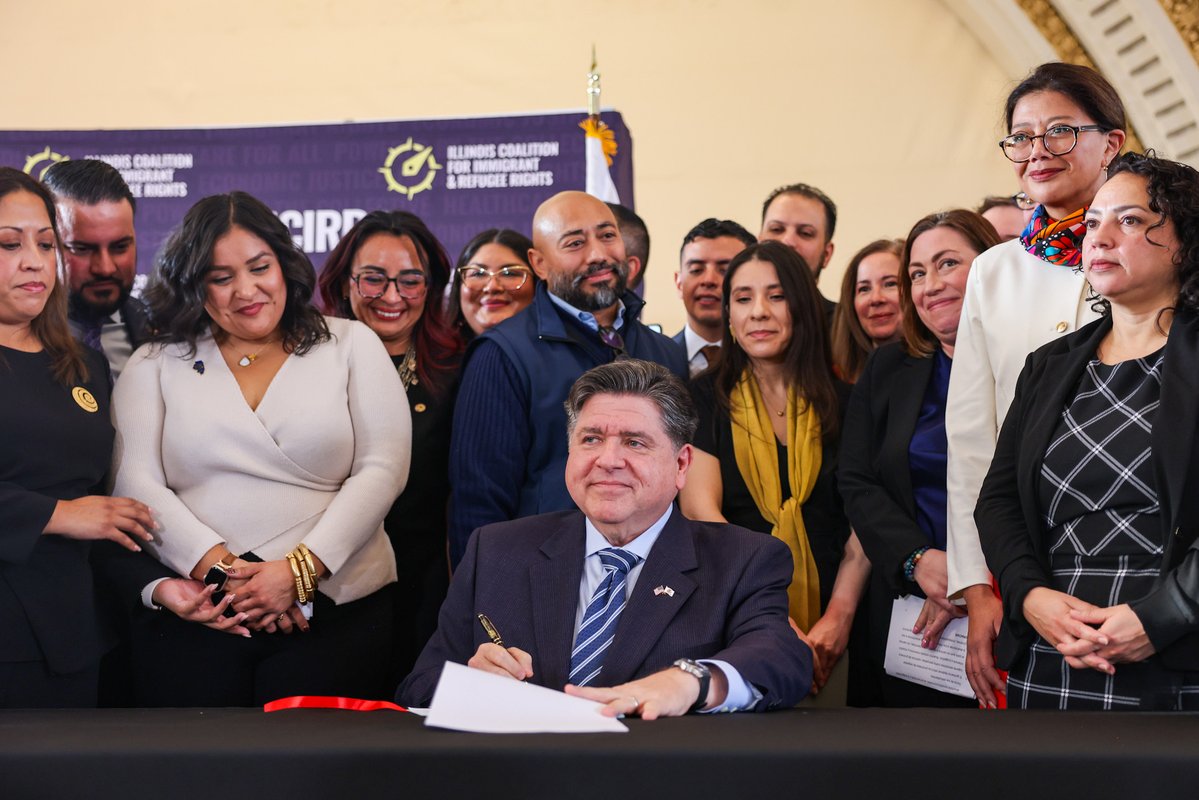
Gov. JB Pritzker signed a bill on Dec. 9 which seeks to expand the rights of immigrants in the state of Illinois.
The Illinois Bivens Act, also known as House Bill 1312, prohibits United States Immigration and Customs Enforcement agents from making arrests at courthouses. It also allows people arrested by ICE agents to sue the agency for violating the Constitution.
The most cited constitutional violations in lawsuits against ICE include the Fourth Amendment, which prohibits arrests without a warrant, and the Fifth Amendment, which outlines the right to due process.
The bill also makes clear that hospitals, daycares, public universities and community colleges are required to have procedures in place in the event ICE enters their facilities.
Schools and acute-care hospitals, which provide treatment for patients who need immediate medical attention, are required to submit their procedures by Jan. 1, while other hospitals need to submit their plans by March 1.
Get The Daily Illini in your inbox!
Pritzker signed the bill in Chicago’s Little Village alongside several advocates, whom he thanked in his speech before signing the bill into law.
“I want to take a moment to thank all of the people across our state who have been working on the front lines in our neighborhoods and in the halls of the State Capitol to help make today possible,” Pritzker said. “We know that this new set of laws can’t mitigate all of the harm, but it gives us new protective tools and is a symbol of our shared action against those terrorizing our communities and our state.”
The new bill comes after several incidents involving ICE agents making arrests in courthouses, daycares and hospitals across the state. In the Champaign-Urbana community, ICE arrested two men outside the Champaign County Courthouse in April and conducted operations in Urbana in recent months.
Lauren Aronson, professor in Law and director of the Immigration Law Clinic, says the passing of the new bill is a great opportunity for more people to know about Know Your Rights, which lists rights people have to protect themselves if confronted by law enforcement.
“After the new administration took over, everyone was scrambling because they didn’t know what to do if ICE came, what their rights were, what they were allowed to do and what could subject them to potential arrest,” Aronson said. “So it’s great and wonderful to clarify those things, and that’s really helpful.”
Despite the potential for more people to be informed about Know Your Rights, Aronson doesn’t think the new law will stop agents from making arrests in Illinois on orders by President Donald Trump’s administration.
“When you’re dealing with an administration that has already demonstrated a lack of respect for the rule of law, doing this is not necessarily going to deter Trump,” Aronson said. “The people who are following Trump’s orders, I doubt, are going to necessarily be like, ‘Oh, well, the state of Illinois says I can’t arrest someone.’”
While Aronson hasn’t seen an increase in her caseload after ICE started entering cities earlier this year, she has noticed an increased volume of people asking for legal advice after someone gets arrested by ICE in the area.
Aronson received no calls from people who knew the two men arrested at the Champaign County Courthouse in April. After their arrests, she says that her clients are now more scared to apply for government benefits.
“What happened after that is that more people are scared, so my existing clients are just more scared to do things and affirmatively request benefits from the government,” Aronson said. “The point is to make it harder, not only make it harder for people to get the benefits, but make them too scared to even try to get the benefits.”
Despite the bill outlining the right to sue ICE agents for unlawful arrests, Aronson is unsure how many people will sue the government for due process violations.
“As far as protecting actual immigrants on the ground, those are the people if, once they are detained, I think it’s gonna be a lot harder for them to bring lawsuits,” Aronson said. “Especially given that people, once they’re detained, are supposed to receive and benefit from due process. However, we’re operating in a time where due process is not being respected.”
Tricia McLaughlin, the assistant secretary for public affairs of the Department of Homeland Security, responded to the new law in a statement to Capitol News Illinois and questioned Pritzker’s knowledge of the Supremacy Clause.
The Supremacy Clause, which is in Article 6, Section 2 of the U.S. Constitution, establishes that federal laws override state laws, and states that the Constitution is the “supreme law of the land.”
“By signing this law, Pritzker violated the Supremacy Clause, his oath he took as governor to ‘support the Constitution of the United States’ – which itself falls under the oaths clause of the Constitution,” McLaughlin wrote. “We hope the headlines, social media likes, and fundraising emails he did this for are worth it!”
Aronson said the Supremacy Clause doesn’t state anything specific regarding the ICE raids. She argued the new law isn’t meant to undermine the Supremacy Clause, but is meant to outline the state’s protection of its residents amid the federal government’s actions.
Aronson, reflecting on the new law, speculates that her clients might become less nervous when going to court, given the law bars ICE agents from making arrests at courthouses.
“My clients go to state court a lot, not because they’re criminals, but because they are often unaccompanied minors seeking to get guardianships instated for them so that they have someone who’s responsible for protecting them,” Aronson said. “A lot of times, those kids have no status, and sometimes the guardians have no status.”