University professor remembered for work as a Monuments Man
Mar 6, 2014
Last updated on May 11, 2016 at 06:35 a.m.
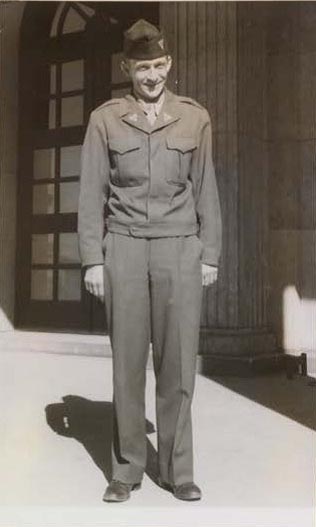
In the wake of World War II, the late University professor Edwin Carter Rae found his dream job in Munich.
The military named him a Bavarian commander, and it was his job to help return artwork that Germany had stolen from other European countries. As a young art history graduate from Harvard, Rae came face-to-face with original masterpieces.
“These are da Vinci’s,” said Sarah Rae, Edwin’s daughter. “These are Rembrandt’s, Michelangelo’s, Matisse’s.”
This was a stark change from his humbled status as a volunteer for war effort in 1943. He started off with tasks like taking out the trash cans.
Get The Daily Illini in your inbox!
“He went in and got no special treatment whatsoever,” said Edwin’s son, Thomas Rae.
Rae’s superiors quickly learned that he was a teacher who had recently accepted a job at a university, and they taught him to give orders to troops.
When the Allies mapped out bomb-drop locations, Rae said he advised them how to avoid buildings that housed valuable artwork, while remaining true to the purpose of the bomb: to kill as many people as possible. Sarah said that her father used black humor to explain what he did.
This effort to tip-toe around certain buildings eventually got too tiring for the military.
“At the beginning of the war, they tried to pin-point the bombs. But at the end, they just didn’t care,” Sarah said. “They did saturation bombing, which was really horrible. It destroyed a lot of originals — buildings with artistic significance just decimated.”
But after the Germans surrendered, the temporary recklessness turned into a clean-up effort.
Rae was selected in August 1945 to be part of a group known as the Monuments Men. Whenever Rae received an artifact, he worked on identifying, protecting and returning the piece to its origin.
Rae once looked after the Holy Crown of Hungary, found in 1945 by a U.S. infantry unit in Austria. The crown was finally returned to Hungary in 1978 by Jimmy Carter, when the country was stable. Sarah remembers seeing the event on TV in college.
“I remember my father telling the story about this crown and how he had wished he had a picture taken of him with the crown on his head,” she said.
And it was on a train ride between Budapest, Hungary and Munich where Rae would learn a Hungarian love song while sitting next to an opera singer. Years after his service in the military, Rae would break out into that song.
“He had memorized it word-for-word — and I don’t know if he really knew what it meant — but he remembered how it went,” Sarah said.
When he was discharged from Munich in 1947, Rae returned to the U.S. and taught art at the University until 1979. As a send-off before he returned home, Rae received letters from Germans who appreciated all he had done.
“I think it takes a few decades of distance to see the magnitude of what this meant,” Thomas said. “No, they weren’t the ones who went into concentration camps and pulled the people out to save them. They were doing something else — they were helping to restore European culture and history.”
It wasn’t until 2010 that these thank you letters, along with a photo album and diary, were found. Thomas and Sarah were going through everything in their old home in preparation to sell it. The basement of the house reminds Thomas of the one in Silence of the Lambs because of the elongated hall that led to “piles and piles” of Rae’s belongings. Sarah said that, because her father was so consumed in teaching, he never told either of them about his possessions from his time as a member of the Monuments Men.
“I was awestruck,” Sarah said. “I didn’t realize this existed.”
There was one belonging Thomas or Sarah never would have guessed would be their father’s: a Nazi flag.
“I still remember the day my sister called me and told me that,” Thomas said. “I was like, ‘What the hell do we do with this?’”
Thomas said soldiers like his father likely brought flags back without thinking much about it. He plans on asking a Jewish society if they would like to have it.
About a year later, Sarah donated the photos, letters and diary to the University Archives. Bill Maher, University archivist, is happy that the documents can now be viewed by the world although the snapshots don’t have any captions.
For a while, Maher wondered why a picture of Hitler was included in the photo album. Then he noticed that the same table and room that the Nazis apparently used as their headquarters may be the room that Rae and his colleagues worked in after Germany’s surrender.
“What I really regret is that we didn’t have a chance to sit down with Professor Rae when he was still alive and have him page through and talk about what he’s seeing,” Maher said.
Rae passed away in 2002. Sarah and Thomas remember him, not through his “dryly” written diary entries, but as the man they grew up with.
“He could talk to anybody about anything — he was that type of person,” Sarah said. “I remember I was coming back from college on the bus at Union Station. He was talking with one of the security guards or something. They were having the best conversation — like they had known each other for years. He had just met him, and they were talking about I don’t know what. I had to get my bags so that gave him time to converse some more with this stranger he had just met a few minutes earlier. He was excited about life.”
Stanton can be reached at [email protected].