Be careful when comparing yourself with other people
Mar 30, 2019
Over spring break, a high school senior said to me, though he already got into the best school (UIUC), he would be receiving his final college admissions decisions in the next couple of weeks. He defeatedly explained how he was born in 2000 and his class was abnormally large because people thought having babies in 2000 would be cool, meaning this year’s college application pool is one of the most competitive.
Whether his reasoning is correct, our generation is evidently more competitive than our predecessors. We are also partying less and are more stressed about the future. As students, we experience this generational contrast, sometimes, without being aware of it. We also experience the temptation to compare ourselves to our peers and across generations. From this, we can become discouraged or we even attempt to inflate our egos.
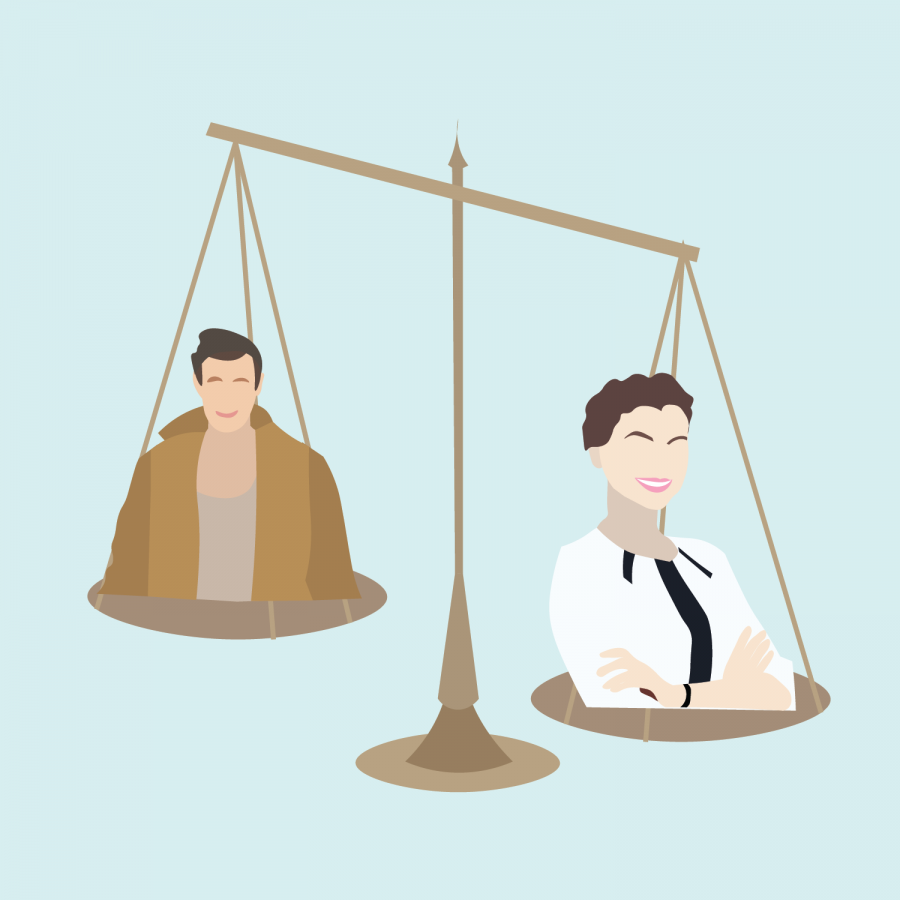
So, the advice that is popular to give nowadays is to not compare ourselves to one another. This sounds good, but is fatalistic and does not cut at the root of our issue. Comparison in and of itself is not bad. It’s our motive when we make comparisons in the first place. We attempt to make value opinions of our self-worth and the worth of others. This stems from narcissism.
We warp our realities by magnifying the weaknesses in people, including ourselves. Then, we wrongly identify which strengths are to be coveted, including our own. We attempt to lie to ourselves every day so that we can feel better about ourselves and the world. But if this is what is produced from comparing people, what should we do about it?
We can instead attempt to hold accurate and passionless comparisons. These allow us to see ourselves, and other people more accurately. “Why” we compare people is usually so we can feel good about ourselves, or even so we can try to “beat” others. Our “why” must be to see the truth clearly.
Get The Daily Illini in your inbox!
Consider also how the older generations seem to love to harp on millennials and “Gen Zers.” The older generation partly does this because they are also attempting to skew their own reality, and say that they’re better than a large swath of people.
But, it is also a manner of how the older generation is more knowledgeable about about themselves, so they are better able to see generational differences than young people, who are mostly unconcerned with the behavior of older generations. In the future, we may find ourselves bashing on the habits of whatever generation comes after the letter Z.
This truth-seeking can be practically applied in the workplace. Ideally, we choose jobs that match our strengths and passions. Some of you guys who are reading this are mediocre at communicating and shouldn’t be writers for the Daily Illini, and that’s okay. By comparison, you figure out maybe you were a pretty good writer compared to your peers in high school, but you come to college and realize you’re illiterate.
Your course of action is not to beat yourself up, you instead find ways to improve your communication skills because a baseline of these is ideal for almost all work settings and for a healthy family life. But then, you compare yourself to others to realize your strengths and where you can excel.
Entire tests are created for people to understand their personalities and what they’re good at, but you can also pay closer attention in your everyday life to see where you outperform others. Again, this is not for the sake of inflating yourself and finding ways that you’re better than other people, but it’s about seeking the truth. This keyword is “why.”
All of my anecdotal evidence is useless if you try to practice comparing yourself to others with the wrong motive. You will inevitably create a distorted view of reality and you would be better off not comparing anyone with anybody. Knowing the truth usually makes for an optimal experience as a human and part of the truth is taking a hard glance at why you do the things you do.
David is a junior in LAS.