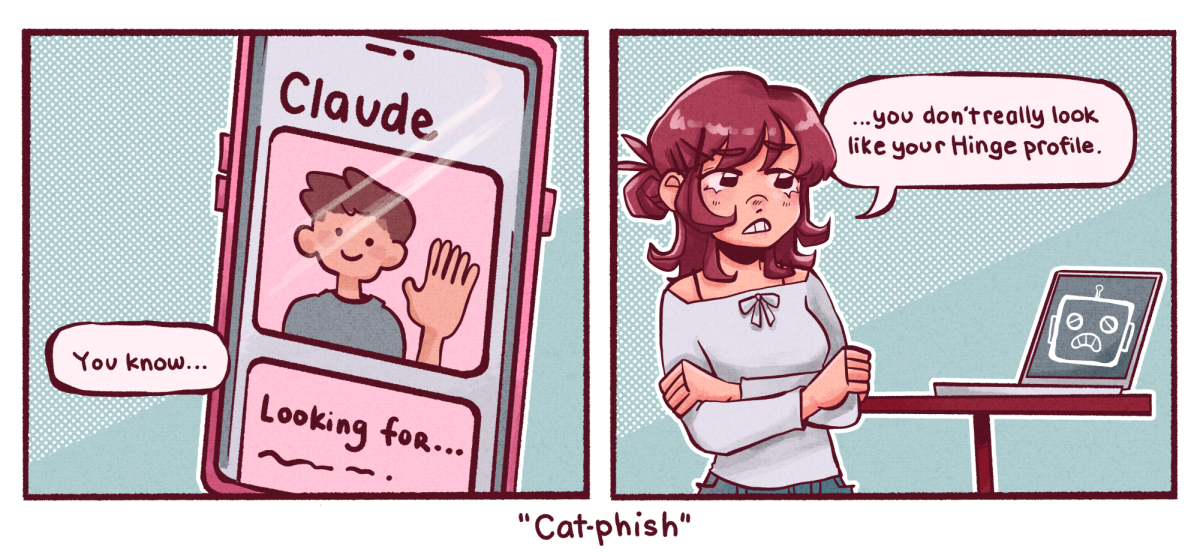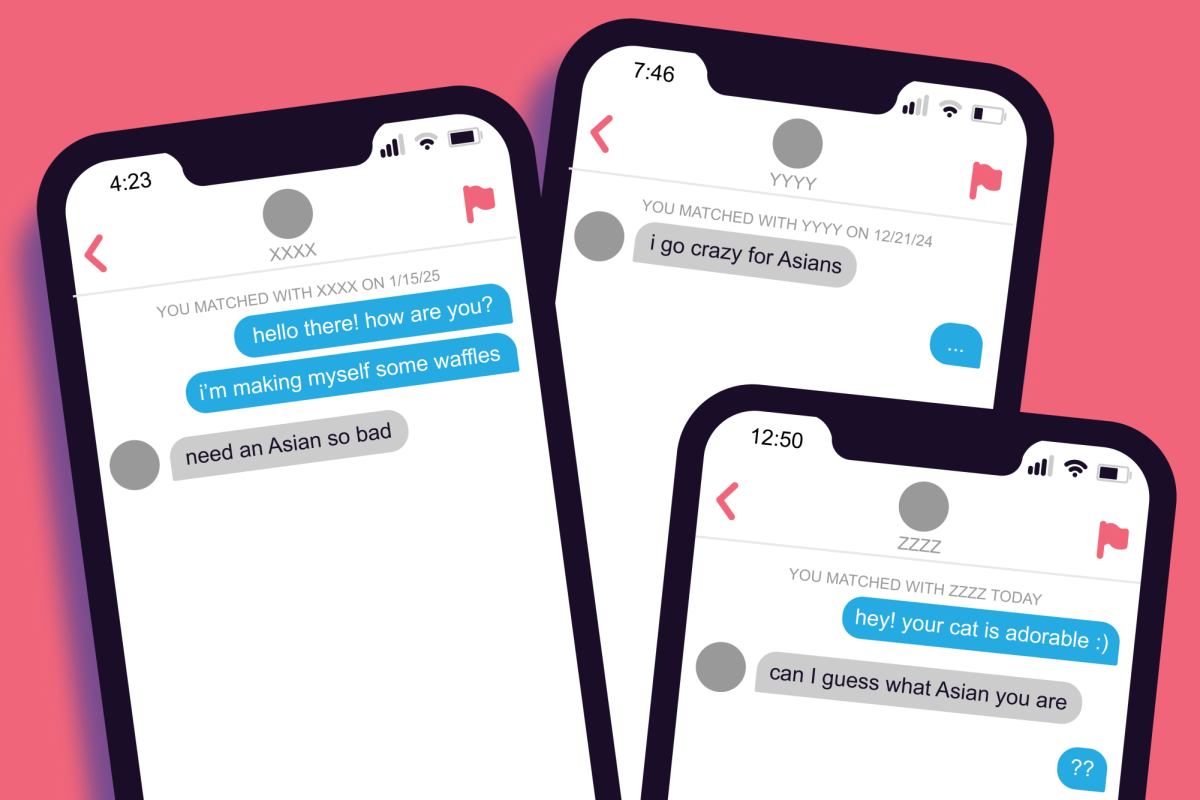
It is an agreed-upon fact by women in their 20s that the dating scene is bleak. Add in the intricacies of romantic prospects trying to fetishize your existence, and the pool of acceptable options becomes even smaller. Conversations that start normally quickly progress into microaggressions, and you can find yourself headed back to square one.
The hypersexualization of Asian women has been present for much longer than the existence of dating apps. The Page Act of 1875 was one of the first instances in which the concept of an “immoral” Asian temptress appeared. The law essentially barred Chinese women from immigrating to the United States under the assumption that they were prostitutes.
This rhetoric was expanded in 20th-century media like “Miss Saigon” and “The Good Woman of Setzuan,” where Asian women were either extremely sexualized or painfully submissive. Throughout these shows, one constant holds true: these women exist to please others, not themselves.
The insistence that racial preferences are somehow different than fetishization is undeniably ignorant. Any reason that one might prefer a specific race is no doubt rooted in stereotypes that emerged from racist tendencies years ago — a practice that is by no means exclusive to Asian women.
For example, Black and Indigenous women are often projected onto controlling images like the promiscuous “Jezebel.” Black men are also often portrayed as hypersexual or violent in the media — all qualities that can be traced back to settler colonialist ideals like eugenics, used to control bodies of color.
Get The Daily Illini in your inbox!
Biological racism reflected in fetishization is not coincidental.
Dating apps create an online environment where racism can run rampant. These semi-anonymous sites make it easy for users to send racist and degrading messages. While most sites provide a manner to report inappropriate behavior, it’s fairly easy for individuals to create another account with different contact information.
Many platforms also allow users to filter out their preferences based on race or ethnicity, a process known as “cleansing cyberspace.” This opens up the perfect opportunity for users to rank various races based on fetishization and stereotypes without consequences.
While it may seem extreme to police people based on their dating preferences, it is important to recognize how unsettling the effects of fetishization can be. The illusions that people can associate with people of color can lead to significant dehumanization and violence.
In the Atlanta spa shootings of 2021, a white man attacked three different spas and murdered six Asian women. When questioned about the attack, he blamed his sex addiction — diverting blame onto the very women he killed.
These attitudes are also present throughout the incessant U.S. militarism in Asia and the Pacific Islands, where American soldiers have historically exploited sex trafficking.
Cases such as the murder of Jennifer Laude — a trans-Filipina woman who was drowned by U.S. Marine Lance Cpl. Joseph Scott Pemberton in 2014 — are far too common. Although Pemberton was found guilty of homicide, former President of the Philippines Rodrigo Duterte pardoned him in September 2020.
Even in the past year, U.S. military personnel stationed in Okinawa were accused on several different occasions of sexual assault, the youngest of the victims allegedly under 16 years old.
It’s easy to reduce fetishization to a practice whose only consequence is offending its recipients. However, the truth is that it’s just another way to modernize racism into socially acceptable terms.
Instead of guessing someone’s ethnicity or describing your type in shades of skin, it might be more effective to ask them their name.