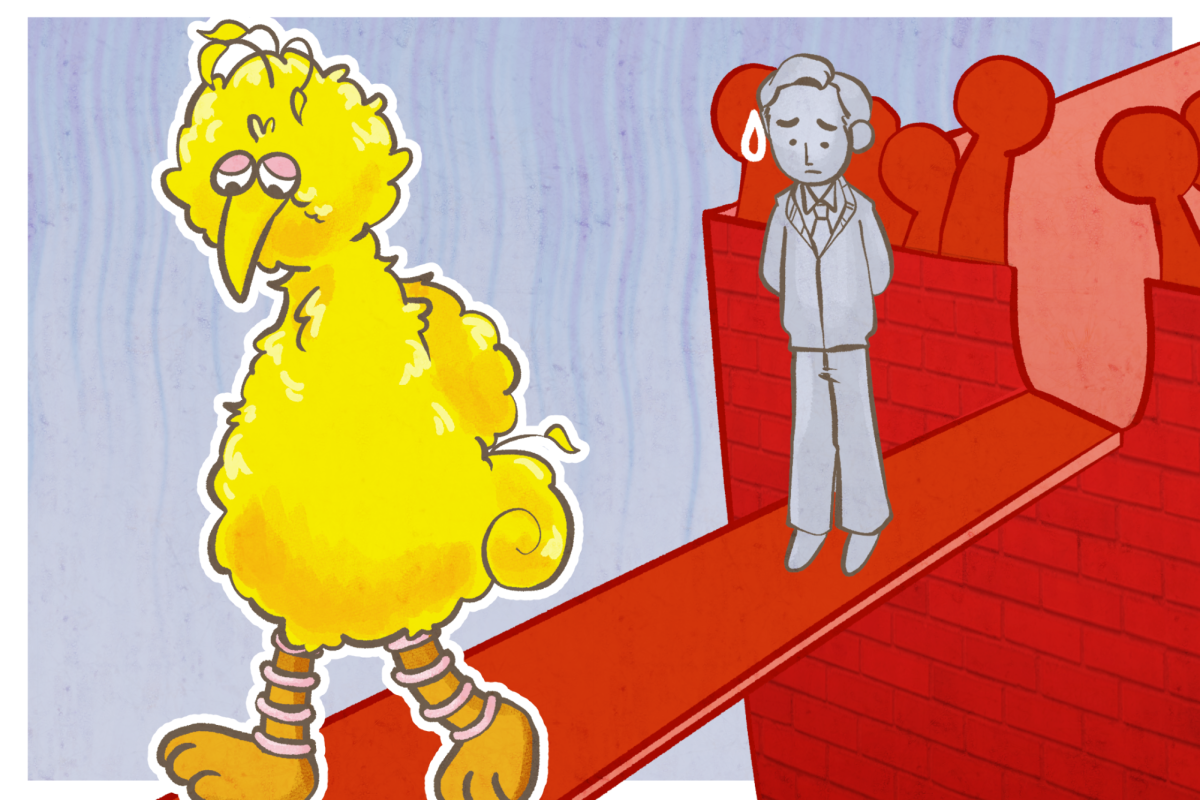
Republicans in Congress are killing Big Bird.
On July 18, Congress voted to cut $1.1 billion in public broadcasting funds, effectively ending all government funding for National Public Radio, the Public Broadcasting Service and many local stations that rely on federal funding. Illinois Public Media at the University faces $1.5 million in cuts.
As with many of the provisions in the recent spending bill, it appears that rural voters (the majority of whom voted for Donald Trump) will be hit hardest. Maps from The New York Times show that dozens of rural counties are at risk of losing public radio and television access.
There is no profitable media industry in these rural areas, so federal funding has historically filled the gap in local reporting in these communities. By the end of this fiscal year, perhaps no more.
Both of my senators from South Dakota — Majority Leader John Thune and Senator Mike Rounds — voted in favor of the cuts, but one fifth of South Dakota’s TV and radio funding comes from the federal government. What will local stations who are already strained for resources do when 20% of their funding is gone?
Get The Daily Illini in your inbox!
It seems quaint now, when I was a young child watching educational PBS shows like “Cyberchase” and “Sesame Street.” Every once in a while the thank you message would play, a very direct expression of appreciation compared to corporate stations: “This program was made possible by contributions to your PBS station from viewers like you. Thank you!”
Public media isn’t beholden to the marketplace, but to viewers like us and to the public good. The PBS show “Mister Rogers’ Neighborhood” was made with the sole intention of creating a less profit-driven, addictive and violent show for child consumption. Public media has the wonderful capacity to be values-driven, not profit-driven, and teach children important life skills, like school-preparedness, emotional regulation and “small-L” liberal democratic ideals.
Fred Rogers went to Congress to defend public media from cuts in 1969, when Nixon vowed to defund public media because of its supposed liberal bias (sound familiar?).
“I’m very much concerned, as I know you are, about what’s being delivered to our children in this country,” Rogers testified. “And I’ve worked in the field of child development for six years now, trying to understand the inner needs of children … I end (“Mister Rogers’ Neighborhood”) by saying, ‘You’ve made this day a special day, by just your being you. There’s no person in the whole world like you, and I like you, just the way you are.’ And I feel that if we in public television can only make it clear that feelings are mentionable and manageable, we will have done a great service for mental health.”
In an age of “iPad kids” and a youth mental health crisis, I fear that our politicians don’t have any concern for what our children are consuming, nor what local news will be lost in vulnerable rural areas.
In 1995, House Speaker Newt Gingrich went after Big Bird again, but Republicans at that time couldn’t ignore the value of public media in their rural, red states.
Nowadays, there is a two-fold issue: firstly, a sycophantic allegiance to the current administration, resulting in a completely pliant Republican Congress. Second is the idea that with the internet, alternative media can somehow fill the information gap, and that these publicly funded stations are out-of-date and biased anyway.
But the issue is always with the incentives. What incentives do new media have to be moderate, educational and civically virtuous? Very few, and it’s evident in the slop that we see online.
Social psychologist Jonathan Haidt, author of “The Anxious Generation,” described the information environment on social media as unsuitable for child development.
“If you’re immersed in stories that have a moral order to them — which is what I was immersed in when I was a kid — all the stories had some sort of moral,” Haidt said on the Ezra Klein Show. “But what you see on TikTok and Instagram are not really stories. They’re really amoral or immoral. A lot of them are just horrible things. The boys are seeing lots of videos of people getting into accidents or violence. So the long way to answer your question is that kids need moral formation.”
Since its inception, public media has always tried to create moral stories for children in a world ridden with selfish amorality and sadism.
The key objection I can already hear a Republican retort with is that NPR and similar public media have a liberal bias, and public media paid for by the taxpayer shouldn’t be biased. But my response is this: Why cut funding for unbiased local media then? Why cut funding for programs like “Mister Rogers’ Neighborhood?” And where are poor, rural children going to get access to quality educational media?
The socioeconomic divides in our country will only worsen as a result of this decision. I do not understand Republicans’ incessant need to rip apart every aspect of a government program rather than tailor it to their party’s interests (at the very least). Instead, we’re all going to lose.
NPR and PBS have federal funding until September. They are reaching out to philanthropic organizations for future funding support.
You can donate to the Public Media Company that runs PBS and NPR and/or specifically to rural and underserved stations here. You can donate to Illinois Public Media here.
Grace is a graduate student studying urban planning.