Beep! Beep! Beep! Yawn. Press the “stop” button. 8:30 a.m. OK, I’m up. And you know what? Today, I’m going to follow Andrew Huberman’s advice and not go on my phone for the first 30 minutes of the day. I will fight my screen time addiction.
I’ll leave my phone on the nightstand. Alright, now I’ll go to the desk to check emails on my computer.
Clack, clack. Bookmarks bar. Outlook. NetID, password. Incorrect. Oh, wait, I forgot I had to reset it yesterday. OK, new password: Change the 24 to 25. Logging in, yada yada.
Wait. Oh no. The little white box with the blue line on top pops up. No, you’re not doing this to me today. Please, no.
Duo Push. F— me.
Get The Daily Illini in your inbox!
Just when you think you’ll focus on one screen at a time, you’re hit with another chance to pull out your phone. It is yet another opportunity to open Snapchat or Instagram or check your Bitcoin for the third time that hour.
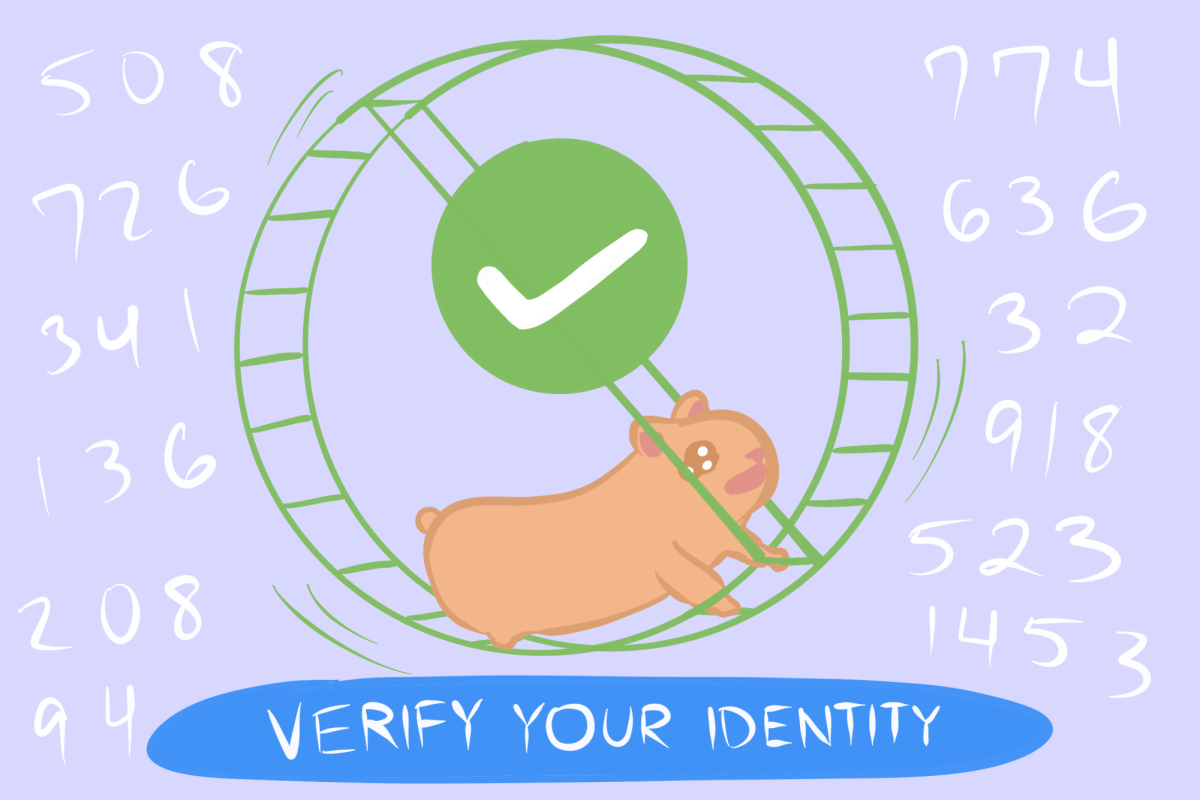
We are being interrupted by screens so frequently that our screen time is being interrupted by … more screen time. The average American checks their phone about once every five minutes while they’re awake, according to Reviews.org. An interruption can come in many forms — a “Verifying your identity” notification from Duo Push or a Snapchat Bitmoji “typing…”
Gloria Mark, a Chancellor’s professor in informatics at the University of California, Irvine, found “that it takes over 23 minutes to fully regain focus on your original task after an interruption.”
So, chances are, if you checked your phone right before and in the middle of a 50-minute lecture, you were never fully paying attention.
This is crippling to the human condition. Frequent interruptions “lead to higher rates of exhaustion, stress-induced ailments, and a doubling of error rates,” according to the University of California, Berkeley.
Duo Push is a classic form of two-factor authentication advertised to “quickly verify identity.”
However, there are many inherent flaws in its design. Cybersecurity experts point out issues with 2FA, saying that problems “stem from their dependency on device authentication rather than true identity authentication.”
If someone has access to your computer, who’s to say they don’t have access to your phone? In fact, with a MacBook, you can access iMessage from your desktop. With more traditional 2FA, when you send the six-digit code to your phone, you don’t actually need access to your phone for the coveted “342791.” This renders the process ineffective and useless.
Duo will ask if I can trust the device I’m using, and I will click “Yes, this is my device.” But it continues to prompt push notifications every time I log onto my computer. The answer could be cookie settings or Duo Push’s security program.
There is no consistency in when the program decides to “verify your identity.” Sometimes, I will log onto Canvas or Outlook with no issues. Other times, I’ll close the tab, open the app right back up and have to log onto Duo Push just to get back on.
This is not a call to end 2FA as a whole. In fact, in 2019, Microsoft claimed multi-factor authentication can prevent 99.9% of attacks on accounts. Layers of protection for valuable information are essential in protecting our online identity.
But Duo Push is not the answer. It is inconsistent, obtrusive and distracting to students. It is just flat-out annoying.
We, as a University, should seek an alternative solution to Microsoft account protection. Researchers at the UK National Cyber Security Centre suggest biometric authentication — like the use of fingerprints and facial recognition — as a more secure and convenient alternative to passwords and traditional 2FA.
Biometrics do bring into question the ethics of integrating our personal information and physical bodies into the endless void of cyberspace. Regardless, they are one of many possible alternatives to 2FA.
How are we supposed to focus on our education when we’re more exhausted, more stressed and make more errors because we’re constantly being interrupted by the very things advertised to help us?
Here, let me go email some University professors who know more about this field than I do. Maybe they’ll have answers to some of my questions.
New tab, bookmarks bar. Outlook. Loading, loading.
Not again.
Alex is a sophomore in LAS.