Flowing into thousands of villages, the muddy flood waters fully submerged and desecrated hundreds of thousands of acres of crops. Bodies of drowned cattle littered the ground. Only skeletons remained of the thousands of homes that the flood had ravaged. Only corpses remained of the hundreds of Indian and Pakistani lives that were stolen.
Over the past few weeks, the Indian and Pakistani states of Punjab have watched their annual, expected monsoon season transform into the worst flooding the region has experienced in over three decades. Entire livelihoods have been lost in the agrarian state.
Many news outlets, like The New York Times, lean on climate change as the explanation for the unprecedented floods.
While it cannot be denied that climate change is a real problem — as the melting Himalayan glaciers and wetter atmosphere have undoubtedly played a significant role in the ecological catastrophe that has unfolded — it is not the entire equation.
India’s breadbasket is facing ecological ruin. This is not just the result of ecological causes. This is the legacy of treaties signed without the consent of those who lived along the banks. These are the broken promises of independence. This is about people stripped of their waters, now drowning in them, with no sovereignty over their own rivers.
Get The Daily Illini in your inbox!
This disaster developed long before the rain.
Punjab underwent its Green Revolution, a period of intense agricultural advancement, in the ’60s when India’s central government pushed it to multiply its crop production. This push was due to the desire to battle famine and poverty with self-sufficiency in food production.
Over the course of decades from the ’50s to today, Punjab’s rice production quadrupled, and wheat production increased over tenfold.
High demand for crops meant high demand for water. To keep up with production demands, farmers found themselves having to drill tube wells, which are pipes stuck deep underground, so that they could tap into aquifers.
On top of the high need for water within Punjab, India’s central government also diverts Punjab’s river waters to other states, like Haryana and Rajasthan, through the use of canals like the Bhakra Main Line and the Sutlej-Yamuna Link.
India now extracts more groundwater than any other country worldwide, extracting almost 245 billion cubic meters of water, according to a 2024 report by the Central Ground Water Board, an Indian government agency.
According to that same report from the CGWB, water levels are dropping at an average of almost 20 inches per year in these tube wells.
In Punjab, the overexploitation of groundwater has led to land subsidence — the gradual or sudden sinking of the Earth’s surface.
Furthermore, when aquifers are overdrawn, they lose their storage capacity. Good aquifers act like a sponge, absorbing excess rainwater and refilling groundwater.
Punjabis have historically asked and fought for sovereignty over their waters, protesting against the construction of canals and advocating for more state rights, such as in the Anandpur Sahib Resolution. The resolution was a political document with requests to return more power to the states, including Punjab’s right to control and distribute its own waters and resources.
For Punjabis, sovereignty over water was tied to dignity and self-determination.
The resolution was dismissed, and today, Punjab remains without the right to manage its waterways fully. Its rivers are governed through a central authority. Its farmers, denied surface water, have been forced to over-pump groundwater, driving aquifers to near collapse.
Monsoon rains have significantly intensified, made more erratic by global warming trends. When land subsidence lowers ground surface levels, and less rainfall is soaked underground from aquifers, Punjab bears the brunt.
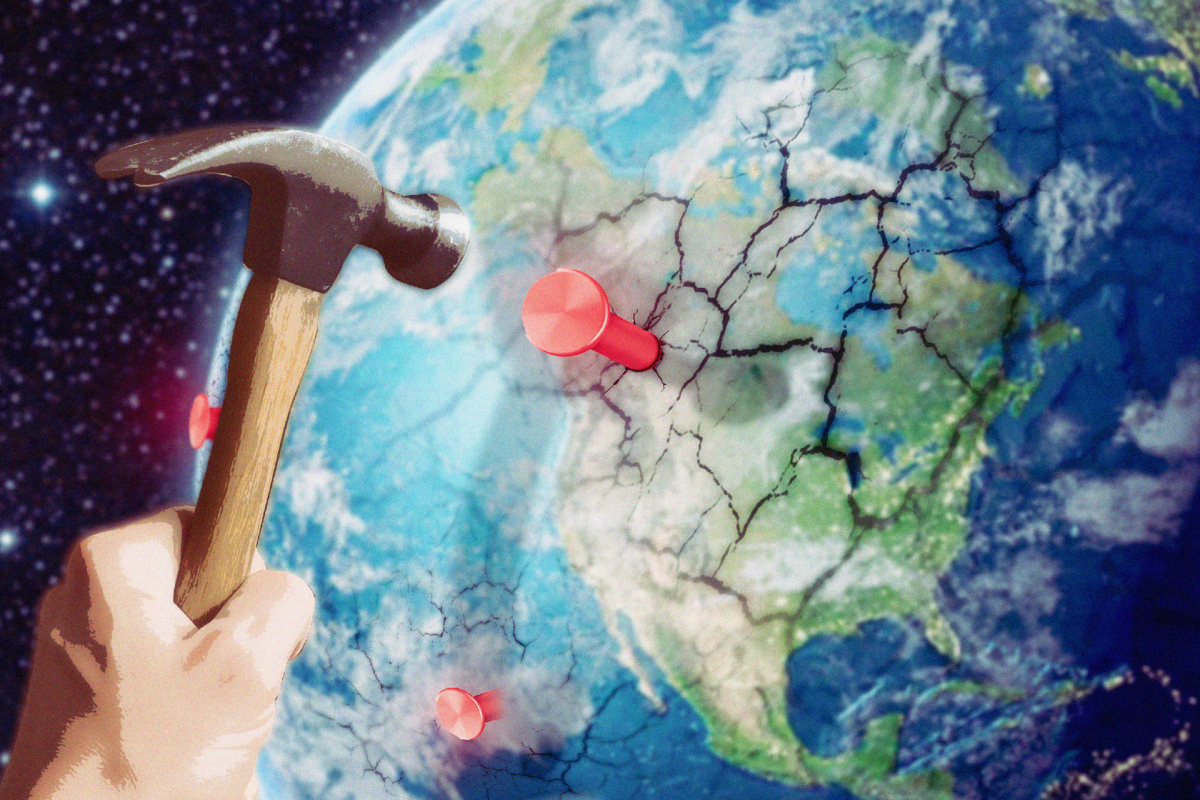
Treating Punjab’s floods as the result of “just climate” turns a human-made vulnerability into an act of nature. Climate change warmed the dice, but policy decided where they landed. The real story is reflected in how poor water governance and restrictions on a state’s rights transformed heavy rain into mass loss.
Painting it as a climate-only story breeds fatalism and risks treating disasters as inevitable natural events rather than outcomes shaped by human decisions. Human-made causes can also mean human-made solutions.
This issue finds roots here in the United States, too.
Hurricane Katrina was one of the deadliest natural catastrophes in U.S. history, marked by nearly 2,000 confirmed fatalities and over $100 billion worth of damage. The storm is often taught and talked about for its disastrous impact. Rarely is it discussed how the disaster was human-made in its impact.
Even former President Barack Obama admitted that the storm had as much to do with economic inequality and the failure of the government as it did the forces of nature.
The levees and floodwalls protecting New Orleans were poorly designed, constructed based on outdated data and weak soil foundations. Had the levees held, the flooding would have been about one-third of what occurred.
The hardest-hit communities were overwhelmingly low-income and racial minorities, reflecting long-standing racial and economic segregation. Underinvestment in their neighborhoods meant weaker infrastructure and slower recovery.
Disasters are never only about nature’s force; they are about human choices layered on top of it. Climate change may intensify rainfall or storms, but governance failures and neglect can transform heavy weather into a humanitarian catastrophe.
Ignoring these human-made dimensions erases responsibility, leaving communities to relive the same tragedies while those in power escape accountability.
To truly confront disasters, the full story must be told: not just the science of warmer air or rising seas, but the history of broken promises, poor planning and systemic inequality that make them lethal.
Naming these failures is the beginning of reclaiming the possibility of solutions. If human decisions created this vulnerability, then human decisions can also undo it. Recognizing that truth is the first step toward building resilience, justice and dignity for the people on the frontlines of natural disasters.
Gurneer is a sophomore in LAS.