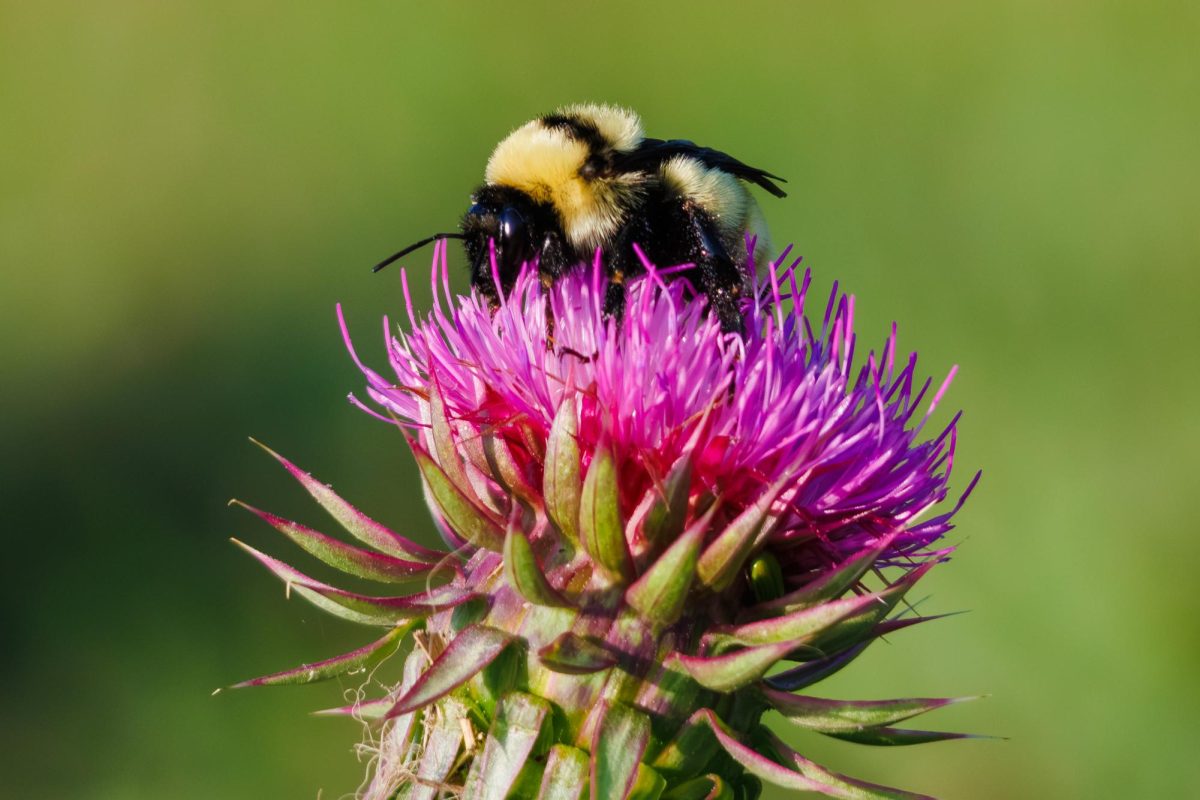
From the agrarian ideals of Thomas Jefferson to the emergence of the military-industrial complex of post-World War II, the bee has remained an essential figure of American progress and democracy.
As our country expanded westward and established our government, the honey bee has long been a marker of the past, present and future of the United States of America. Yet today, the downfall of the honey bee at the expense of American progress has raised concerns about the future of our nation.
Arriving to the American colonies during the early 17th century, the honey bee quickly became acclimated to the ecosystems of North America. Although the modern species of Apis melliferia is native to Europe, an extinct species of honey bees once pollinated the landscapes of North America 14 million years ago.
Bees, native and nonnative, have become an essential part of American ecosystems, agriculture and biodiversity. As major pollinators, bees boost the food crops of the United States and work to reduce the impacts of climate change across the globe.
Yet today, the modern bee faces the same threat it once faced 14 million years ago in North America: extinction. As anthropogenic climate change and pollution rapidly increase, pressures are placed on bee colonies throughout the country.
Get The Daily Illini in your inbox!
Regardless of origin, species of bees and pollinators are threatened today under American lifestyles, consumption and policy, facing up to a 70% colony loss in 2025, the highest in U.S. history. Bees pollinate 75% of U.S. food and agricultural crops, contributing $15 billion to the U.S. economy every year.
The urgency hasn’t been placed on reducing bee habitat fragmentation or curbing the use of agricultural pesticides that have sparked a huge loss in colonies. Instead, the United States has taken a technological approach to curb pollinator losses and avoid changing lifestyle habits altogether.
An insulting mark of bees as infrastructure and replaceable technology has shifted the importance of bees from one of ensuring food security to agricultural profit, underscoring the profit-driven mindset amid an environmental crisis.
This leads us to question whether potential solutions exist to protect bees for pollination or to ensure monopolies have cheap, ready-to-use pesticides at their disposal. As the Environmental Protection Agency reports, “certain pesticides are harmful to bees,” further stating their measures and guidelines for “protecting bees” on product labels.
Here’s the question: If the EPA knows that certain pesticides are harmful to bee colonies, why are we still using them?
Here’s my answer: profit and influence.
As agribusiness attempts to maximize yields while cutting costs, cheap pesticides will continue to be used alongside monetary incentives towards the EPA to turn a blind eye to the scope of the problem. Under the current presidential administration, we see a reversal of any progress made when deregulation is placed in their hands.
Recently, institutions and research labs, in attempts to address growing colony losses, have begun developing artificial pollinator technologies to tackle the growing strain on pollination.
Under the status quo, can we expect the needed changes to occur? Here’s the short answer: no. As development and research ramp up through robot bees and artificial replacements to native pollinators, we are going in the wrong direction.
What this does is move the use and importance of bees away from their environmental importance, crucial during a time when more emphasis on environmental protection is needed.
What is so appalling about the development of pollinator technologies is the lack of actual credibility or accountability towards anthropogenic causes of bee habitat losses and colony decline. Instead of changing consumption patterns, the United States has encouraged technological advancements that have no long-term stability.
The effectiveness of artificial intelligence replacements or modified bees is dependent on specific environmental conditions and infrastructure. Natural bees are far more efficient and effective in saving and preventing gaps in pollination. In simple terms, protecting bee habitats or changing pesticide usage is far easier than developing and pouring countless dollars into artificial replacements.
To achieve true environmental sustainability and ecological solvency, actual bees need to be prioritized, and all parties must be held accountable for degrading actions. The solvency of the American agricultural industry and food security across the globe rely on the pollination of bees.
A reality that most farmers can not afford new technologies only furthers the dominance of agricultural monopolies, creating inequalities that could be avoided by simply preserving natural resources and bee populations.
To protect our crops from the impacts of anthropogenic climate change and consumption, the U.S. needs to prioritize the ecosystems of pollinators over human demands to avoid the same fate as 14 million years ago.
Without the honey bee, our democracy and values shift from one of the American dream of freedom and prosperity, to a reality of scarcity, degradation and denial.
Protecting the honey bee is as essential as protecting our democracy and the industry on which our country was founded. To be better, accountability and action need to be taken at the root cause of the decline in bee colonies.
Samantha is a freshman in LAS.