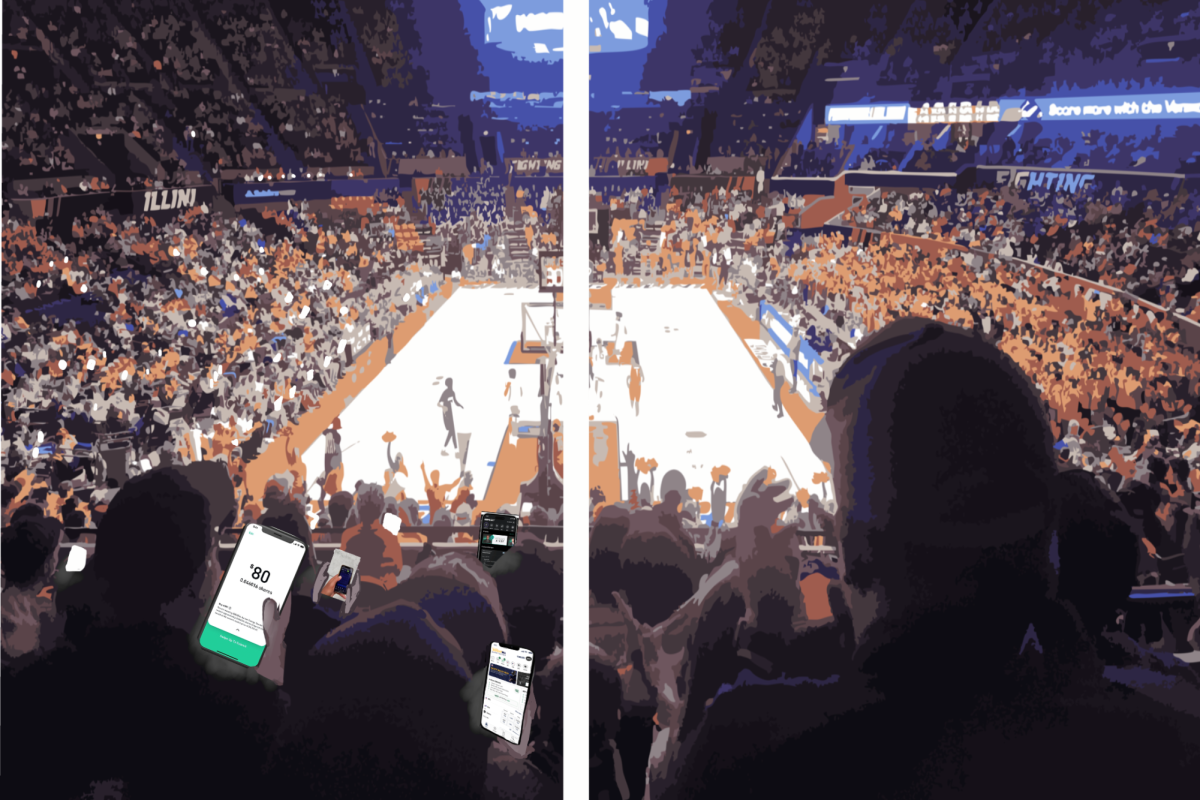
You’re at a basketball game, and you realize no one is simply watching anymore. During a timeout, the guy next to you isn’t talking about the pick and roll; he’s sweating over whether he needs one more three to hit his parlay.
A row behind you, a teenager is flipping between TikTok and a live betting app like it’s the most normal thing in the world. Somewhere along the way, being a fan quietly turned into being a gambler with better seats.
After the U.S. Supreme Court struck down the federal sports-betting ban in 2018, the ruling opened the door to legal sports betting. Thirty-eight states, plus Washington, D.C., have since legalized it, according to the Congressional Research Service.
Sports leagues, media companies and app builders took it from there, weaving betting into the basic experience of watching a game. The legalization didn’t just open a market — it rewired how Americans experience sports.
Globally, the U.S. is racing Australia for the title of biggest gambling nation. For years, Australians have led the world in money lost per person, with an average of about $940 per head spent on sports betting in 2025, according to a G3 Newswire analysis.
Get The Daily Illini in your inbox!
The same report estimates that Americans will spend about $630 per user on sports betting this year, which is well above the global average of $426 and closing the gap with Australia.
However, the raw numbers matter less than the trajectory: Australia is already maxed out, with gambling losses holding steady after years of saturation. In comparison, the U.S. is still in the explosive growth phase, racing to catch up.
In 2024, U.S. commercial gaming revenue hit a record $71.92 billion, a 7.5% increase from 2023, according to the American Gaming Association. It was the industry’s fourth-straight record revenue year, driven largely by online sports betting and internet casinos.
The money is increasingly coming from younger adults. A 2025 report from TransUnion found that betting activity rose to 30% of all U.S. consumers, and the biggest increases were among Generation Z and millennials. The two generations were up 34% and 42%, respectively.
These aren’t retirees in Las Vegas; they’re 20 and 30-somethings on their phones. According to an NCAA survey, 63% of on-campus college students recall seeing sports-betting ads. More than half of them said the ads make them more likely to bet.
That kind of exposure matters because access has fundamentally changed. What once required a trip to a casino, racetrack, or seeing a bookie now takes only a phone and a verified account, turning sports betting into a 24/7, always-on activity.
PlayToday.co put U.S. online sports wagering in the tens of billions of dollars for 2025, highlighting how online betting has become one of the primary engines of sports-handle growth.
Phones removed the hassle of betting, and legalization removed the stigma. The result is a level of constant access that addiction researchers would normally flag in bright red.
And yes, this bleeds far beyond traditional sportsbooks. Look at Robinhood, the trading app that built a business on young retail investors. Robinhood’s customer base averages between ages 31 and 35, according to The Wall Street Journal.
In 2025, Robinhood launched a prediction markets hub that lets users trade event contracts on things like Federal Reserve rate decisions and college basketball tournaments, via a partnership with Kalshi, according to Reuters and the company’s own announcement. Each contract pays out if a specific outcome happens and goes to zero if it doesn’t. It’s mechanically indistinguishable from a sports bet, just with better branding.
If that weren’t blurry enough, consider Kalshi itself. In 2025, Kalshi rolled out a U.S. college ambassador program in a now-deleted social media post, bragging that “college campuses are the best place to spark new financial movements” and would help bring “the next 100M (million) users to prediction markets,” according to GamblingHarm.org.
Kalshi invited student clubs at Yale, Harvard, the University of Michigan, the University of Texas at Austin and other major universities to “trade and build” on the platform as part of its campus ambassador push. That’s not subtle at all: a federally regulated betting exchange directly recruiting college students as new users.
After public criticism and concern from the NCAA about wagering on college sports, Kalshi pulled back parts of its campus marketing push.
Meanwhile, old-school sportsbooks are blanketing young fans with ads. A University of Mississippi study found that 39% of college students had gambled in the past year. Six percent of those who bet on sports met criteria for problem gambling as defined by the American Psychiatric Association.
When a product is engineered to encourage compulsive use and then aggressively marketed on campuses, harm is not a side effect — it’s a predictable outcome.
According to studies summarized by the American Psychological Association, psychologists and addiction researchers have warned for years that young people are especially vulnerable to gambling disorders. Their brains are still developing, and they tend to be more impulsive.
Add in the steady drip of betting promos from popular content creators like Nadeshot. According to Esports Insider, he spent over $40,000 opening Counter-Strike cases on stream after taking casino sponsorships.
For viewers, that kind of content normalizes gambling behavior, especially when the financial risk to the creator is cushioned by sponsorship deals — and it feeds an online culture that nudges fans to gamble right along with them.
So what do you do when the casino is now just part of the internet? The best option is to treat gambling the way we learned to treat cigarettes: as a public-health risk that deserves hard rules, not just soft warnings.
In Australia, a 2023 parliamentary inquiry recommended phasing out online gambling ads over three years, according to Reuters. In making the case, public health advocates pointed to the success of long-running tobacco advertising restrictions, which helped push daily smoking down to 10.6% of adults in 2022, according to the Australian Bureau of Statistics.
There’s no reason the U.S. can’t follow that playbook. Concrete steps are not hard to imagine.
Lawmakers could ban gambling ads during sports broadcasts and on college campuses, and prohibit “risk-free” language and influencer promos aimed at obviously young audiences. Regulators could force all betting and prediction apps — including Robinhood’s event contracts with Kalshi — to follow the same age-verification and consumer-protection rules as traditional sportsbooks, instead of hiding them behind financial-market jargon.
States could mandate default deposit limits and easy self-exclusion tools, rather than burying them in settings menus. Schools should be teaching about gambling risk, alongside vaping and alcohol — that’s the real peer environment kids live in now.
The uncomfortable truth is that this gambling boom is not an accident; it’s the product of calculated policy decisions and a relentless marketing engine that knows exactly how to hook people young and keep them chasing losses.
We’ve made it seamless to go from checking a score to betting your paycheck on the next drive. We don’t want a generation of fans to learn the hard way that the house always wins.
Adi is a freshman in LAS.