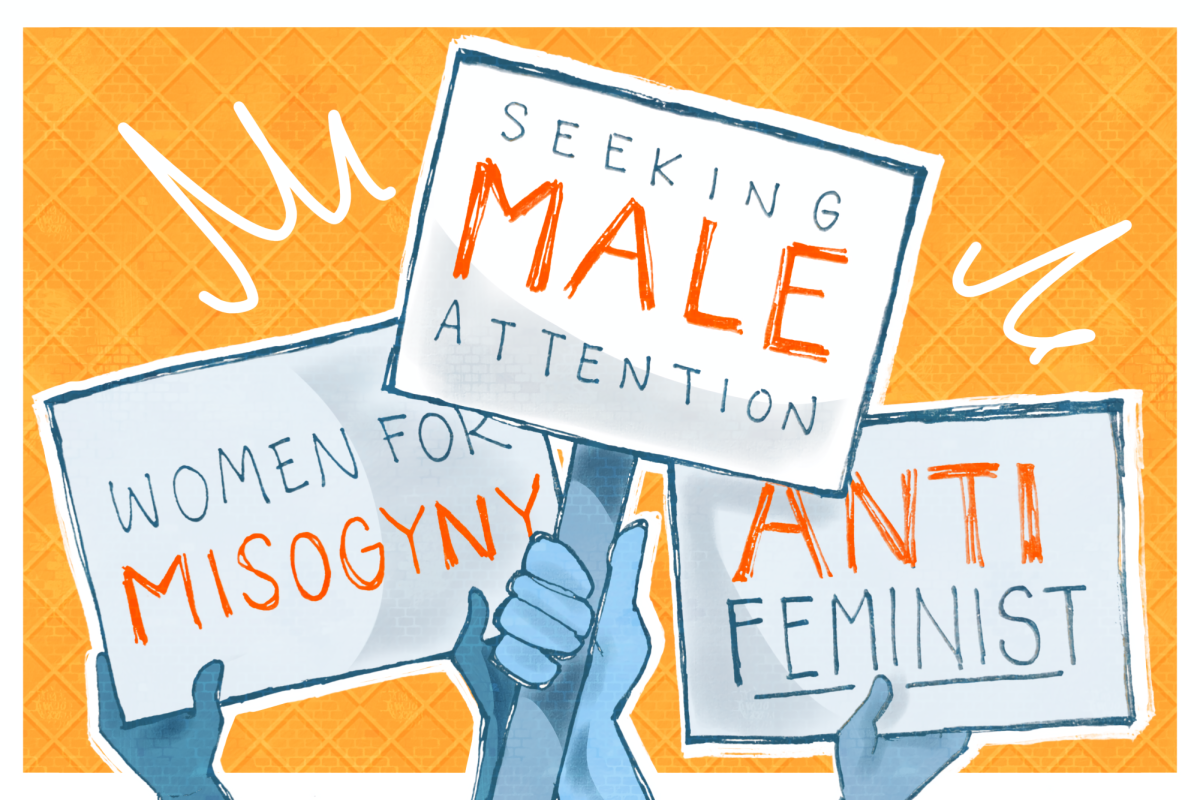
In the past year, several women have come under fire in the media for setting back feminism. The phrase, “pandering to the male gaze,” has been thrown around countless times, but it doesn’t seem like anyone can agree on what actually warrants someone being called a misogynist.
One of the most popular examples of this debate is the controversy surrounding Sabrina Carpenter’s new album cover and all that it insinuates.
From the moment Carpenter announced her album, critiques flooded in. Most of the negative reaction has been backed by claims that Carpenter is reinforcing the idea that women exist to serve men — both sexually and socially — and the insistence that her unapologetically sensual lyrics are regressive.
It’s no surprise that numerous women are uncomfortable with seemingly degrading imagery, especially in a political climate that favors sitting on the chests of feminists to keep them silent. Things are bleak to say the least, and it would be remiss to antagonize anyone fearful that one wrong step could plummet us back into the past.
However, it’s difficult to ignore that the focus of most of this criticism is coming from implication and interpretation rather than actual actions.
Get The Daily Illini in your inbox!
The idea that blame should be placed on a woman who enjoys sex shamelessly as opposed to the lawmakers who push for misogynistic policies is distasteful. The fact of the matter is that misogynists do not need a reason to oppress women. No actions of a woman — no matter how provocative or controversial — could be to blame for the inequality we experience.
There is also the misconception that women cannot act sexually without it being a ploy for male attention. Not only is this thought inherently heteronormative, but it also implies that women’s sexuality cannot exist without being tied to men.
It also suggests that modesty somehow awards respect or intelligence for women — an ironically misogynistic sentiment to be reinforcing in the name of feminism.
Carpenter said in an interview for Apple Music that the album cover was originally intended to feature an image of a man playfully twirling her hair, but the chosen model kept accidentally pulling and tugging at it.
This unintentional metaphor for how affection from men can often turn aggressive and controlling over time is also reflected in the album’s tracklist, which details the volatility of a relationship with a man who has simply fallen out of infatuation. But that’s just one perspective.
Actress Sydney Sweeney has also encountered some heat for her business endeavors, including selling men’s soap made from her bathwater and a jeans commercial for American Eagle that received criticism for having racist undertones.
It’s difficult to compare Sweeney’s backlash with Carpenter’s, if only due to the ways that the ad fueled white supremacy in a time when eugenics is not only justified by the United States administration but also celebrated.
The aftershocks of this ad are reminiscent of Lana Del Rey’s controversial “question for the culture” Instagram post in 2020. The statement attempted to challenge the media’s accusations of her music “glamorizing abuse.” However, it instead read as though Del Rey was victimizing herself against women of color in the music industry, like Beyoncé, Nicki Minaj and Doja Cat.
We must recognize the importance of intersectionality in situations like these. There is nothing inherently wrong with emphasizing one’s sexuality. However, when you weaponize it to persecute women of color — who have fought a thankless fight for all women despite the discrimination they faced — you become truly harmful to the cause.
You cannot expect grace from those you had no problem condemning.
Feminism in times of fear and uncertainty is difficult to navigate. Conversations about where sexuality fits into the movement can be uncomfortable, but they are necessary. We need to recognize whether our anger stems from women’s actions or if it is the potential reaction from men.
Hailey is a senior in Business.