Picture stepping off a plane into what should be a fresh start, only to discover your new university has already labeled you as an outsider.
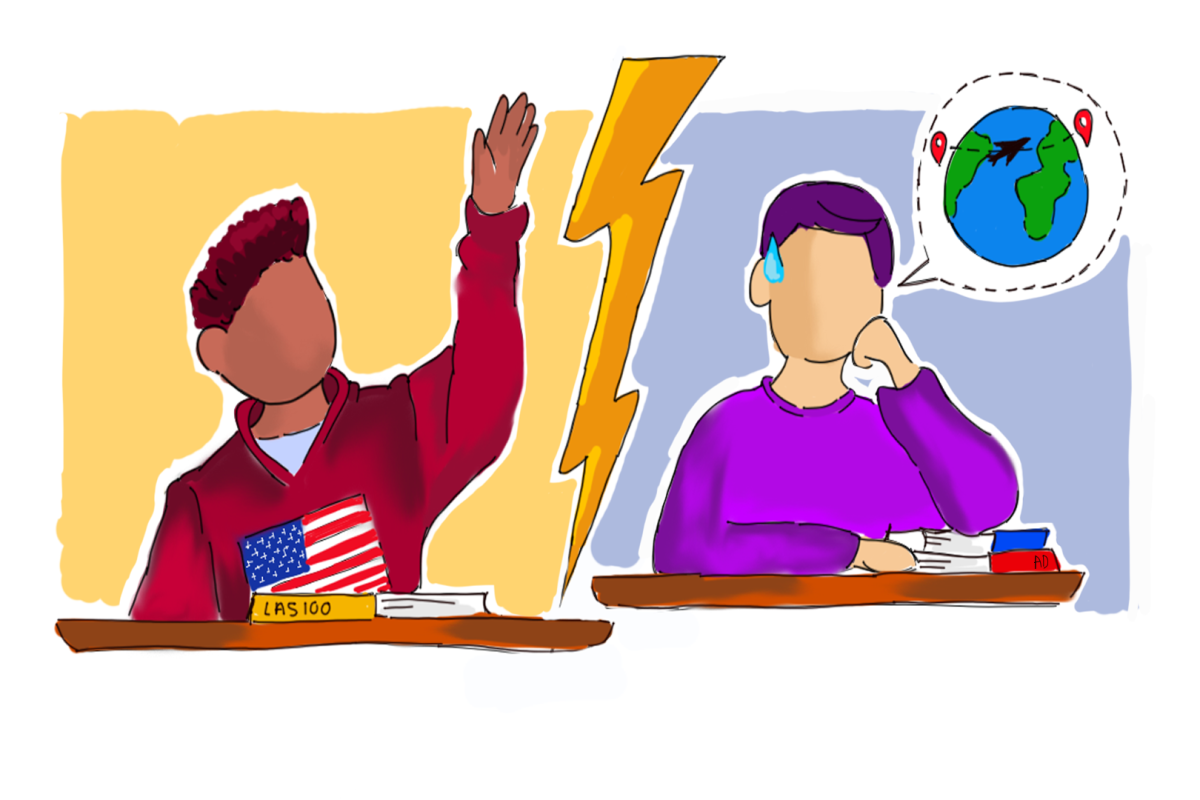
That’s the reality for international freshmen at the University. Before students even arrive, they are informed that they must take LAS 100: Success in LAS for International Students. The course is pitched as a gateway to belonging, yet it’s a hurdle that alienates the very students it claims to support.
The college itself frames LAS 100 as “support(ing) … transition to a new culture and education system” and as a complement to LAS 101, LAS 102 and LAS 122; it’s 2 credits over the first eight weeks and typically ends with a reflective four to five-page transition/plan assignment. The University insists LAS 100 builds community and eases the cultural transition. What it really does is put international students in a separate box, a different track that sends a message: “You don’t belong until we’ve taught you how.” That message lands heavily on students who already feel pressure to adapt, and it undermines the promise of inclusion that the University so loudly advertises.
According to the College of Liberal Arts & Sciences, when LAS 100 was optional, it enrolled around 40 students per semester. That scale made sense; students who felt they needed the course could opt in.
Then came the 2020-21 academic year, when LAS administrators decided all incoming international freshmen would now be required to take LAS 100. Overnight, the course ballooned into nearly 300 students, delivered online during the COVID-19 pandemic. What was once a small, supportive seminar morphed into a catch-all requirement that was imposed indiscriminately on every student with an international label.
Get The Daily Illini in your inbox!
The impact was immediate. International freshmen were saddled not just with LAS 100, a two-credit course, but also with LAS 101: Design Your First Year Experience, a one-credit orientation required for all LAS students. Together, that’s three credits of “transition” coursework — triple the burden of domestic freshmen.
Because LAS 100 adds two credit hours to schedules already capped for freshmen, it can crowd out a needed elective, lab or gateway prerequisite. For an ambitious freshman trying to stay on track for a competitive major, losing a class to bureaucratic filler can mean an extra semester of fewer opportunities down the road.
Even more galling is how the requirement fails to account for nuance. International students are not a monolith. Some arrive directly from overseas high schools with limited exposure to the United States.
Others, who grew up here, went through the U.S. school system and were still required to take LAS 100 simply because of their visa status. Being told to sit through lessons on American classroom culture when you’ve spent years in one is insulting.
The University’s own description says LAS 100 teaches U.S. college expectations, explores the purpose and values of higher education “from U.S. perspectives” and walks students through campus resources and a four-year planning exercise. It shows how the policy homogenizes all international students together without acknowledging their diverse experiences.
The University hosts one of the largest international populations — 15,376 students in 2023-2024, according to the 2024 Open Doors report. It’s ranked second nationwide among public universities.
In Fall 2024, 16.6% of students in LAS were international. The freshman class for Fall 2025 included 1,410 students from 62 countries. These numbers are even more impressive when considering this is an increase from 1,233 and 48 countries in the prior year. That is not a side population but a defining feature of the campus.
Instead of integrating this group into the same orientation structures as domestic peers, the University siphons them off in a parallel experience. How is the course supposed to help international students fit into American society more easily if they are alienated from day one, forcing them to see themselves as separate?
International students already report rates of social isolation 42% higher than those of their domestic peers, according to Wilson T. Trusty and Chun-Kennedy from the Pennsylvania State University Counseling Surveys. Adding a course that physically and symbolically separates them only reinforces that divide.
The very act of walking into a room full of “only internationals” each week sends a subtle but corrosive message: “You’re not truly part of the larger student body yet.” Integration through segregation doesn’t work — it entrenches the very barrier it claims to solve.
International undergraduates pay more than $20,000 in tuition as opposed to in-state students, and now they’re forced to burn tuition money and credit hours on a class that no domestic student has to take. To top it off, even the policy’s internal logic doesn’t hold. Transfer students, whether arriving from abroad or from another U.S. institution, are not required to take LAS 100.
The administration believes a 20-year-old student transferring in from the opposite side of the world can handle campus life without it, but an 18-year-old student who grew up in Illinois and happens to hold foreign citizenship cannot. The inconsistency exposes the hollowness of the rationale. It doesn’t seem to be about genuine need, just another requirement.
If LAS 100 contains content worth knowing, then make it optional or weave its lessons into LAS 101, where international and domestic students can learn together. Nothing about its structure prevents merging or making it an opt-in. Otherwise, scrap the requirement altogether.
Trust international students to seek resources if they need them, the same way domestic students are trusted. These are not children to be corralled; they are young adults admitted on merit. They came to the University for the same education as everyone else.
Adi is a freshman in LAS.