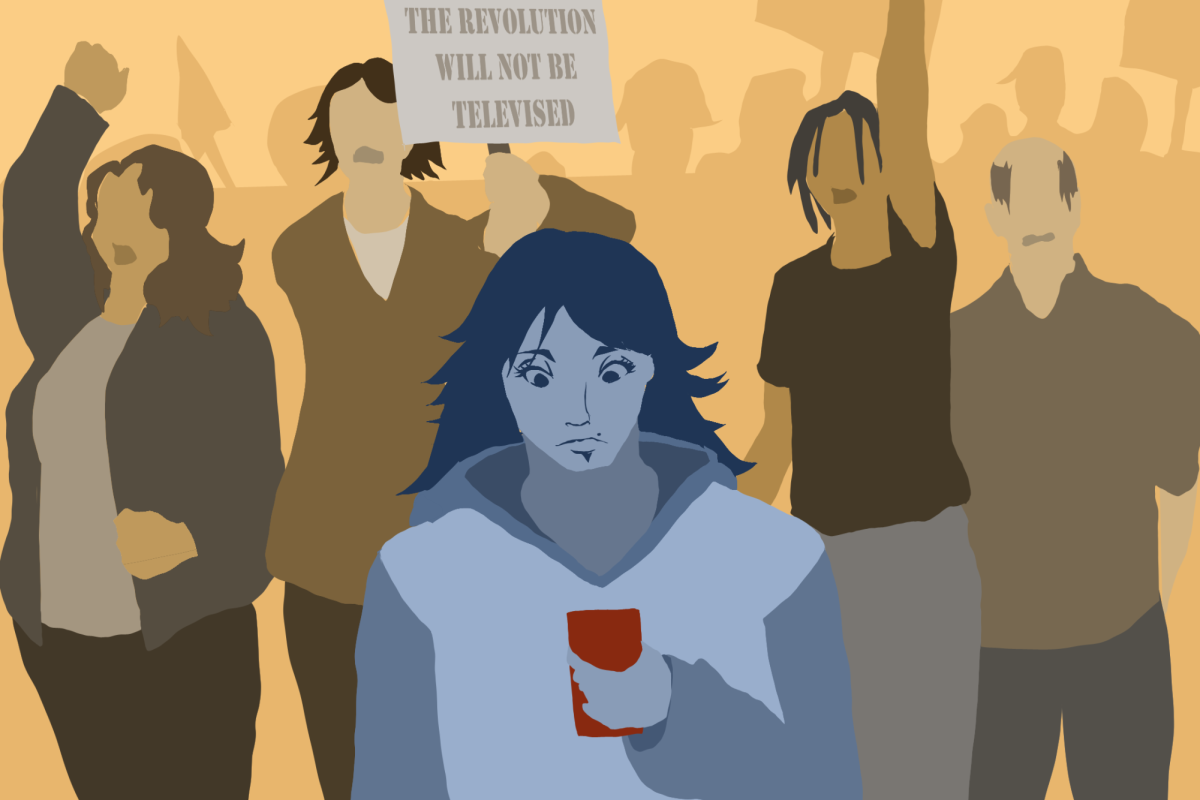
In 1971, Gil Scott-Heron delivered his iconic song, “The Revolution Will Not Be Televised.”
“You will not be able to stay home, brother/ You will not be able to plug in, turn on and cop out,” Scott-Heron urged.
These words came during a political upheaval over civil rights, the Vietnam War and other important social issues that were sweeping across the country.
Scott-Heron warned his listeners not to treat the revolution as something to watch from the sidelines. He urged them not to be spectators, but participants.
His words are just as much of a warning now as they were then. Scott-Heron was speaking to a distracted American people. A country that needed revolution and change through active participation. Our generation and media have not only televised the revolution more, but we’ve also digitized it.
Get The Daily Illini in your inbox!
Let’s take things back to 2020. I know, it’s painful. It’s summer, there’s the COVID-19 pandemic, and it’s a time filled with racial unrest.
Protestors filled the streets demanding justice, and our timelines were filled with online activism and opposition. All of a sudden, everyone was an activist — or thought that they were.
Then came the black square: On June 2, 2020, nearly 28 million people posted black squares on Instagram. It was part of #BlackoutTuesday to show support for the Black Lives Matter movement.
Somehow, filling our timelines with black squares had millions of people convinced that they would create social change.
Rather than creating change in the Black Lives Matter movement, posting the black square did more harm than good, according to leaders of the movement. The flood of black screens using #BlackLivesMatter drowned out crucial information about the movement.
The work, or lack of work, of 28 million people accomplished nothing. You see, this generation has a passion for change. Researchers say that Gen Z is changing activism and that they’re made for social change.
Nearly one-third of Gen Z are regularly engaged in activism or social justice work, according to a study by United Way of the National Capital Area. That means two-thirds are not, but I’d like to boldly assume that many of those two-thirds believe they are taking part in social change. Yet, in actuality, they’re just taking part in social media and calling it change.
We call ourselves activists, but a lot of our activism starts and ends with clicking a “share” button. This is an age of passive activism. The only “act” in a lot of our activism is simply the move of a finger, literally. We’re clicktivists.
We simply repost activism instead of participating in it. Our ability to post activism within seconds can easily confuse awareness with action and posting with protest and participation.
None of this is to be overcritical of social media. Social media makes us aware of things we’d never be aware of otherwise. It awakens our consciousness and stirs us to act and urge others to be aware. But awareness isn’t action.
This is also not to say that people aren’t truly passionate about the causes that they post for. We post because we are passionate and want to see change. But to create sustainable change, there needs to be action behind it.
Does posting on social media actually hold institutions accountable, or just our friends on social media? Both are important, but the former is more important than the latter.
There is a benefit to posting to raise awareness, but our posting only disrupts algorithms, not systems.
The problem is that while social media has made activism more accessible and far-reaching, it has also made it more convenient. This, I believe, strips it of its cost. Activism in youth movements in the past required sacrifice. Activism wasn’t trendy; it was a commitment.
I’m not asking Gen Z to put our lives on the line, but I am asking us to move past convenience and cause more disruption. And disruption is not just protesting or standing in the streets. We can cause disruption and create change by practicing everyday activism.
Take action by caring for and forming relationships with marginalized communities. Disrupt by writing letters to your government officials. Make time to volunteer. Spend money on a cause that fosters change. Engage in educational activism by reading books and staying informed in ways that aren’t social media.
If we want the world to see our revolution, we have to live it and match our passion with participation.
Prayse is a senior in Media.