Since Dec. 3, 1818, the sun has set and risen across the state of Illinois. From the urban center of Chicago, to the agricultural cores of Peoria, Champaign and Decatur, to the fields of the southern counties, generations have seen the same sun mark the passing of every day.
Today, Illinois no longer shares the same mark of a new day. In the north, the day ends with the light of opportunity. In the south, the sun sets into the darkness of poverty.
In 2025, Illinois Gov. JB Pritzker announced a joint collaborative investment with Avina Clean Hydrogen Inc. to develop a $820 million biofuel aviation fueling plant in southwestern Illinois. Both parties announced the investment in huge advancements to promote clean energy economies and lead a national industry.
Illinois’ investment comes at a time of increasing climate vulnerability across the United States and the globe. As calls for environmental stability and justice increase, calls for change arise across the U.S.
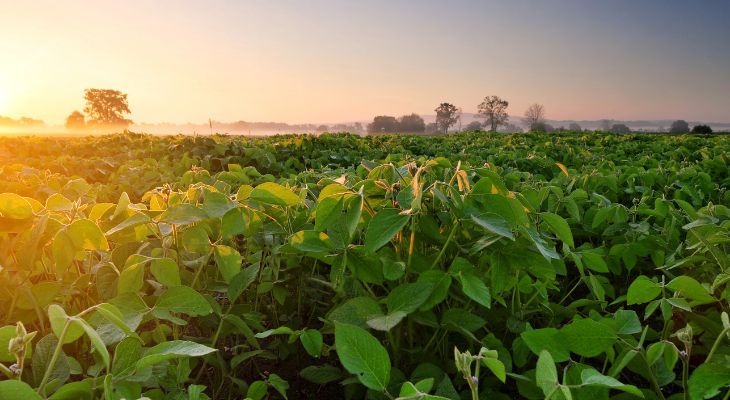
What is critical about the investment is the location: the agricultural heart of Illinois, home to acres of farmland, the national leader of soy crops and a dominant producer of field corn. Illinois is a critical contributor to the efforts of biofuel production. Yet Pritzker’s policy lacks long-term solvency to protect the true heart of Illinois: our farmers.
Get The Daily Illini in your inbox!
The issue with the investment in the sustainable aviation fuel plant, in its simplest form, exists within the goals of the Pritzker administration and actions for environmental sustainability. Nowhere have the interests and environmental justice of Illinois communities been attempted to be protected.
In the status quo, Illinois is home to over 71,000 farms — over 95% of them being family operated. Even when disregarding the scale of operations, family farms are crucial in preserving local ecosystem health. Family farms use less intensive farming practices, leading to less nutrient and soil degradation.
The importance of soil health extends far beyond simply growing crops; a healthy soil holds more organic carbon. When we boost soil health, we reduce carbon dioxide in the atmosphere through carbon being held in the soil, strengthening photosynthesis alongside increased water retention and soil nutrients.
Currently, soy and corn crops are major contributors to the input of biofuel production. When investment in biofuels expands, more operations are going to grow soy — due to easier management and lower production costs — in larger quantities to maximize profits. The issue with this is that when soy is grown more frequently, Soil Organic Carbon decreases, causing soil health to decline and emissions to rise.
The SAF project poses a major challenge to the health of Illinois soil, indirectly encouraging monoculture cultivation. This is critical as operations attempt to invest in a growing industry, projected to be worth $257.61 billion by 2034.
Solvency in the long term is limited for Illinois farmers due to distance decay. One of the premises of the project is entirely designed to benefit large-scale corn and soy monopolies over Illinois farmers, through the dominance of agricultural monopolies and their control of the entire supply chain.
What we see here is a shifted reliance on monopolies to meet higher demands for corn and soy through higher production methods, streamlined through unsustainable and soil-degrading cultivation.
Even if we argue that Illinois farms will be able to keep up with production demands and not be outcompeted by large-scale operations, they will still be placed at an economic disadvantage. As the distance from the market increases, the interaction between the two places decreases, due to local operations remaining more cost-efficient to run.
As infrastructure increases in southwest Illinois, to maximize profit and minimize costs, large operations inherently want to be near the plant. Large-scale operations are further outcompeting Illinois farmers through control of the supply chain and placing localized pressure.
To acknowledge the impacts of wide-scale climate change, the transportation sector is a heavy producer of greenhouse gas emissions. However, the only impacts you see from the Avina plant are the depreciation of Illinoisans’ livelihoods and the sustainability of poverty, not the climate.
One critical factor is true: the biofuel plant is for aviation, a factor that does not justify the impacts on local communities. Major airports are marginal within southern Illinois, making the positive benefits of aviation biofuels not relevant to southern Illinois, nor would they justify the lack of protective policy.
I am not saying that we should avoid investment in clean energy because it has no direct impact on Illinois. We should avoid investments that exacerbate existing inequalities placed on rural constituents, paired with no direct benefits for the community.
Holding Pritzker at his highest ground, you see job growth of roughly 150 permanent positions, critical in any rural economy, temporary or long-term. What you also see is that the lack of skill sets needed for working in the biofuel sector is not transferred over from local rural populations, but instead outsourced to people outside of rural communities.
This is essential as the soy industry is already facing pressures amid the Trump administration tariffs and China’s boycott. Investing in a facility with no protections for rural Illinoisans whose very livelihoods rely on the next harvest exposes them to unemployment and poverty.
What I am not doing is disagreeing with Pritzker’s policy and the SAF project’s long-term goals. I am, however, disagreeing with the implementation and the decimation of the backbone of the State of Illinois: multi-generational family farms.
While sustainability, energy and fuel investment are essential for our state and nation in the long term, the SAF project, today, does not provide the change that all can benefit from.
To encourage proper sustainability, Pritzker needs to change his priorities from profit to his people. Constituents who are further isolated from opportunity to advance the goals of wealthy agricultural conglomerates.
For once, the emphasis of environmental action and justice needs to prioritize the sustainability of our current generation, not the future. To create true change and solvency, our farmers need to be protected rather than threatened.
Samantha is a freshman in LAS.