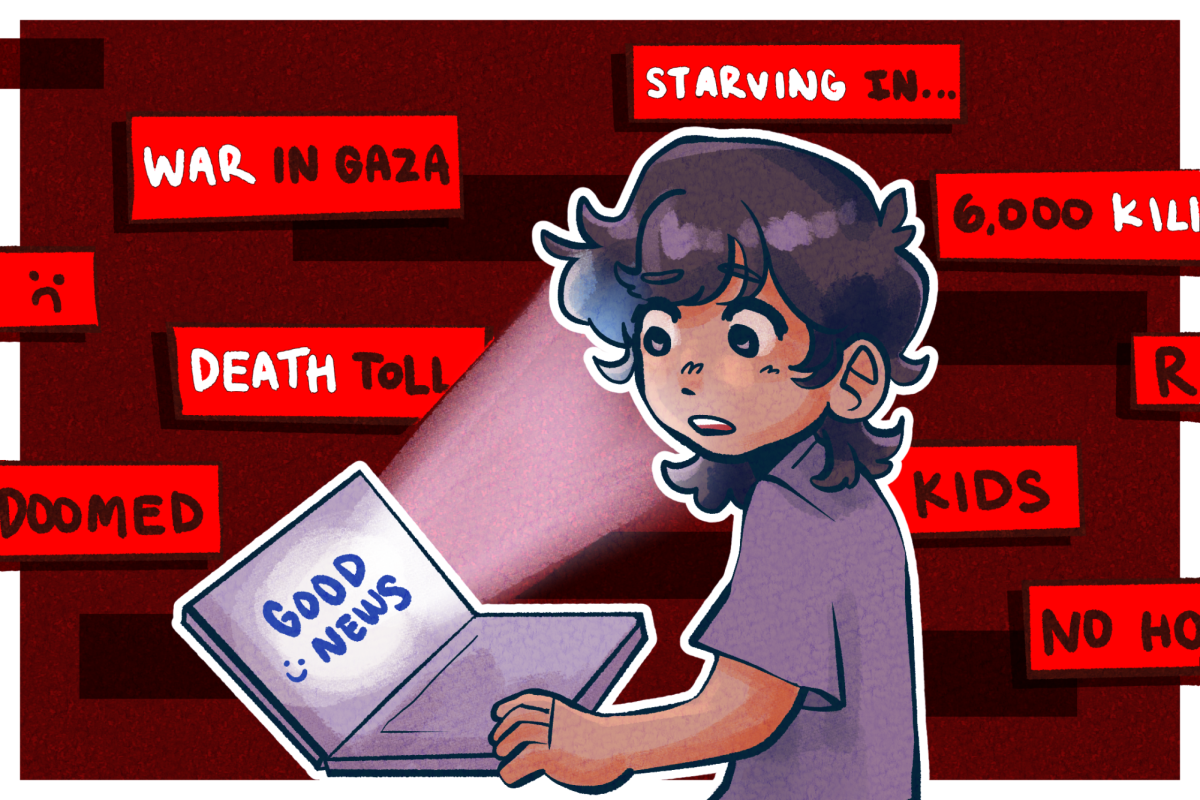
You open your feed: climate disasters, political fights, another outrage. Before you know it, an hour has passed in a haze of doomscrolling, leaving you anxious and drained.
Every click seems to deliver more bad news, leaving you dreading participating in a world that feels like it’s perpetually bleeding out.
It turns out this flood of negative news isn’t just in our heads — it’s by design. Social media algorithms amplify emotional, negative content because those posts go viral more often.
A 2023 study published in the Nature Human Behaviour journal confirms that negativity drives engagement: Each additional negative word in a news headline increased the article’s click-through rate by about 2.3%. In chasing online traffic, several news outlets have leaned into the “if it bleeds, it leads” mentality, saturating our feeds with sensational gloom.
In a 2025 survey published in the Psychiatric Times, 73% of Americans said the relentless pace of world crises last year took a toll on their mental health. In fact, according to the UNICEF Perception of Youth Mental Health Report 2025, 6 in 10 Gen Z report feeling overwhelmed by news in their communities and the wider world.
Get The Daily Illini in your inbox!
The more news people consume, the more distress they report. Roxane Cohen Silver, professor of psychology, medicine and public health at the University of California, Irvine, found higher anxiety and depression — even symptoms of trauma — in those who consume more media about crises.
For some, the only coping mechanism is to turn the news off. According to a report in 2025 by the Reuters Institute for the Study of Journalism, about 40% of people worldwide say they sometimes or often avoid the news, attributed largely to the negative impact on mood.
When the news makes people feel hopeless and powerless, many young readers disengage from the news altogether. However, disengaging from the world isn’t a real solution; it merely leaves us uninformed and disillusioned about what’s going on in the world.
That’s where positive journalism comes in. Far from fluffy filler, positive or constructive journalism reports on how problems are being solved and highlights people making a difference.
Its job is to balance and to pair problems with credible paths forward. More importantly, constructive journalism doesn’t ignore hard truths; it widens the frame to include what’s working alongside what’s broken.
There’s evidence that emphasizing positivity in journalism can lift audiences when coverage feels crushing. The Guardian found that its solutions stories kept readers engaged: Almost 1 in 10 readers on average shared these positive articles on social media, a remarkably high share rate.
Academic research backs up the newspaper’s discovery. Consuming constructive news boosts audiences’ moods and fosters a sense of empowerment in readers, according to the Constructive Institute.
The study also shows that audiences do not perceive solutions-oriented reporting as lower-quality journalism. Newsrooms can adopt a more hopeful lens without sacrificing credibility or audience trust and actually build deeper engagement in the process.
For Gen Z, a shift toward positive journalism could be a lifeline. We are a generation passionate about change, yet we’re bombarded by media narratives that suggest nothing ever improves. We need journalism that keeps us informed and reminds us that progress is possible.
Adi is a freshman in LAS.