“I love to lie,” one of my friends said, sweetly tricking our gullible friend with another one of her fibs.
“No, but be for real,” my other friend responded. She’s in agony.
“I am,” she replied, with Cheshire Cat-eyes and a knowing smile. She is the epitome of ironic detachment, with a shifting gaze, rubbing her forehead comically.
While I am enjoying this exchange, chuckling at her chaotic antics, I wonder about the social distance being created between her and other people. When we started hanging out more, I began to ponder if I’ll ever really know this friend, or if the irony will keep her genuine self-gated from me.
I’ve been typecast by my undergraduate friends as an “elder Generation Z,” and while there is sometimes a sting to that label, I have also noticed where I differ from my slightly younger counterparts. I’m 25, but most of my younger friends are still in their early 20s, either finishing up undergrad or accelerating their graduate degree attainment.
Get The Daily Illini in your inbox!
While the pandemic enveloped the latter half of my college experience, my high school and early college years went along smoothly — well, as smoothly as any freshman year can go. But these friends went through those same years in isolation, and the resentment of having a normal adolescence stolen from you sticks around.
Gen Z tends to view the world pessimistically, being the first generation in recent decades projected to have worse outcomes than the previous generation.
Internet humor has also shifted from “Charlie bit my finger” slapstick to layers and layers of lore and ironic posturing. To be earnest online is to be vulnerable, read easily and torn apart by trolls. It’s much easier to be coolly distant, without any serious commitments. Nothing you say is serious, so you can’t be hurt.
For Gen Z, irony is an important protective guard from criticism and fatalism that comes at them from all sides. For all the talk about millennial avocado toast in years past, at least that generation seems to be able to afford a home.
In some ways, Gen Z echoes Generation X, another generation forged in detachment and disarray. Gen X grew up in the turbulent ’60s and formed their views about the world in the reactive ’70s. Older people today will often compare what’s happening now to back then — the political violence, the radical politics and this sense that the country could end as we know it.
“Because of an ever-more self-reflexive culture and generational mores, we see everything through the prism of postmodernism,” wrote journalist Darragh McManus of his generation. “Everything is a pseudo-apathetic pose, a wry jibe, for Generation X; everything we say and do is lacquered with the bitter patina of sarcasm. We’re ironic and infantile and don’t take anything seriously, and yet we take everything seriously.”
In both cases, the political context one grew up in affected how they interact with the world. I remember politics before President Donald Trump, when history seemed to be moving forward. We had the first Black president and the legalization of gay marriage — who knew what else was to come? But the bitter moment of history bending back, or sideways, or however, in 2016 left me disaffected, too.
Now, the future is murky, with signs of the apocalypse at every turn. Climate change, artificial intelligence and income inequality threaten Gen Z’s longevity financially, physically and existentially. It’s a heavy load.
And so, while I understand this about Gen Z — and as an elder Gen Z, I can relate — I also have words of caution about irony. For one thing, irony has been a big help in mainstreaming fascist rhetoric. Young supporters of far-right influencers constantly defend people like Nick Fuentes with “Why can’t you take a joke” comebacks, which reveals their gamified, small-minded perspective of political discourse.
“(Today’s fascism) bubbles up from memes, jokes, ironic playfulness,” said John Ganz, author of “When the Clock Broke,” on The Ezra Klein Show. “But the text, not the subtext, of all of them is a constant barrage of propaganda that’s antisemitic, racist, misogynistic, homophobic — you name it.”
For another thing, back in the ’70s, Gen X didn’t have TikTok to soothe them. They had each other. But now, it sometimes feels like we don’t even have that.
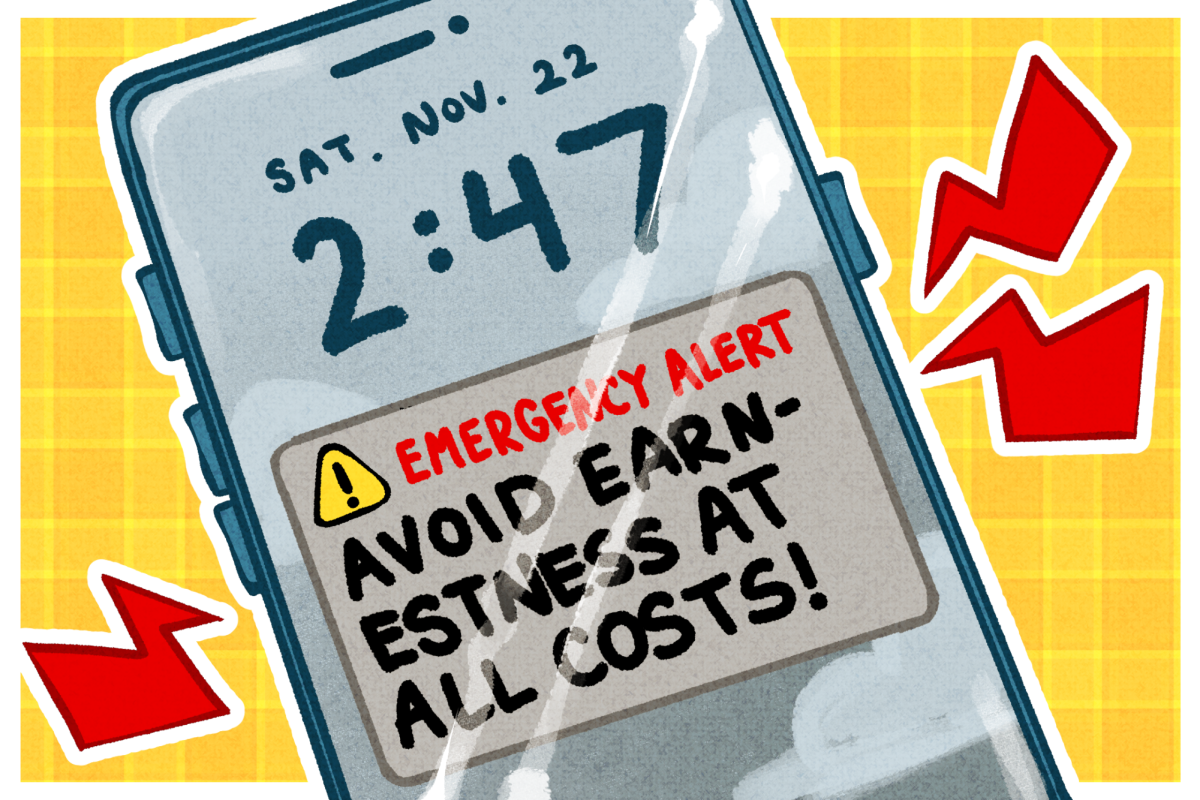
The pervasive “loneliness epidemic” is, in my view, related to Gen Z’s dark irony. Rather than putting ourselves out there, we hold back. Even in friendships, there is this fear that we don’t want to come on too strong. We don’t want to be too earnest or cringe.
I met a new friend recently and was surprised and delighted by her direct questioning: “Can we be friends and hang out again?” I hadn’t heard someone directly state their desire for closeness in a long time, and it was wonderfully clarifying.
That this interaction surprised me is a cause for concern. Between 2003 and 2023, among people younger than 25, in-person socializing decreased by 35%.
Why don’t we hang out with our friends more? While there are many factors at play, I believe that within Gen Z culture, there is a self-created social distancing — a distancing that is amplified by an ironic posturing. If we never really let people know what they mean to us, genuinely, then our friendships fail to progress any further than something casual.
Still, I have hope for Gen Z. The most recent political figure to ignite this generation is New York City mayor-elect Zohran Mamdani, who oozes earnestness and conviction, always grinning ear-to-ear without giving his potential cringeness a second thought. He has broken through detachment and shown young people a politics of integrity, a frankness that believes in the future while holding the present to account.
That kind of mentality made all the difference. Mamdani’s canvassing operation, largely made up of young people, was the largest field operation in New York history, with over 100,000 volunteers getting out the vote ahead of November. It seems that the youth sorely desire positive politics and in-person activism in these troubled times.
So: Guys, gals, friends — tell your buddies you love them. Tell them you’d like to see them more often. For real. It won’t kill you. On the contrary, earnestness is the key to unlocking deeper, more connected friendships and a politics that draws from a well of optimism, rather than despair.
Grace is a graduate student studying urban planning.