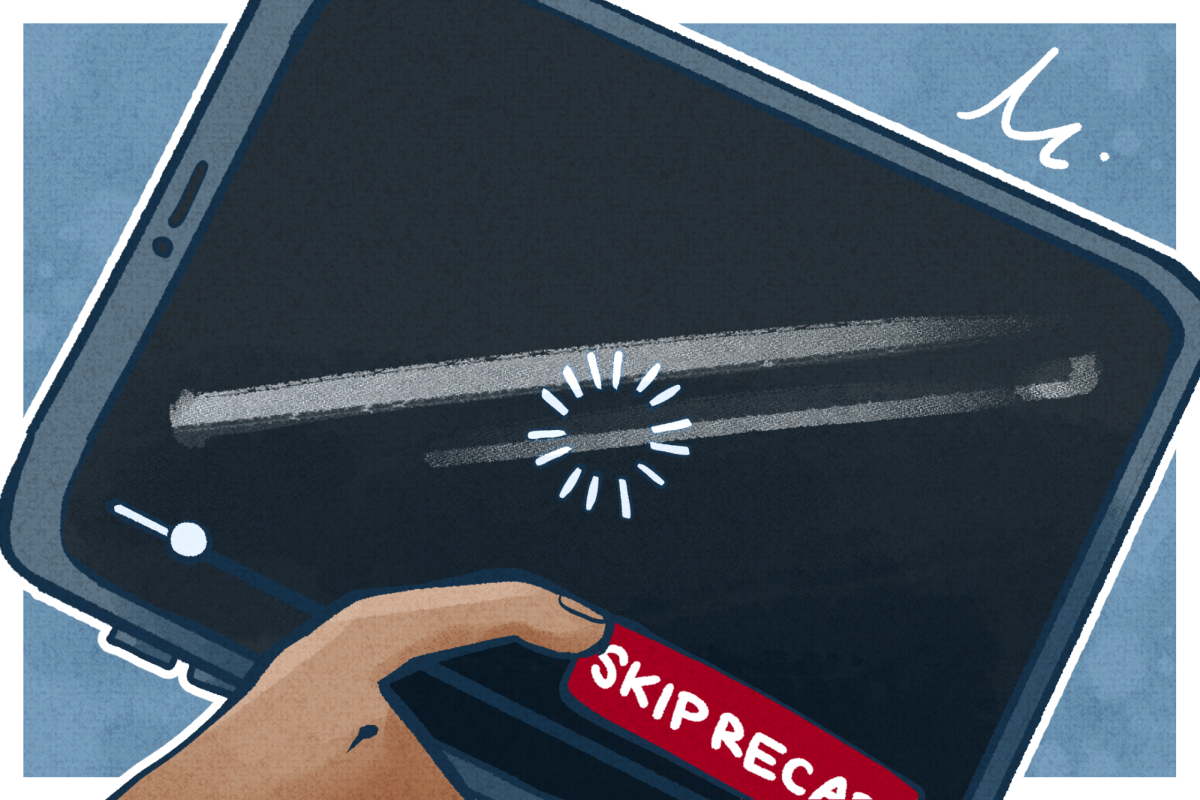
Watching that little rectangular box load up the “Next Episode” at the bottom right corner of the screen feels like it takes a lifetime. We click through to speed up the process of barely five seconds. And another Netflix feature even skips the opening credits of the following episode, letting you get right back to where you left off.
We are living in a world where streaming services dictate and manipulate the way we spend our TV time. We bow to their commands.
TV shows have become increasingly popular in recent years with the rise of streaming services. With the instant gratification one can get through an entire season’s release, patience is not a necessary factor in finishing a show.
Additionally, short-form content shoves temporary fulfillment down our throats, which forces other activities to maintain a competing level of engagement. One can see this in the way YouTube Shorts, Instagram Reels and advertisers have a small window of time to catch a viewer’s attention before they scroll past, which can happen within the first 10-20 seconds of the video.
This is also why someone might complain that certain movies are boring with fewer storylines and more deliberate pacing. We have become accustomed to overstimulation in what we watch. Streaming services enable us to continue watching uninterrupted and constantly jump through threads of multiple narratives.
Get The Daily Illini in your inbox!
Orçun Can, professor of digital economy at King’s College London, highlights this tactic in TV shows, specifically focusing on “Gilmore Girls” and its sequel, “Gilmore Girls: A Year in the Life,” due to their highly rated bingeability. Without the presence of ad breaks on platforms like Netflix, serialized programs have increased flexibility in the way their narratives are structured. I make a point to emphasize this because it is what is altering the way we engage with episodic content and is making it more difficult to simply close the window and come back later.
Being divided into snippets, TV shows like “Gilmore Girls” need constant development and must generate interest continually to keep the viewer engrossed. But the story arc of one episode is hinged on the next one. Aren’t cliffhangers the annoying thing with watching a TV show? When I watch a show that has some element of resolution at the end of the episode, it is much easier to stop. On the other hand, when the storyline is dedicated to constant new developments, one episode becomes four.
Can references “beat-sheets” which, according to Michael Z. Newman, professor in the Department of English at the University of Wisconsin-Milwaukee, are patterns of narrative changes that control the story flow. These patterns, when manipulated, will affect us as viewers since bringing in new and captivating content more often makes the episodes more bingeable and harder to step away from.
The quick-paced nature of such shows affects younger ages, too. Children’s TV shows are packed with fast-paced and overstimulating content that leaves them restless and sometimes aggressive when they aren’t zoning out in front of the screen. Keeping children entertained is uphill work when we have to compete with the likes of “Cocomelon.”
It is easy to get around the idea of binge-watching four episodes of a show if it’s the typical 25-minute episode. But as journalist Stuart Heritage writes in an article about the runtime of TV episodes, shows are taking more and more liberties to increase runtimes. And the absence of ad breaks once again creates an open field for keeping the viewer seated.
We are now bingeing episodes that are individually the length of movies that we don’t have the “patience” to sit through. This disconnect is reflected in how our screen time is increasing, and, with it, our expectations for faster and more efficient unsatisfying satisfaction.
There will never be enough episodes, nor a storyline to satisfy us, when by maintaining compelling storylines, using fast-paced changes in narrative and eliminating breaks, shows can extend freely without having to worry about losing us. They’ve reeled us in for good.
Streaming services have us right where they want us: “Next Episode.”
Zaynab is a senior in LAS.