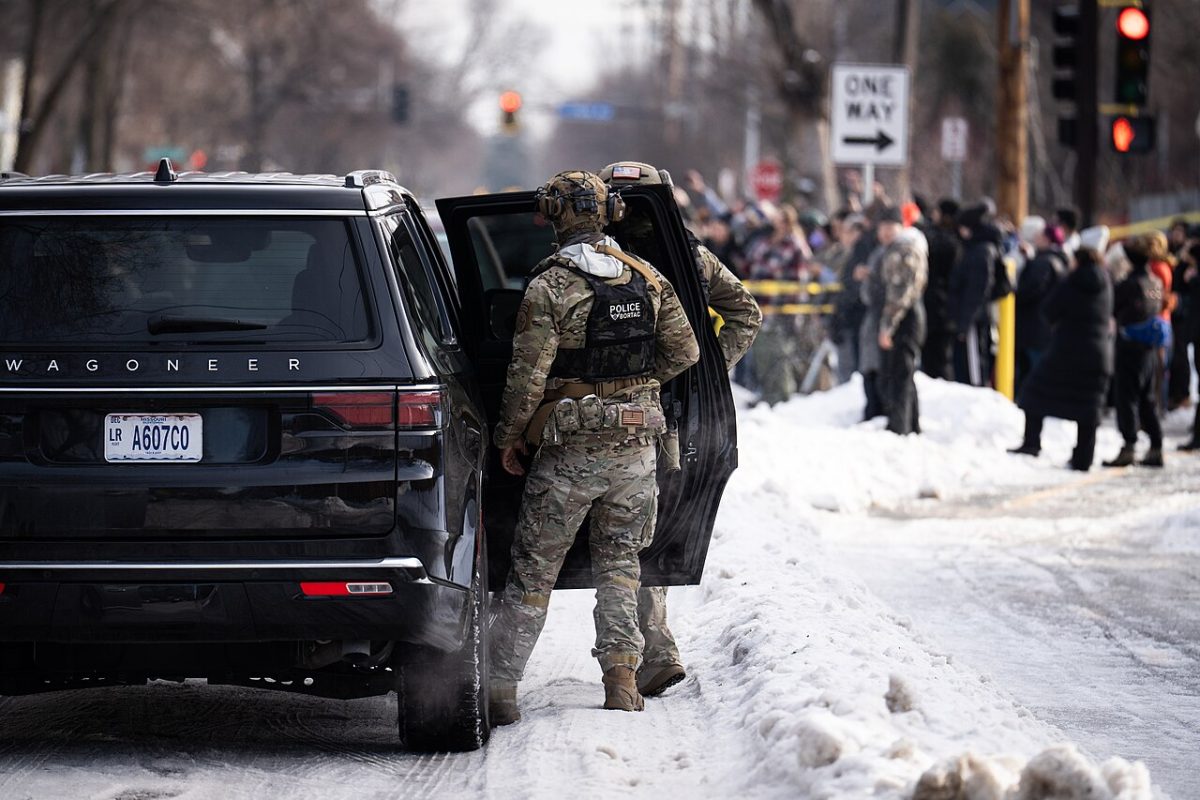
Immigration and Customs Enforcement made a mistake invading Minnesota in the winter.
Weeks into ICE’s Operation Metro Surge, the community’s response has turned Minneapolis into the epicenter of resistance to the Trump administration’s draconian immigration policy.
An estimated 15,000 protesters took to the streets in subzero temperatures, coming together in a way that can be compared to the protests after George Floyd’s death. But now the city has a new purpose: force ICE out of Minnesota.
Undocumented immigrants in Minnesota make up about 2% of the state’s population and around 1% of undocumented immigrants nationwide. This calls into question why the Trump administration targeted Minneapolis for Operation Metro Surge. The government has cited the fraud crisis involving Somali immigrants as a reason, but investigating fraud has little to do with ICE’s ground operations.
Regardless of the reason for selecting Minneapolis as the site to send 3,000 ICE agents — larger than the Minneapolis and St. Paul police departments combined — what the federal agents found upon arrival was organized public resistance of unprecedented nature.
Get The Daily Illini in your inbox!
What makes Minneapolis a standout civic stronghold? For one thing, the city has learned plenty from the Black Lives Matter protests in 2020. Local activists from past protests organized and taught new allies how to watch and interact with ICE using nonviolent and legal tactics.
Residents have legally observed ICE entering their snow-covered neighborhoods and notified their neighbors. Hundreds of people attended vigils honoring the lives of Renee Good and Alex Pretti, the two individuals who died at the hands of ICE agents.
Adam Serwer, a staff writer at The Atlantic, has termed the activism in Minneapolis as “neighborism”: “a commitment to protecting the people around you, no matter who they are or where they came from.” In an era where politicians seek to divide us along racial lines, people of all backgrounds have shown up to promote safety, stability and diversity.
Serwer recalled driving past businesses where almost every window had an “ICE OUT” sign. On Jan. 23, up to 700 businesses and organizations in Minneapolis closed in solidarity with the organizers of the general strike, a daylong protest and economic blackout.
As a result of this pushback, the Trump administration demoted Greg Bovino, the “commander at large” who led ICE’s operations on the ground. On Jan. 29, White House Border Czar Tom Homan said the government plans to scale back federal immigration operations in Minnesota.
I grew up in South Dakota. Half of my family is from Minnesota, and I have friends who live in the Twin Cities today. When I see videos of protesters speaking out against ICE, they speak in the accent of my family and my community back home.
These are the kind of people who will shovel the snow on their neighbor’s driveway without a second thought. They’ll take a hot dish to your house when a loved one dies.
Videos of the Minnesota National Guard exhibited a touching contrast to ICE’s aggressive tactics. Guardsmen wearing distinctive yellow vests and helpful smiles handed out coffee and doughnuts to protesters outside of the Bishop Henry Whipple Federal Building — the home base for ICE’s operations.
One of my friends who lives in St. Paul works at a refugee clinic. Every day, she worries that agents will enter her clinic and take her patients away. Patients call her office, saying they are afraid to come in and pick up their medications — they don’t want to leave their homes because ICE is outside asking questions and racial profiling people in their neighborhoods.
When I ask her if she is doing all right, she asks me to pray for her patients. The faith community in Minnesota has struck me as an important force in all of this. Clergy, lined up in prayer, led a protest against deportation flights at the Minneapolis-St. Paul International Airport. Police arrested about 100 of these faith leaders, who peacefully complied.
The moral power of nonviolent protest in the face of state violence has sent shock waves through the nation. The people of Minnesota’s strong sense of justice is a guiding light for us all.
In my experience, it’s an uncomplicated sense of justice, a pure sense of right and wrong, but not a simple one in execution. Good people protect their neighbors and communities, no matter the circumstance.
The people of the plains don’t put up with nonsense. Nonsense gets you killed in the harsh winters. This January, ICE found out the hard way.
They should vacate Minnesota and be held accountable for their abuses.
Grace is a graduate student studying urban planning.