“First blood.”
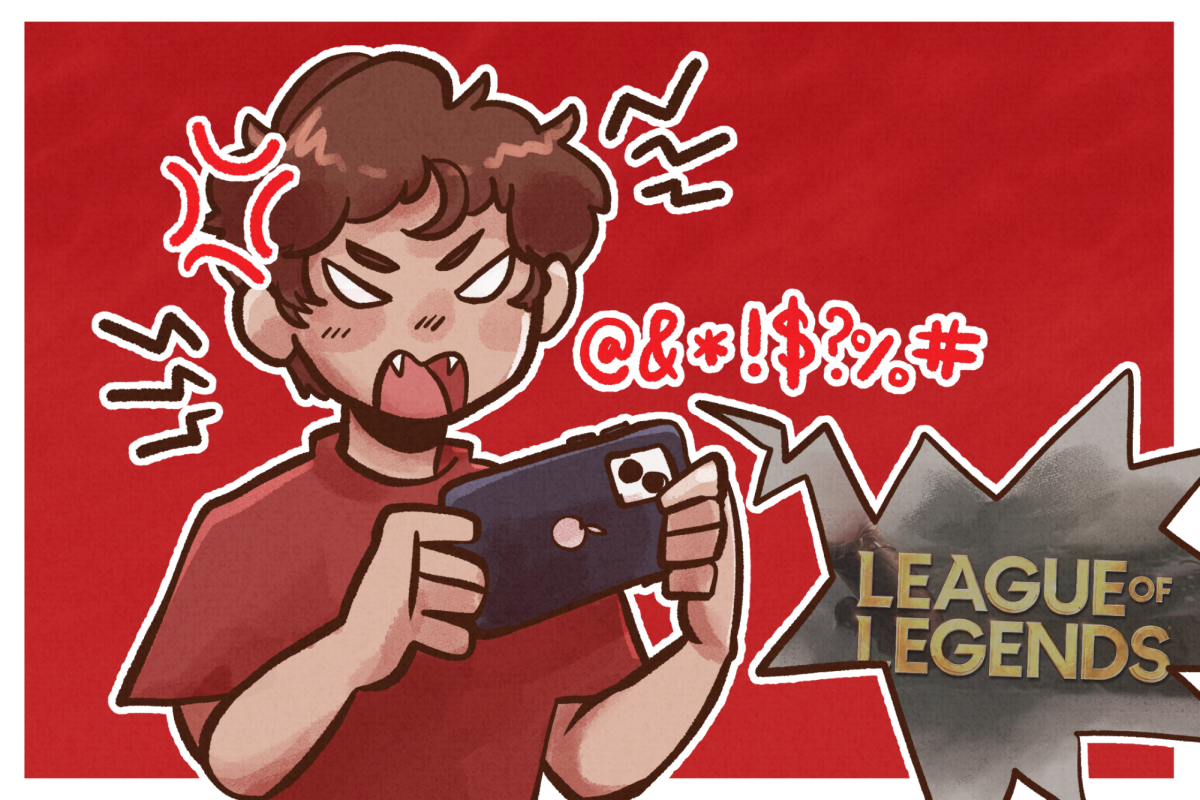
The words flash across the screen, and my jaw tightens. Somewhere on the map in a multiplayer online battle arena — or MOBA — game, an enemy has eliminated my teammate after their miscalculation. My nerves tense immediately, and I find myself hoping that they will not jeopardize our chances of victory with another mistake.
As a fan of the genre, I had never seriously questioned its reputation until a casual lunchtime conversation with a friend. When I mentioned that I played MOBA games and sometimes get angry with my teammates’ underperformance, he froze for a second before reacting with visible disgust and disbelief.
“Seriously?” my friend said. “Those games are toxic.”
A 2014 study by Jeremy Blackburn and Haewook Kwak introduced the term “toxic” in relation to video games, with their study focusing on whether a crowdsourcing platform should punish players with toxic behavior or not. By toxic, the study refers to players being “subjected to beratement for every little mistake.” Actions like trash talk, harassment and poor sportsmanship are all considered toxic within MOBA communities.
Get The Daily Illini in your inbox!
The phenomenon became so widespread that video game developers like Riot Games redesigned their honor systems and implemented behavioral analytics dashboards to address it. Despite years of moderation efforts, the problem persists and has somehow even grown more pronounced.
At its core, a MOBA game is about teamwork: around five players coordinating roles, timing and strategy to achieve a shared victory. Ironically, how much genuine collaboration can truly occur in a virtual, camera-closed environment that lasts around half an hour?
This leads to the first paradox of MOBA design. These games demand teamwork but offer extremely limited means of communication. Players must coordinate through rapid text messages, pings or occasional voice chats in fast-paced matches. A single misstep can reverse the entire game, so there is little room for error, discussion or mutual adjustment.
As a result, when disagreements arise — as they frequently do in groups of strangers — there is no time for negotiation. What follows instead are arguments, accusations and trash talk. Players lack both the patience and the incentive to empathize with anonymous teammates behind computer screens.
When a teammate makes a visible mistake — giving up first blood, missing a crucial team fight or triggering a disastrous group elimination — that individual is often reduced to a scapegoat for the entire loss. Frustration turns personal in these moments. Verbal abuse, sarcastic pings and message harassment emerge not merely as emotional outbursts but as attempts to assign blame.
“I mean, it’s just a game,” my friend said. “You don’t have the right to treat someone badly just because they made a mistake that has little effect on your real life. Games are simply virtual games.”
Yet, MOBA games have detached from their original entertaining purpose. Here lies the second paradox of competitive MOBAs: Although they are framed as recreational, they are built around fierce competition and ranking systems that come to define competence and even self-worth.
Most MOBAs feature elaborate ranking systems and public scoreboards that explicitly display a player’s skill level, sometimes extending from local districts to global leaderboards. These systems stimulate competitive spirit, but they also exert psychological pressure.
Over time, MOBA games form their own social hierarchies, where rank becomes a marker of status. Losing a game does not merely mean losing once; it means dropping in rank and, with it, an implied loss of dignity. Such games become capital for self-validation, rather than tools for relaxation.
I used to believe responsibility lay squarely with individual players. If someone chose to play ranked mode, they should have completed the tutorial and practiced their character beforehand. If they made a mistake that cost the game, it was simply their failure to follow the learning process.
Only later did I realize that MOBA games themselves do little to prepare newcomers for real matches. Take “League of Legends” as an example. While its tutorial teaches basic mechanics like minions and turrets, it largely ignores advanced concepts, like role responsibilities and map awareness. When new players enter actual games, they quickly discover that reality is far more complex.
Toxicity is not merely a problem of bad manners. It is the outcome of competitive pressure, fragile collaboration and inadequate onboarding built into the very design of MOBA games.
I must admit that it feels uncomfortable to be associated with a community labeled “toxic.” I, too, have caught myself instinctively blaming teammates for their mistakes, long before that lunchtime conversation with my friend. Recognizing this tendency has forced me to reflect on my own role in perpetuating the problem.
Perhaps change does not begin with stricter punishment systems or better algorithms but with small moments of self-awareness. The next time I feel the urge to type a harsh message to an anonymous teammate, I may pause and remind myself: If toxicity is learned, it can also be unlearned.
After all, I am not defending a title or a rank. I am simply a player who came to MOBAs to have fun.
Yueran is a freshman in Media.