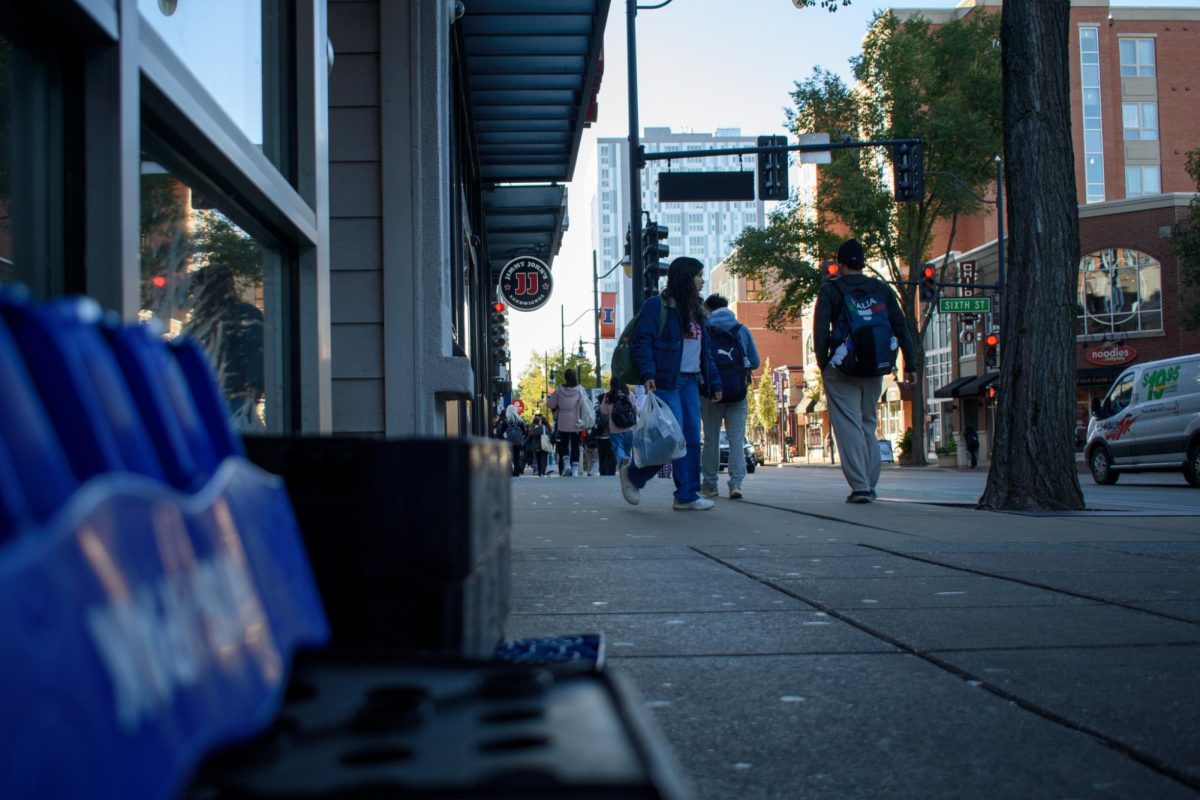
As a University student, you know Green Street: the heart of Campustown and home to such fine establishments as The Red Lion and Raising Cane’s. You’re likely also familiar with the figures sitting on the sides of this busy street — the person on the ground holding out an empty cup by Target, for instance.
The first time you experienced their presence, you may have felt surprised or uncomfortable. Maybe you felt empathetic or sorrowful. Perhaps you considered placing some spare change in the cups, or maybe not.
But you probably didn’t know that homelessness is getting worse every year, and we, as a community, are doing little about it.
Champaign County’s homeless population has increased by 65% since 2023. Yes, you read that percentage right. In 2023, there were approximately 215 homeless people in the county, but the number has now risen to 355.
To make matters worse, Champaign residents voted down future funding for the Strides Shelter — the county’s only low-barrier emergency shelter — in April, putting the shelter’s continuing operation in jeopardy.
Get The Daily Illini in your inbox!
I was a teaching assistant for an urban planning course where students decided to study Green Street. They asked people what the University could do to make Green Street safer, especially at night.
To my and my students’ surprise, quite a few respondents said they wanted authorities to “get rid of the homeless people on Green Street.” That would make them feel safer.
But would they actually be safer? I haven’t heard a single story of a homeless person assaulting a student, and I’m sure if they had, it would be big news. Campus Safety Notice emails more commonly contain reports of vehicle theft and sexual assault at fraternity houses, not homeless people creating safety issues.
It seems to be a perceived safety issue rather than a real one. According to Nyssa Snow-Hill, professor at the University of Illinois Chicago, “Fear of danger far exceeds the actual risk of danger” when it comes to the visibility of homeless people in the public sphere. Rather, homeless people themselves are far more likely to be the victims of violence than the general population.
When respondents say they feel unsafe, what they might really be feeling is an uncomfortable pity. I can imagine that, for many students who grew up in the Chicago suburbs or less populated areas of Illinois, this might be the first time they’ve regularly seen homeless people.
Some people, when they’re growing up, are taught that panhandling is bad. In Sioux Falls, South Dakota, where I went for my undergraduate degree at Augustana University, there are now signs all around downtown that read “say no to panhandling.”
I’m not here to sermonize you about giving money to poor people — though, admittedly, I’m one to hand out a few bucks now and again. What I am here to argue is that, in a homelessness crisis with dwindling public support, poor people have a right to exist in public spaces where they aren’t harming anyone.
There are two kinds of panhandling: passive and aggressive. Most people sitting along Green Street are passive panhandlers — they rest quietly with a cup placed in front of them and don’t speak much to passersby. That makes it pretty easy for people to choose whether or not they want to engage.
Few people will engage, and that’s normal. But a “pull yourself up by your bootstraps” capitalist philosophy has constructed our society’s general distaste for the poor and the moral indignation with which we judge them — and ultimately blames homeless people for their situation.
However, in a homelessness crisis (that is, nationwide, not just in Champaign-Urbana), it’s hard to fault the homeless. There are systemic factors that heavily contribute to the problem. Danielle Chynoweth, supervisor for Cunningham Township, argues that the current level of homelessness in the county can be attributed to a lack of shelter space and both transitional and affordable housing.
My hope is that when you see a homeless person on the street, you think about that side of the story. You sit with your discomfort. I’m not asking anyone to be Mother Teresa, but instead to evaluate the way you think and talk about homelessness.
A crucial step to solving the problem is for people to recognize that the dramatic rise in homelessness is not an individual failure but a policy choice. Supporting homeless shelters and developing more affordable housing are necessary strategies to help our most vulnerable populations access the lives they want to lead.
Grace is a graduate student studying urban planning.