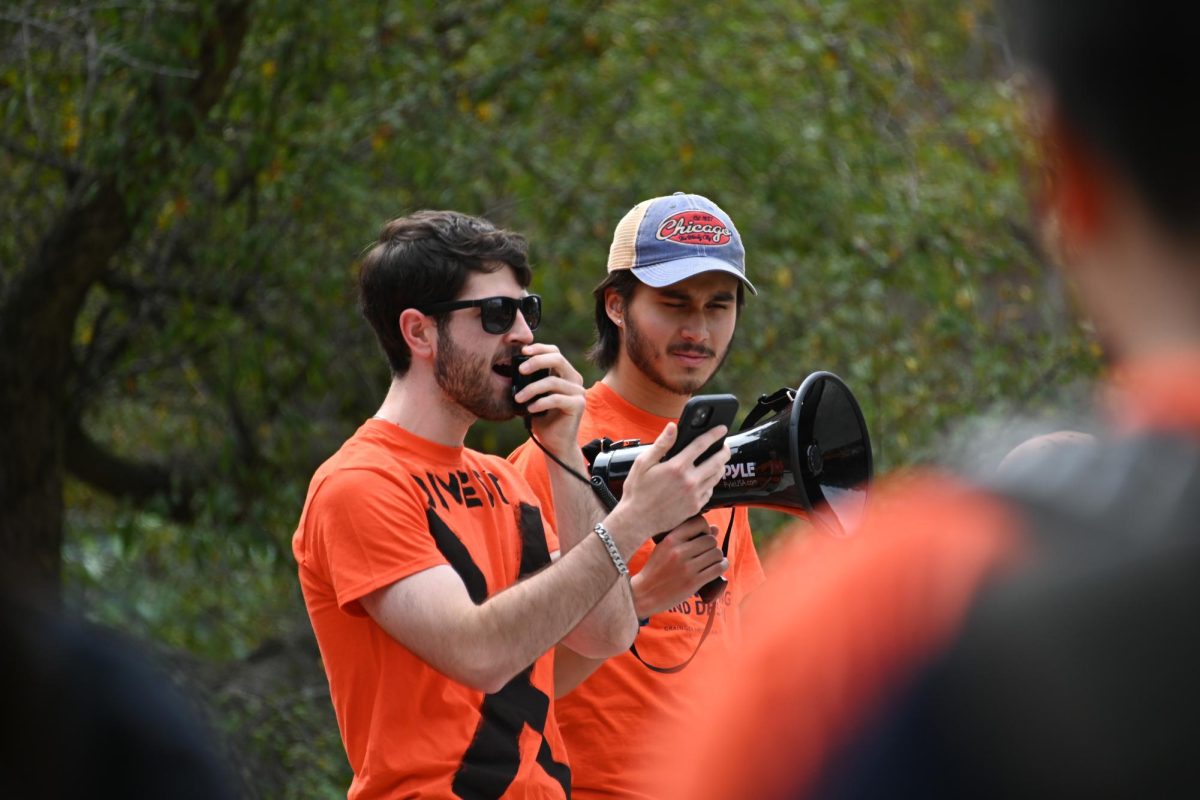
Standing in front of Alma Mater on Sept. 19, I felt myself tremble like I had never before. Speaking to a sea of activists through that megaphone, I was petrified of what repercussions I may face.
The I-Team lingered roughly 50 feet away — the same distance protesters are now forced to stand from academic buildings — and watched us to ensure University policy was being abided by. Yet, it was those I spoke to that subsided my fear. I saw myself in each one of them, as I once stood where they did one year ago.
In Fall 2024, I marched in the streets for divestment from fossil fuels. It was my first introduction to Students for Environmental Concerns — the oldest environmental RSO at the University and the organizers of the semesterly Climate March. The then-action coordinator for the group, Gabi DalSanto, spoke to why we were there, saying that “the University teaches us to protect, and we are the reality of that education.”
SECS demanded that the University stop investing in what it teaches us is killing the planet: fossil fuels. However, the response it received wasn’t acquiescence from administrators but punishment.
Following the Spring 2024 encampment on the Main Quad, which led to the removal of Students for Justice in Palestine as an RSO, the University created a new Expressive Activities policy to prevent similar actions by other groups. The result was a crackdown on campus protests. SECS was one of the unfortunate casualties.
Get The Daily Illini in your inbox!
The group received a strike against its organization and was placed on probation, meaning a loss of its RSO status for engaging in any further protests. At the same time, DalSanto and those who supported her received similar treatment, an academic strike.
Months later, I would find myself in that very same role. I was elected action coordinator at a time when coordinating actions could lead to academic punishments. My new role was no longer able to fulfill its express purpose, and as such, I had to find an alternative avenue to allow our voices to be heard and enable others to do the same.
At the time, I was involved with a similarly aligned organization, Fossil Free Illinois — a group advocating for divestment but not registered with the University. This lack of affiliation presented an interesting opportunity, a protest with no organizational backlash from the University. As a member, we decided to organize the Climate March instead of SECS.
Regardless, this wouldn’t protect me or my fellow students from punishment, a reality we were constantly aware of.
In August, we began planning and coordinating the march. Yet, we quickly realized this fear of protest wasn’t isolated within us; the student body was afraid, too. Breaking through that fear was our greatest challenge. It was the same fear I felt when facing that crowd, and it’s the fear I have now writing this story.
We had to make a difficult choice: organize the march in a way that complies with University policy or not. We chose the former — a decision I now question. Nonetheless, I received no strikes, and the University received its restrained action.
However, not all activists will be as restrained as we were, and they shouldn’t have to be. Protests are meant to be a disruption, showing those in power that what they are or aren’t doing is unacceptable.
This will be the legacy of our University if it chooses not to change. One that chose instilling fear in students over embracing their desires.
But as I said through that megaphone, while quoting the words of Martin Luther King Jr.: “‘The arc of the moral universe is long, but it bends toward justice.’ But it won’t bend without change. We are the pressure necessary for change, change that will show us to be the moral victors of history, regardless of how long it takes.”
Grayson is a junior in LAS.