The election on Nov. 4 brought a surprisingly clear message to the Democratic Party: It’s time to rethink values.
Across the country, Democratic candidates not only held ground but made notable gains. In Virginia, New Jersey, California and Pennsylvania, candidates won with a clear momentum that signaled both a rejection of long-stagnant politics of the past and a desire for more result-driven leadership.
For example, in Virginia, Democrats not only won the governor’s mansion but also elected Ghazala Hashmi, a Muslim-American woman, as lieutenant governor.
But the most instructive win may come from New York City, where Zohran Mamdani’s victory gained lots of attention not just domestically, but worldwide. His win offers a blueprint for what Democratic leadership must become if the party hopes to keep up the pace with the changing demands of the public.
Since the 2024 presidential election, Democrats have spent the past year locked out of power in Washington, D.C., with the majority of the House and Senate filled with Republicans. That loss of political influence has forced Democrats to once again focus on regaining control, as if reclaiming seats would solve deeper problems within the system. In this past election, Democrats received the lowest rating from voters in 35 years.
Get The Daily Illini in your inbox!
This mindset misses the larger picture. Power alone doesn’t fix disconnection. For too long, Democrats have relied on electoral wins as proof of progress instead of confronting why so many voters feel unheard.
Democrats rely on slow, cautious transitions rather than bold shifts in policy, believing moderation will uphold the stability; however, that same caution can make them seem detached from the voices of voters. Mamdani’s campaign proved that authenticity and urgency can win where traditional party messaging falls flat.
Mamdani, a 34-year-old Democratic Socialist, won the 2025 New York City mayoral race, becoming the city’s first Muslim mayor, the first of South Asian heritage and the youngest mayor in more than a century. He won despite running against major figures in his own party, including former Gov. Andrew Cuomo, and without the backing of prominent Democratic leaders.
As a Democratic Socialist, he spoke directly to the concerns of everyday New Yorkers. Housing costs, transit access and fair wages are issues too often softened or sidelined by party leadership. His focus on economic justice and grassroots organizing helped him connect with voters who feel alienated by their leaders.
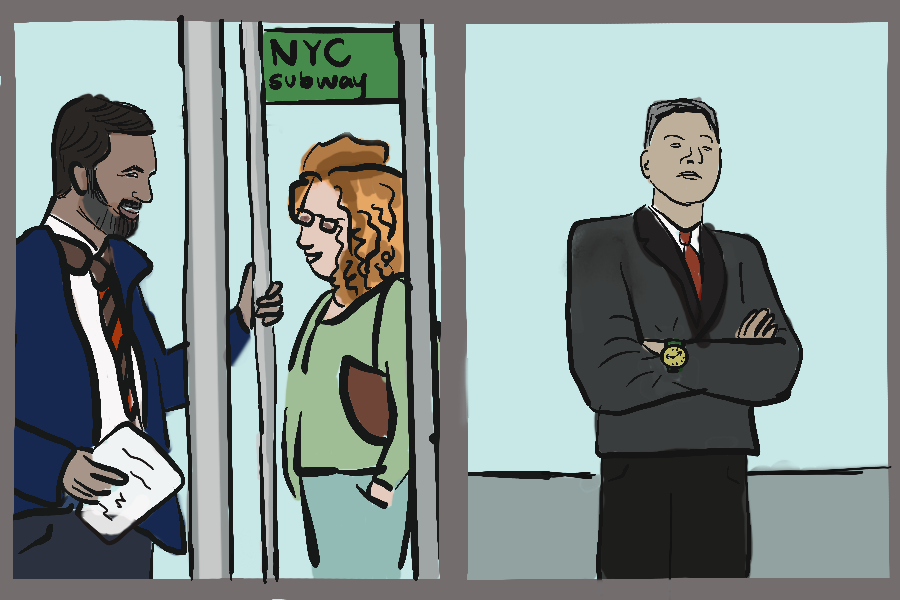
However, what set him apart wasn’t just his policy agenda. It was how he carried himself. Mamdani leads like an everyday New Yorker: he takes the subway, a taxi, a bus or even walks. He chooses to commute the way his constituents live, not the disconnected, chauffeured routine most politicians follow. He puts it more bluntly in an interview with Wired: “Too often, if you’re riding around only in a car with tinted windows, the only New Yorker you might see is a reflection of yourself.”
That disconnect is exactly what causes leaders to stop engaging the way they should. Mamdani rejects that model entirely. His commitment is clear: to experience the city the way New Yorkers actually do — to feel their delays, frustrations and daily struggles firsthand so he can respond to them with real solutions. As he stated in the same interview, “You will not feel the pain of the slowest buses in the United States until you ride that bus.”
David Hogg, a former vice chairman of the Democratic National Committee, put it bluntly in an interview with CNN: “People are tired of being lectured by men with Rolexes about affordability.” Mamdani’s victory underscores what many Democrats still overlook, which is that you can’t speak for working people from behind closed doors, and too many leaders promise action while remaining untouched by its consequences. His win makes that gap impossible to ignore.
So what can Democrats learn from this astonishing win?
First: ownership of issues that matter to everyday people. Mamdani’s campaign focused relentlessly on affordability. A platform of practical, immediate concern rather than ideological stances. He promised a rent freeze for 2 million New Yorkers in stabilized units, free buses and a minimum wage of $30 per hour.
In doing so, he tapped into the frustration of many voters who feel the system no longer works for them. Democratic leaders too often rely on incremental messaging or preserve the status quo, but Mamdani proved voters are ready for something different.
Second: willingness to challenge the party status quo and adapt to generational change. Many in the Democratic Party were cautious about Mamdani’s socialist label or his lack of traditional viewpoints, but the electorate showed that the old formula of running as a moderate centrist or relying solely on endorsements is no longer sufficient to address real issues.
An example of this is Mamdani’s stance on the crisis in the Middle East, where he has been outspoken in condemning the actions of the Israeli government and its genocide of the Palestinian people. This isn’t a stance many Democratic leaders agree with, but it proved that his agenda resonated with voters who value honesty over political convenience and courage over caution.
Third: the cost of ignoring the new dynamics. Democratic leaders who stay locked into the old models by depending on endorsements and big donors instead of bold ideas and grassroots energy risk being passed over. Mamdani’s win was not just about New York, but has sent ripples across the country, as voters increasingly judge parties not by tradition but by responsiveness. If party leadership doesn’t adjust, it will continue to lose ground in places that are shifting.
The takeaway is clear: This moment offers a wake-up call for Democratic leaders. They cannot keep up with the changing demands of the public, especially young voters, the working class and voters of diverse backgrounds, by relying on tactics that have worked in the past. Instead, they must learn from Mamdani’s example: speak to real issues, engage broadly, be bold rather than incremental and trust that voters will meet you halfway.
Looking ahead, the Democratic Party must ask itself: Are we building leaders who look like the future? Are we addressing the urgent issues of everyday people? Are we empowering new voices and movements inside our party rather than suppressing them? Because, if not, Mamdani’s win will simply be an outlier. But, if yes, it could spark a new, more dynamic chapter for the Democratic Party.
In short, don’t just celebrate wins, but learn from them. Mamdani’s victory shows how to do it right. Democratic leaders would do well to internalize that lesson now, before the window of opportunity closes.
Hajera is a junior in LAS.