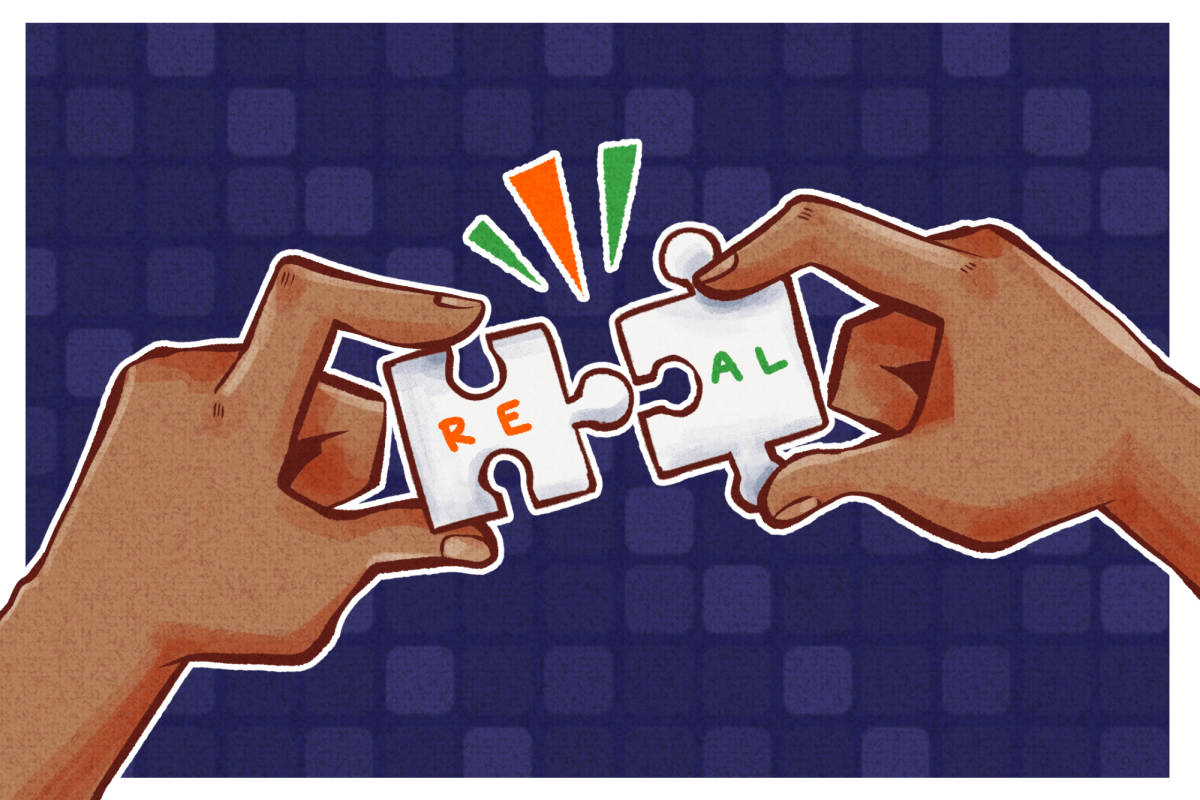
“So how does it feel to be in a real college now?”
That sums up the gist of what many people wanted to know from me, since I transferred from community college to the University. That emphasis on “real” was fascinating to me, as if the first two years of my college education were merely a figment of my imagination, or a test run of some kind.
I transferred in my junior year, decidedly intimidated by the big school and being away from home for the first time. I have always considered my time at community college and at the University as a legitimate part of my undergraduate journey.
But as an overthinker, I am always on the lookout for ways to worry. All the talk about big schools surrounding college applications made me worry that I was getting bogged down in trying to prove something by choosing a state school, although I knew that wasn’t at all the case.
I had a great feeling about my decision to transfer to the University, yet found myself questioning it. I felt pretentious. Was I embarrassed about coming from community college? No, of course not. I loved my experience there.
Get The Daily Illini in your inbox!
Did I think picking a big school was the only way to get the “real” college experience? I can safely say I didn’t believe those things, but they have made me think about how my journey shaped my own perceptions of this college experience.
Coming in as a transfer, it takes a minute to regain one’s footing. I was in the mindset of a person who was well used to the way college worked, but simultaneously felt that I was a freshman. That’s the nature of transferring: You hit the ground running, and if you stumble a bit, it’s just part of it.
I was welcomed with open arms, but for some reason, that first year, I felt the need to always tell people I had transferred. It seems incredibly silly to say it now, but not volunteering that information made me feel like a poser — as if I couldn’t claim belonging there because I wasn’t there from day one. Now, I have grown to know that I can comfortably claim my place at the University and am even more bent on making every day count, since they feel all the more numbered.
That change was helped by my exploration of campus, specifically on my own, like trying new study spots and engaging in campus activities. Doing things with friends is great, but I found that making time to try things for myself helped me feel like I was in my element. I was making memories with people and with myself.
Many people have told me (or insinuated) that going to community college is a mistake and a waste of time, but for me, it served as a sort of test for seriousness. I was pushed to take initiative in my education in a different way. This is not to say a four-year university won’t do this, but I make a point that community college — at least if you intend to transfer from the beginning — must also be fully committed to it if you wish to get the maximum benefit out of that path.
As someone who was homeschooled before college, my mom was my primary educator. She is a big reason why the courses I took at community college set me up so well to transfer. Whenever the time came to plan my schedule, she was reminding me to check the transfer guides for the courses I planned to take, and I had learned early on about courses that were guaranteed to transfer.
I realized just how valuable this was when, during my transfer applications, I was sitting in a transfer informational meeting, and the moderator asked who knew about IAI courses. I was the only one in a group of almost 80 students who knew what they were.
Your transfer year will be an uprooting and replanting process that you should account for when setting off. During my second year at community college, I was told once that credits don’t just transfer from community college, as if that was a stone-cold fact. This is a poor way to argue that community college is a subpar excuse for a real and beneficial college experience.
It could be true if you close your eyes and let someone make every educational choice for you. If you simply hold onto the rope they’ve thrown you without looking where you’re being pulled, then yes, you may just get stuck with a lot of wasted time and money, even a frustrated sense of loss.
Doing your own research is your way to minimize and, hopefully, to eliminate that risk. If you have made the conscious decision early on to go to a four-year university down the road, you have to dedicate the additional time and effort needed to make that happen productively. I had tons of help in this, so I consider myself very blessed; it can be a hard thing to figure out on your own.
But there’s no reason why one’s time in community college should become a “mistake” that they thankfully got out of before too much damage was done. Community college was a valuable tool for me to figure out what I wanted to do and where I wanted to do it. Now, in my senior year, I feel satisfied with my choice. Isn’t the “real” universal college experience the doubt, the indecision and the discovery of what works for you?
We simply can’t all do the exact same thing. We’re all our own people. Knowing myself and the way I am, I was in the right places at the right time. Yes, I didn’t get the dorming experience, but is that what defines getting a degree?
This split experience considerably enriched my college experience instead of dampening it, like so many intimated to me that it would. This path worked for me. And I think that’s pretty darn real.
Zaynab is a senior in LAS.