I remember sitting in math class in middle school, struggling with a concept and asking questions about it. My teacher told me to “just visualize it”: to sit there and, in my head, imagine what it would look like in theory. I thought that was a ridiculous metaphor.
“Just visualize it” or “just imagine it” has always been quite a foreign concept to me. I did hypnotherapy and was continuously told to imagine myself in a room and see the room in great detail. I simply could not see it, and grew increasingly frustrated because of that. That was one of many forms of self-help that would never be able to help me.
This inability to visualize is called aphantasia. Aphantasia is a characteristic of the brain that causes an inability to create mental images. While some people with aphantasia think in concepts, my thoughts are entirely linguistic.
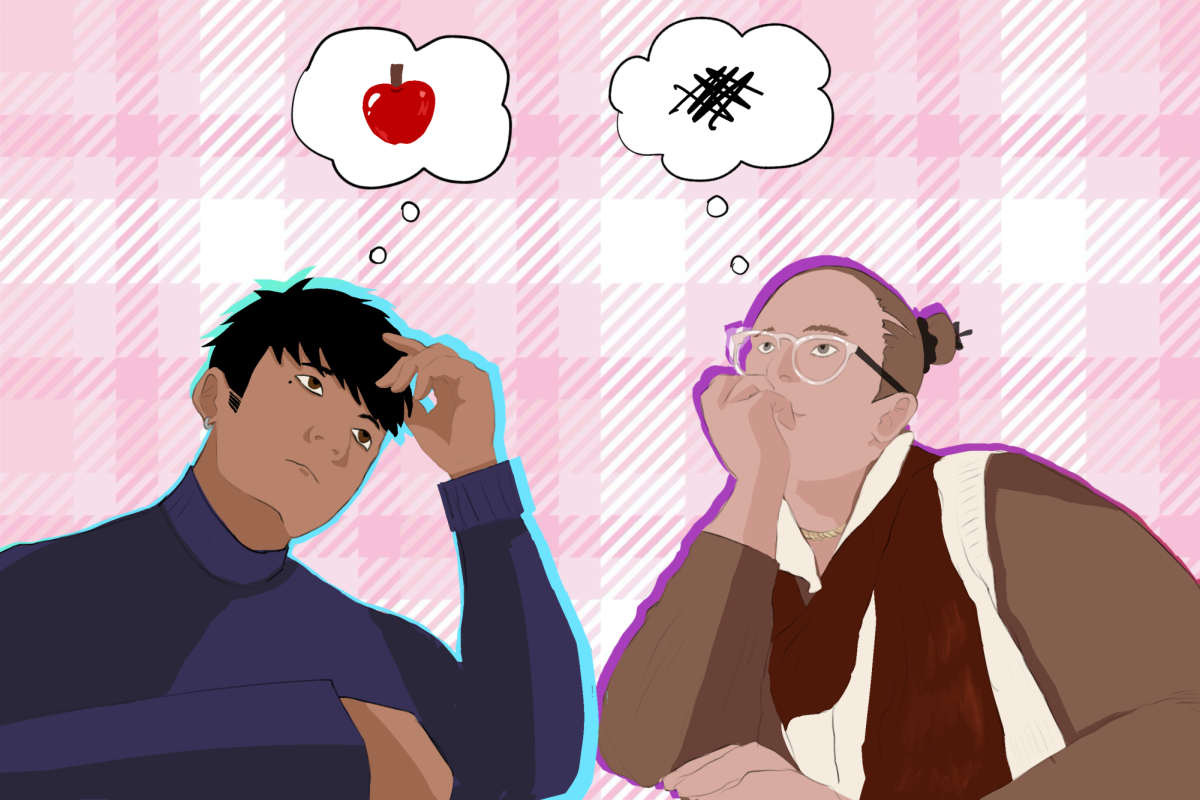
The most popular determination of whether one might have aphantasia is the discussion of the apple: Do you see an apple in your head? If so, how vividly?
Where this separates me from most other folks isn’t imagination — I imagine in my wordy brain — it really comes from memory.
Get The Daily Illini in your inbox!
I have never been able to relive a memory or relive an episode of events. A 2022 study, “Memories with a blind mind,” found that people with aphantasia have a “diminished ability to re-experience the past and simulate the future.”
Note that phrase, “re-experience”: not recall. For people without aphantasia, the idea of an event is not retrieving data, but mentally returning to where one was when they experienced it.
Episodic memory is where you are able to recall past experiences and are brought back to that exact experience. Imagine what it was like to ride a bike for the first time. Do you relive the feeling of getting it, balancing, panicking, maybe all the emotions overwhelming you?
But also note the phrase “simulate the future”: visualizing yourself doing well or being the best version of yourself, as all the self-help books instruct you to. I believe this was why hypnotherapy was not helpful to me, as it asked me to visualize myself as something else.
I don’t revisit memories; I simply know them.
That same 2022 study is where researchers found that while people with aphantasia might be able to recall fewer episodic details, they did not lack in sharing total details. Semantic memory is what people with aphantasia have the highest abilities in, so recalling facts or timelines rather than internal, more emotional details, that reliving the memory would ensue. People with aphantasia tend to experience memories by recalling the facts of the events.
This became personally apparent to me when I saw a video from The Korean Vegan where she shared the story of her first love. Her parents and church were nervous about her getting pregnant with this person, but her support systems failed to teach her how to guard herself from when “two fully clothed young people bare a little bit of their souls to one another.”
The examples The Korean Vegan provides of “baring souls” to one another was the act of sharing memories. This is very clearly a profound experience for her and the boy she was on a date with.
I was so puzzled as to why I found stories about myself not profound in this same way. It was really odd to find out that people relive those memories, and it can be an emotionally taxing or hard experience because they are going back in time and reliving that experience.
From my outside perspective, this kind of intimacy looks like letting someone else walk through that same experience with you, seeing what they saw and feeling what they felt all together. This is a type of vulnerability that I’ve never been able to understand.
My closest equivalent to that kind of intimacy is simply living. Being honest and not masking has been how I experience emotional intimacy in a lot of my closest relationships – maybe that too can be baring a soul.
My best friend and I have this clear understanding of presentness with one another, as they are also a person with aphantasia. I often call them and describe everything happening in my mind and body while I try to get the words out, particularly about school. They will sit there and listen, maybe make a snarky comment or two while I work through whatever I am doing.
We simply exist in the same emotional moment with one another. This is what intimacy looks like for me. I might not go back and relive memories with people or feel nostalgia in the same way, but I am brutally honest about my experience in the present with the people closest to me.
In that sense, I do not experience myself primarily as a past self or future self. Without the ability to mentally simulate the future or relive the past, my sense of self exists purely in the present moment, with life often feeling like standing still while others drift into other times to rehearse futures or return to moments that have come and gone.
Perhaps there is its own intimacy in that: not returning, but sharing the present exactly as it is.
Mary-Audrey is a freshman in LAS.