Here’s a secret: College is expensive. Whether you’re in-state or out-of-state, fresh out of high school or coming from a community college, there’s no question that the price tag called “tuition” is something to take seriously.
Luckily, the University is aware of this and has a variety of cost-free programs to make the most of students’ money.
Here are three free-for-students programs that you can get involved with to make your time at the University enjoyable.
Stress Management Program
The Stress Management Program, tucked away within the Health Education branch of the McKinley Health Center, is a highly active program for all students who may need support in tackling their day-to-day challenges.
Get The Daily Illini in your inbox!
Jeanine Bensken, stress management coordinator at McKinley, spoke passionately about the program’s various aspects and its goal to reach as many students as possible.
One of the primary facets of the program is its network of Stress Management Peers, students who learn stress management techniques for themselves, as well as how to help others manage stress.
Bensken and the Stress Management Peers hold tables at various campus buildings four days a week, providing a stress management theme of the week, resources such as self-care checklists and, most importantly, smiling faces.
“We are aiming for consistency and connection,” Bensken said about the program’s presence at tables around campus. “We know that connection and belonging are the number one student success factors, so (we are) helping students feel connected to something … The consistency of, ‘Hey, if you don’t know where to go, we’re here’ every week.”
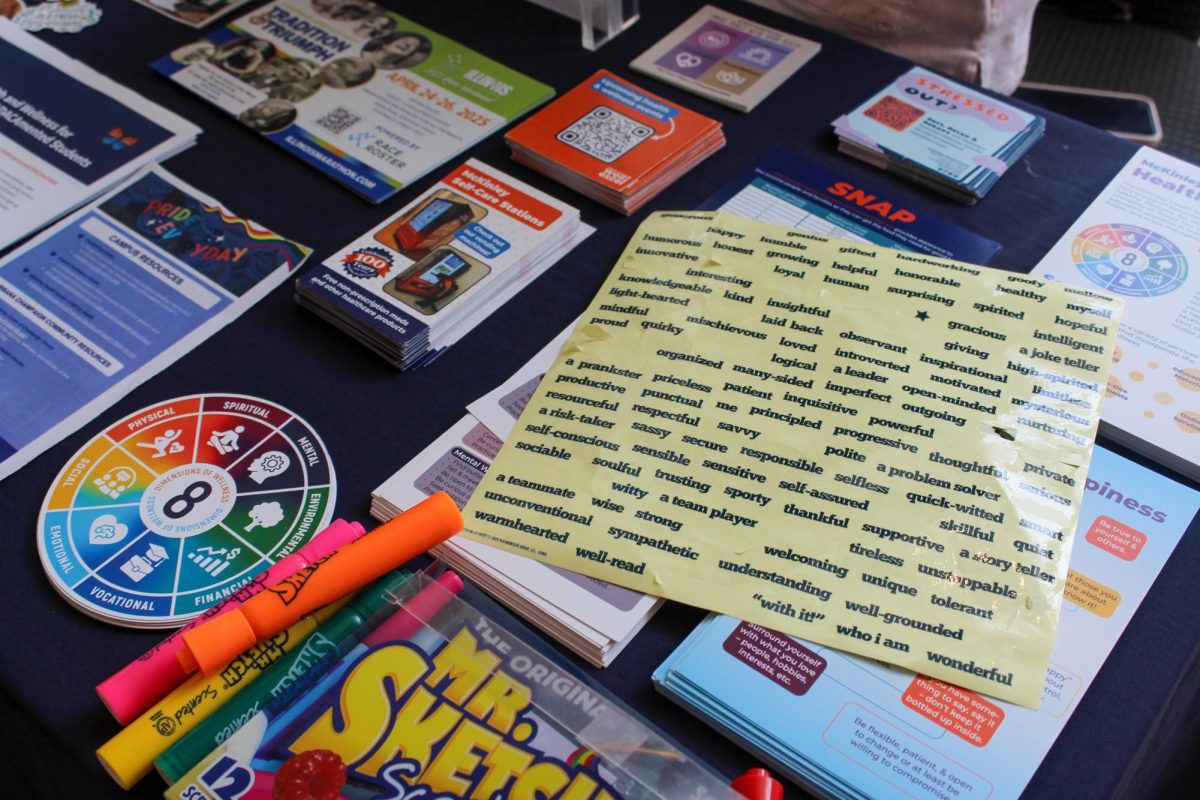
Spread across the table were a variety of resources, including a flyer with their weekly schedule and positive, uplifting stickers. The table also offered a plethora of mental health resources, such as a daily self-care checklist, a wellness wheel and QR codes for more mental health resources on the McKinley website.
As Bensken spoke about the program, many students passed by the table. Some stopped to chat with the Stress Management Peers manning the table, and others simply passed by with a smile. All these reactions are welcome, according to Bensken.
“Some (students) will walk past this table and kind of ‘side-eye’ it and be like, ‘What are you doing?’” Bensken said. “And then (they can) walk up and learn something.”
Bensken also said that over the past year, she has not had to do any recruiting for the Stress Management Peers.
“We’ll have people coming up to the table and saying, ‘Oh, I want to get involved, I want to help with this.’” Bensken said.
The Stress Management Peers meet every week to discuss how to best support students, including themselves, from a stress management standpoint. After being briefed on that week’s theme at their weekly meeting, these students run the tables along with Bensken, greeting passersby and passing out their stress management resources.
Furthermore, the Stress Management Peers have a monthly social event. While it is not an official RSO, Bensken wants students to feel welcome in all aspects of the Stress Management Program.
“(The Stress Management Program) is open to you, and you’re welcome,” Bensken said. “Come find what helps you. This is a vibrant campus, and we’re here to help.”
Writers Workshop
Over in the Main Library, the Writers Workshop has been helping students and faculty with all their writing needs for 35 years and counting.
The Writers Workshop is available to all students and faculty and does much more than check for grammar mistakes.
Carolyn Wisniewski, senior director of the Writers Workshop, wants students to know that they are there for more than just your basic essay.
Students and faculty can turn to the Writers Workshop for help with any piece of writing, including cover letters, poster presentations, and graduate or undergraduate theses.
Students can make appointments on the Writers Workshop website to meet with a Writers Workshop consultant. The consultants are undergraduate or graduate students who have been trained to assist students and faculty with all things writing.
“We have really student-directed meetings, so we’re not going to come and say, ‘You need to do x, y and z,’ but we’re going to ask, ‘What do you want to focus on?’ and then help you achieve that,” Wisniewski said.
The Writers Workshop is there to help at any stage in the writing process. Students can make an appointment with a Writers Workshop consultant before they have even begun writing, just to get some guidance in streamlining their ideas.
“Anything from coming up with ideas, getting an outline together, checking your thesis statement and argumentation, figuring out citations and integrating sources, to, of course, that final layer of polishing, we can help with,” Wisniewski said.
The Writers Workshop is ready and excited to help anyone on campus with all aspects of the writing process, regardless of prompt or skill level.
“I think sometimes there’s a myth that the Writers Workshop is only for, quote-unquote, ‘bad’ writers, but we’re for everybody,” Wisniewski said. “I like to say that we’re just the biggest writing cheerleaders on campus.”
Student Sustainable Farm
A bit of a trek from campus, the Student Sustainable Farm is located on South Lincoln Avenue and operates six acres of land to grow a variety of produce throughout the year.
While a bit less accessible to swing by, the SSF is an exciting resource that can be found only on a big campus that is surrounded by little but cornfields.
“I got started at a student farm where I went to college … and then just really fell in love with this,” said Matt Turino, director of the SSF. “It’s great to watch the whole process of planting things, taking care of it, watching them grow and then really being able to harvest it and present that to people.”
Any student can get involved on the farm as a volunteer, a hired staff member during the fall harvesting season or a summer intern.
As volunteers, students come to the farm between classes to help with all aspects of the growing and harvesting process.
“One of the nice things and challenging things about vegetable production is that there’s lots of different things to do all the time,” Turino said. “In the fall semester … it’s mostly harvesting. And then in the late spring, early summer, a lot of weed control and trellising and pruning tomatoes, things like that.”
As a volunteer or student worker on the farm, students get hands-on experience with all aspects of vegetable growing. Students learn about planting, harvesting and weeding, as well as how to sell produce during the SSF’s weekly farm stand, which runs each year from May to November.
The SSF also provides food for University Housing to serve in campus dining halls. As an employee or volunteer for the farm, students are directly giving back to their campus community.
“We can give the dining halls 100 to 150 pounds a week over the course of the winter,” Turino said. “And we do processing through the food science department to make pizza sauce. We’ll do a large (crop of) tomatoes in the summer to make pizza sauce, and that gets distributed to ISR.”
Having a direct impact on their immediate community is just one of the many benefits students can take away from getting involved with the SSF.
When asked about some highlights of his work as director of the farm, Turino proudly spoke of the education and experience that students get on the farm.
“It’s really rewarding to hopefully inspire the same kind of lightbulb moment that happened to me while I was a student worker,” Turino said. “I always feel like, even if you don’t become a farmer, hopefully you have a greater appreciation for what the process looks like and why vegetables might cost a little bit more at the farmers’ market than at the grocery store.”