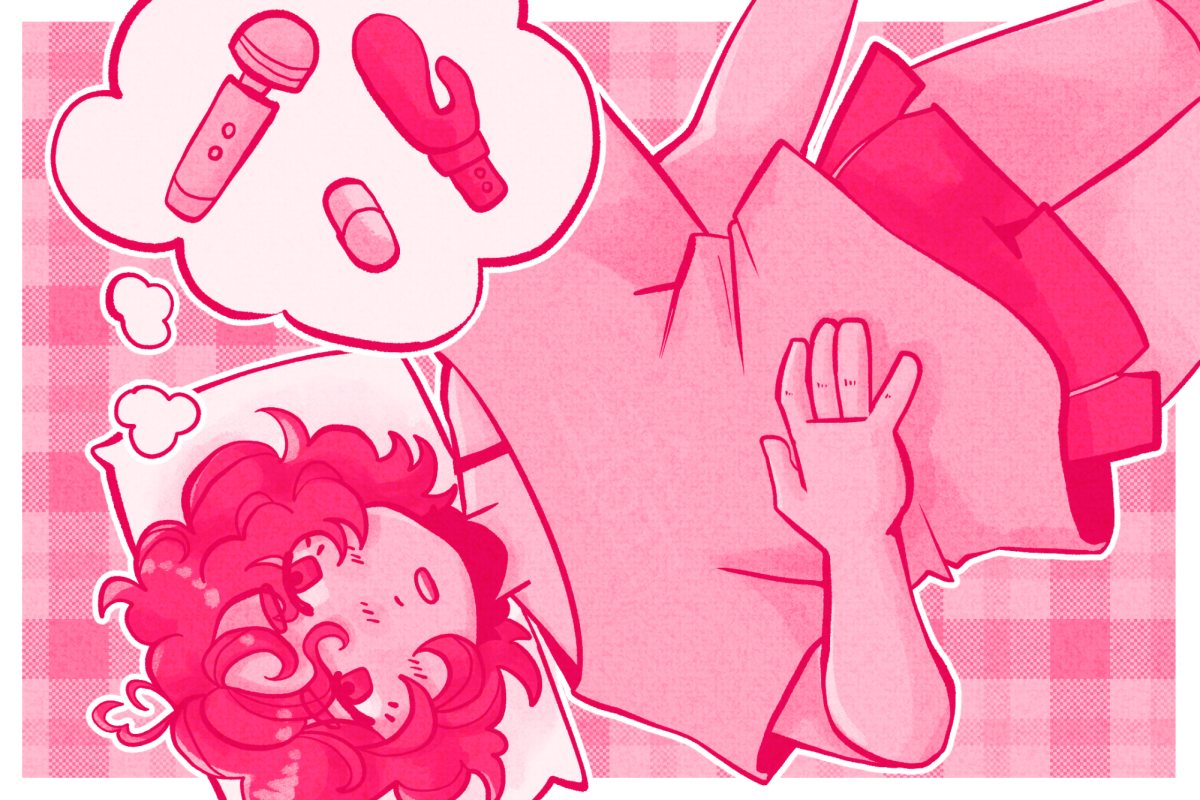
In Season 1 of “Sex and the City,” sweet, conventional Charlotte York is interrogated by her more sexually liberated friends about her apparent obsession with a vibrator called the Rabbit.
“It’s a vibrator, it’s not like it’s crack!” York argues fruitlessly as her friends confiscate it, saving her from “settling for herself.”
The scene, while humorous, frames masturbation as something to outgrow — a consolation prize until sex arrives.
Two decades later, that attitude feels dated, at least on screen. Masturbation is now often framed as self-care, empowerment and even wellness.
Among younger generations, talk of sexual health is more open, less hushed. On more progressive college campuses like the University’s, the conversation is practically institutionalized.
Get The Daily Illini in your inbox!
At the University, students are front and center of this shift. Paige van Meter, event coordinator for the Sexual Health Peers program at McKinley Health Center and junior in LAS, has participated in tabling events to promote open dialogue about sex.
“You’re talking to strangers about something pretty personal,” van Meter said. “So we’re moving towards figuring out ways to make it a more comfortable space and less stigmatized.”
As part of the program, McKinley offers everything from testing for sexually transmitted infections to safe sex supplies, hosting a space where they “meet you where you’re at.”
“I think the peers are really great at not being scary and making the topics be very open,” van Meter said. “Ask whatever you need.”
While efforts to normalize this dialogue are evident, to assume masturbation is casual coffee-shop talk for everyone would be naive. Stigma persists, shaped by religion, culture and gender expectations.
Yet there are voices in the community that are trying to push through these stigmas or taboos.
An example is the “Sex Positive God Pod,” a podcast co-hosted by Rev. Leah Robberts-Mosser, who pastors Community United Church of Christ in Champaign, and Rev. Jennifer Aull from Brooklyn, New York. In their first episode, aptly titled “What About Masturbation?,” they discuss self-pleasure within religion.
“The negativity about this comes from the idea that sex is only for procreation and that masturbation is a sin because pleasure is bad,” Robberts-Mosser said. “But that’s not what all Christian traditions believe.”
Guilt over the act, specialists argue, serves little purpose. Shame, whether due to considering masturbation “sinful” or “unhealthy,” only harms the individual.
The case for self-pleasure, from both a mental and physical standpoint, is stronger now more than ever.
Jenn Aardsma, a specialist in sex therapy in the Champaign area, considers masturbation essential.
“It’s part of an overall self-care package,” Aardsma said. “Relating well with your body, with your sexuality, also caring for your body in other ways as well, like exercise and a healthy diet. It’s all part of that combination of things that supports well-being.”
From a psychological perspective, masturbation can reduce stress, ease anxiety and improve sleep. Endorphins released during orgasm act as natural mood regulators.
It can also foster a sense of autonomy. Knowing one’s body builds confidence that carries into partnered relationships, Aardsma said.
Medically, the benefits are equally straightforward. According to Planned Parenthood, masturbation is the safest sexual act, posing no risk of pregnancy or STIs.
It’s also linked to muscle relaxation, tension release and improved sexual health over time.
And then there’s the benefit rarely defended in academic language: It feels good.
So, while masturbation may be a solo activity for many, it’s important to remember that in the pursuit of pleasure, you are not alone.
“It’s understandable why people would still wonder, ‘Am I normal? Is this healthy for me?’” Aardsma said. “There (are) still doubts and fears of whether the way we experience our sexuality is like someone else’s, and the answer is: It’s going to be yours. It’s going to be personally yours.”