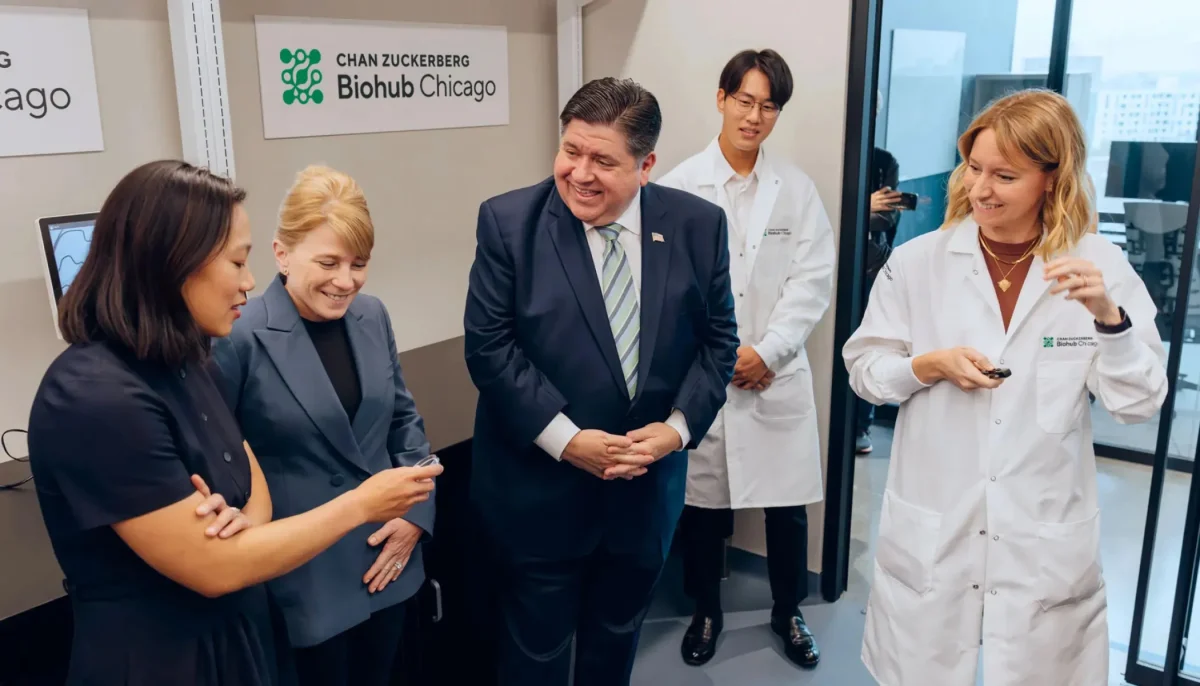
Since Priscilla Chan and Mark Zuckerberg unveiled their plan in 2016 to cure, prevent and manage all disease before the end of the century, the co-founders’ Biohub initiative has expanded to locations nationwide. Now, the initiative utilizes advancements in artificial intelligence to achieve this long-term mission.
After reviewing applications from institutions across the country, in 2023, the for-profit philanthropy organization selected Chicago as the location for the second Biohub. There, experts across disciplines from the University, Northwestern University and the University of Chicago work together to redefine biomedical research.
“We were the one team that they funded nationally out of over 50 teams across the country,” said Rashid Bashir, dean of The Grainger College of Engineering. “There is some history of the three of these great universities working together … and this was a great reason to come together to submit a proposal.”
Researchers at the Chan Zuckerberg Biohub Chicago focus on inflammatory responses, as 50% of all deaths are attributed to inflammation-related diseases. This includes forms of heart disease, stroke, cancer, chronic kidney disease and autoimmune and neurodegenerative conditions.
Gene Robinson, director of the Carl R. Woese Institute for Genomic Biology, said that despite differences in research culture, Biohub promotes cross-disciplinary collaboration between engineers, physicians and biologists.
Get The Daily Illini in your inbox!
“There (are) … different research backgrounds, and it requires some very specific forms of interaction to put the individuals together so that they can learn from each other and develop common goals and a common language … to be able to achieve those goals,” Robinson said.
Genomics, Robinson said, can provide researchers with early indicators about genes and molecular pathways involved in a particular biological process. Biohub then uses this information to develop a more targeted, engineering-based approach.
“(The hub) builds on traditional genomic research … but there’s the engineering flavor to be able to work at scale and to be able to create devices, new kinds of sensors, to be able to measure these phenomena and quantify them,” Robinson said.
From there, researchers work to manipulate and change the functioning of those biological phenomena.
According to Bashir, hub researchers are working on technology that could simultaneously analyze tissue in four different ways.
The first objective, Bashir said, is for the technology to be able to test on living tissue. He then emphasized the importance of accuracy for researchers to perform the tests incrementally over time. The final goal is for the technology to perform spatial measurements. This means the technology could measure several parts of the same tissue.
“The idea is to move in that dimension, to be able to achieve these four characteristics,” Bashir said. “This will really help advance the understanding of inflammation … and if (researchers) understand inflammation, then (researchers) can do something to mitigate it.”
Since its inception, Biohub expanded its research techniques to include AI, a crucial step, according to Bashir. He explained that the researchers’ goal is to develop AI that can perform measurements and provide data, then analyze inflammation on live tissue.
In a November 2025 press release, Biohub also announced the launch of the Virtual Immune System project, a flagship effort to model the human immune system using breakthroughs in AI and immunology.
“I think AI is certainly a tool that is critical to helping to advance understanding of biology as well,” Bashir said. “AI is now truly integrated across the technologies in the hub already, and a lot of work needs to happen in that dimension.”
Simulating immune therapies, reprogramming dysfunctional cells and preventing diseases before they arise are just a few of Biohub’s objectives. In another November 2025 press release, Zuckerberg said AI could accelerate these achievements.
“When we started, our goal was to help scientists cure or prevent all diseases this century,” Zuckerberg said. “With advances in AI, we now believe this may be possible much sooner.”