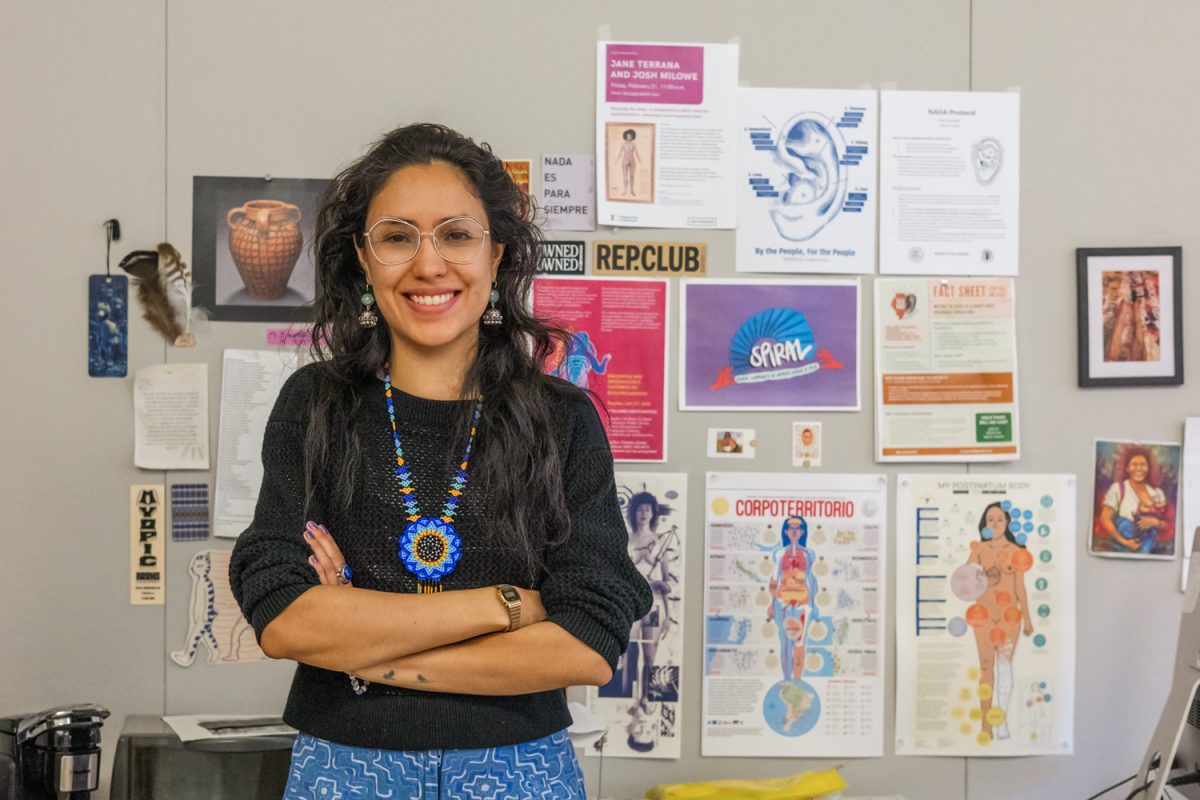
For years, women’s reproductive health research has primarily focused on the medical and anatomical spaces, limiting the psychological and emotional spheres that women’s health explores. Catalina Alzate, professor in FAA, is changing the narrative, merging her passion for art and design with her drive for community-based healthcare.
Her research emerges in the form of body mapping. During Alzate’s research events, participants can create their own body representations through collages, scan art, illustration and texturing. Participants draw and visualize sensations they feel in their body onto paper maps, exploring how physical sensations can outwardly appear through art.
Alzate works with doulas and home visitors in the Champaign-Urbana community to create body maps, producing tangible outputs of how bodies feel while working in those professions.
“I (have) already seen it every time we finish and we conclude with a participatory body mapping session, and people are in tears,” Alzate said. “They’re like, ‘I never imagined that my body had so much to say … and thank you for making me aware of that complexity.’”
Alzate, and one of her undergraduate research assistants, Maya Westbrook, senior in LAS, conduct qualitative research together, gathering insight and creating body maps with women’s health workers from the Champaign-Urbana Public Health District.
Get The Daily Illini in your inbox!
Westbrook’s research team works with the CUPHD’s GREAT Start program’s doulas and home visitors, who are intended for low-income families, as insurance typically doesn’t cover this service. She traveled with the doulas and home visitors to gain insight into the lived experience of these workers.
Westbrook said the project took her four days to complete. First, the doulas and home visitors drew their own individual body maps, representing the sensations in their bodies they feel while working.
One participant drew their heart emitting gold on their body map to symbolize the emotional toll and weight that being a doula takes on their body, according to Westbrook. While Alzate’s research group doesn’t strictly focus on doulas, they tailor their body mapping to each group of participants.
“Professor Alzate has already done a lot of this body mapping work,” Westbrook said. “So it was kind of seeing how we could adjust that to be more useful for the group that we were working with in the moment.”
The next day of research, participants worked together to draw a geographical map that showed how their bodies felt jumping between spaces. For Westbrook’s research, this meant documenting how the participant’s body and mind can shift, moving from offices at the CUPHD to a client’s home.
Westbrook also detailed how workers like these aren’t always respected in professional settings, because they reside in a middle ground between a social worker and a health provider.
“What we talked about on (the second) day also was the doulas saying, ‘When we show up to the hospital with our clients, we’re not really taken seriously,’” Westbrook said. “‘Some nurse midwives or obstetricians feel like we are kind of more of a nuisance when, really, we’re just part of the birthing team.’”
Alzate wants her research to help health professionals in the women’s health and reproductive justice field understand how their bodies work in nuanced settings, like being a doula or home visitor.
She also emphasized that academic research should have a large focus on the communities that it serves, creating meaningful impact.
“Supporting them … dedicating University resources to make the experiences meaningful to (the doulas and home visitors), making sure that the research is not only helping me publish my papers, but that they see the value,” Alzate said. “That’s what I want to see academia doing.”