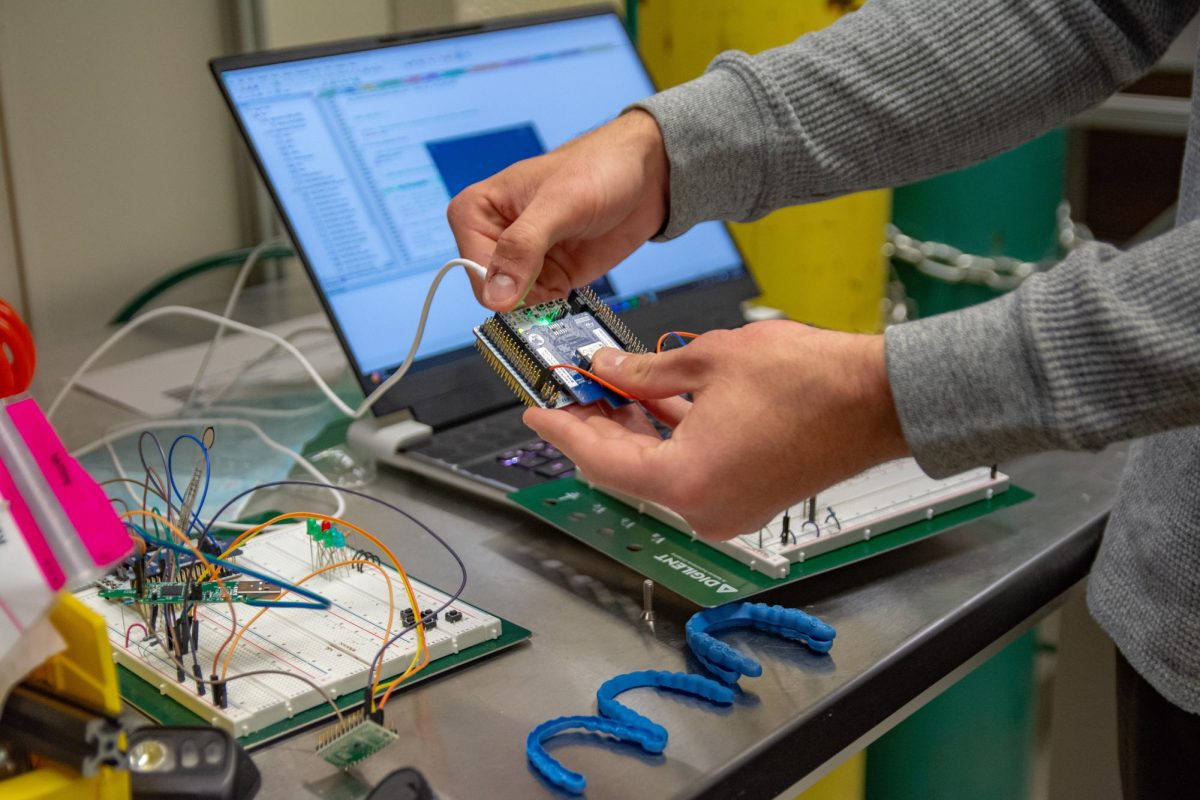
The Kriven Research Group, based at the University and led by Waltraud Kriven, professor in Engineering, is one of the world’s leading research teams in ceramics. Kriven has six United States patents and two more in the works.
The group has been funded by the U.S. government and has discovered ways to make ceramics with less energy. It has also worked with high-profile clients like Microsoft.
However, the most impressive thing the group has done might just be its work with geopolymers, which, for the last 25 years, Kriven and her team researched.
“They’re inorganic polymers,” Kriven said. “Normal organic polymers are organics, but these are inorganic polymers. They’re a potential partial solution to global warming.”
A polymer is a large molecule made up of many smaller subunits, called monomers, that make up a chain. Geopolymers are diverse building blocks for an assortment of different materials.
Get The Daily Illini in your inbox!
Microsoft employed Kriven to help design a cloud building, a structure housing large arrays of computers. Microsoft wanted to use geopolymers for the walls because they can stop electromagnetic pulses, protecting the computers.
Geopolymers can help create fire-resistant coatings, and they can shield against nuclear radiation, gamma rays and neutron rays.
“Gamma is hard to stop, and that’s what we’ve managed to achieve,” Kriven said.
The applications don’t stop there. Geopolymers can be used to encapsulate radioactive waste and store molten salt to create thermal energy, which can be used instead of burning coal. They can stop metal from eroding and be used to stick different metals together.
Porous geopolymers, which are treated with a foam agent to create pores, can remove arsenic from water, helping developing countries get safer water.
The most prevalent application — and perhaps the most beneficial — is how geopolymers can be used as a concrete. Kriven thinks it could replace Portland cement — the most common type of cement made from limestone and clay — in the future.
“Don’t tell them where my office is,” Kriven said. “But Portland cement could be replaced by geopolymers.”
Producing cement releases carbon dioxide, harming the environment. One ton of Portland cement releases one ton of CO2. One ton of geopolymer production releases just a quarter of a ton. Kriven and her team are working to get that to zero.
As it stands, 8% of the world’s CO2 emissions come from cement manufacturing. Postdoctoral research associate Pozhhan Mokhtari believes geopolymers can fix that problem.
“What we are making out of the geopolymer can perform better than cement, with, I believe, zero CO2 emission,” Mokhtari said.
That’s not the only benefit of the geopolymer cement. Mokhtari said the cement used for buildings now can last around 100 years; the geopolymers can stand for thousands.
However, there are problems with getting geopolymers standardized. Kriven said the cement industry likely doesn’t want to be disturbed. It could take time for it to come around.
“That industry needs to be a bit more developed and nudged along,” Kriven said.
The biggest problem is the cost. According to Kriven, the cost of the alkalis sodium hydroxide and potassium hydroxide — ingredients for geopolymers — is what’s holding the technology back.
Since the cement industry is large, it’s easy for companies to manufacture the product. They make money, so they likely won’t change their ways, according to Mokhtari. However, he said, if researchers can get geopolymers on a production line, they would be able to make it more affordable.
It’s easier said than done. Cement manufacturers won’t be easily convinced to halt their production and make a change. It could dig into their profits.
“It’s possible to make it more accessible and more affordable than cement, but we need someone … (to) invest in this material,” Mokhtari said.
For now, Kriven and her research team continue to find ways to reduce the CO2 levels from geopolymers. They are still trying to find ways to get the cost down. Even so, it could be sooner rather than later that geopolymers replace cement as a household name.
“I guess, in 20 years’ time, the geopolymer (is) going to take its place,” Mokhtari said. “This is what I hope.”