Researchers at The Grainger College of Engineering have made a major breakthrough toward building future quantum networks. In a paper published in the research journal Nature in September, researchers in the lab of Jacob Covey, professor in Engineering, detail their work with quantum networking.
Quantum networking is a communication technology that works by sending quantum information, or “qubits,” between nodes. Quantum networks have a level of capability and security not possible with conventional networks.
“Quantum communication generally deals with exchanging information,” said Simon Hu, graduate student studying physics and one of three lead authors on the paper. “It takes a specific protocol, specific setups, to actually distribute our information over long distances, and so … our paper here sort of demonstrated a more efficient way, and perhaps a more scalable way, to implement networking between different places over long distances.”
The research focused on “high-fidelity entanglement” between optical photons and ytterbium-171 atoms. Ytterbium, a rare earth metal in the lanthanide series, is instrumental in much of quantum physics due to its unique atomic properties.
“The problem of all the old-fashioned experiments, basically what they do is generate a pair of entangled photons, and … there’s nothing more,” said Lintao Li, postdoctoral research associate and lead co-author. “So what we really want to do is to further get some kind of interaction between the photon and our system. So, basically, you can make use of the entanglement on the photon states.”
Get The Daily Illini in your inbox!
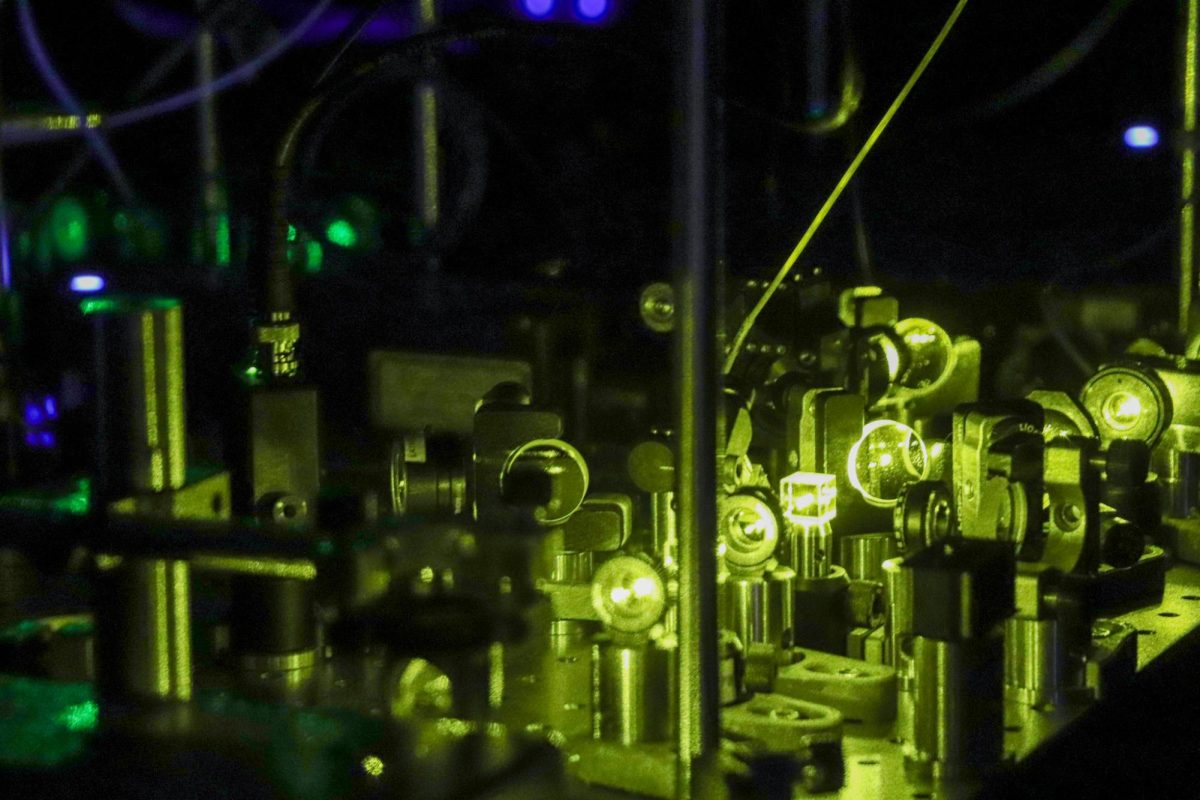
After generating entanglement, the arrays of atoms were then imaged on an optical fiber array to show a networking protocol that could eventually be integrated into scalable quantum networks. The parallelized setup of the atom arrays meant that multiple entangled atom-photon pairs could be used at once, which is a key ingredient for scaling up to larger networks.
Many quantum systems use photons in the visible or ultraviolet spectrum, but long-distance networks operate best in the telecommunication band — a specific range of radio frequencies. Converting between wavelengths usually leads to information loss, introduces noise and limits performance. Covey’s team avoided that by generating the entanglement directly in the telecom band, preserving the coherence of some qubits meant for memory, while others meant for communication were free for their own tasks.
“It’s related to the two core parts of distributed quantum computing,” said Gloria Jia, postdoctoral research fellow and co-lead author. “First, you have to have good nodes, and second, you have to have good, high-value connections between nodes. So we’re sort of done with the connection part, and now, we’re focusing on the single setup. How can we achieve good performance of the qubits trapped within a single system?”
The publication acknowledges there were some limitations within their work. One is low photon collection efficiency, which slows down the rate at which researchers can build entangled links. The researchers suggested that, in further experiments, this rate could be improved by adding an optical cavity to the process. The experiment discussed in the research paper, known as YB1, is being succeeded by further trials on a YB2 array — also hosted in the college’s labs but led by other researchers — which plans to include an optical cavity.
“There are major hardware upgrades,” Hu said of YB2. “They have this optical cavity set up to really enhance the rate at which the photons can be collected out of the system, which ultimately leads to an increased rate of communication between different nodes. That’s sort of the future outlook of this. And that second setup is also happening here.”
As for further applications of the research, the team said that they hope their work can be used in future quantum computing, going toward scaling larger quantum networks.
“In the end, hopefully we can get … many good quantum processors and between any of them are connections by high-fidelity entanglement,” Jia said. “Just to have a good, big distribution on a computer.”