After a full day of classes and running around campus, the only leisure time for college students is at night. By finding a fun activity, they can unwind and hit the reset button.
When most people hear the term “college nightlife,” they tend to think of partying. However, the nightlife is a whole spectrum, which could be outdoor or indoor. The outdoor scene could include sporting events, theatre productions, and formal dinners. The indoor aspect is mostly you staying in your dorm, watching a sporting event or catching up on your favourite shows.
In recent years, however, college students across Canada have been able to strike a balance between outdoor and indoor nightlife. A perfect example is online casino gaming, which brings players’ favourite slots and card games right to their rooms. Students are now transitioning from binge-watching TV shows to enjoying a good game of blackjack for leisure.
The driving force of this trend is a blend of entertainment, social connection, and cognitive engagement. Read on as we break down this fascinating topic.

Get The Daily Illini in your inbox!
Tabletop Blackjack vs. TV: What’s Behind the Shift?
Those who have never sat at a blackjack table (physically or online) might see it as just a game. However, it’s more than that, and can best be classified as a social event.
Unlike passive TV watching, blackjack requires active participation. This includes strategic thinking, such as developing tactics to effectively use promotions such as the Mr Fortune no deposit bonus offer. There is also real-time interaction with peers, which could be your friends.
Another aspect is the simplicity of the game, irrespective of the variation. This can’t be said for movies or TV series, as some might be a total waste of time. For blackjack, the aim is to get as close to 21 as possible without going over. This makes it accessible to newcomers.
Lastly, studies show that college students’ recreational screen time is unhealthy. The average is about 6 hours. By opting for tabletop blackjack, you can reduce your screen time. A gaming session tends to take less than an hour, unlike spending hours watching different series episodes. Also, within the gaming sessions, there is social and cognitive engagement.
Social Benefits of Building Community Around the Table
In the gaming ecosystem, few experiences are as social and community-driven as blackjack. The goal should be to win; however, it’s about the atmosphere for a college student. They see it as a place to interact, bond, and share moments.
Here’s a look at two aspects in which a community is built around the virtual table:
Face-to-Face Interaction
You’re probably wondering how this is possible if the game is online. Certain gaming sites offer a live dealer section. Here, players can stream the gaming session and communicate with one another. However, this doesn’t fully offer face-to-face interactions.
For in-person encounters, students can gather in groups and connect. A good spot for hosting gaming sessions could be the dormitory’s lounge. Such meetings are welcome breaks from excessive screen time isolation.
Stress Relief and Emotional Well-Being
Academic pressures can be overwhelming. However, gaming activities like blackjack offer a proven method for stress relief. Studies indicate that both video and tabletop games can reduce anxiety and promote relaxation. This becomes better when it happens in a social setting, as it:
- Provides a safe space for stress relief
- Encourages teamwork and communication
- Builds friendships and campus community
Cognitive and Educational Benefits of Blackjack
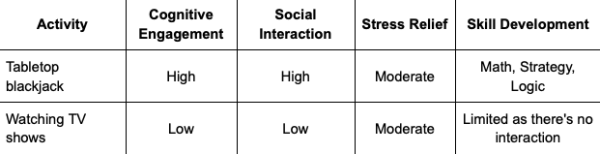
Blackjack is not just about luck; it’s a game of strategy and quick decision-making. Players must calculate probabilities, assess risks, and adapt their tactics on the fly. This enhances mental arithmetic, logical reasoning, and cognitive flexibility.
The game environment also allows students to experiment with strategies. You can’t be successful every time. However, you can learn from the unsuccessful moments. This helps you improve over time.
These lessons can be applied to your academics and real-world scenarios. You don’t stop until you get it right! That said, the table below compares the cognitive benefits of playing blackjack or watching a TV series.
Why Not Just Watch TV? The Limitations of Passive Entertainment
As a student striving for good grades, it’s easy to get lost in a world of passive entertainment. TV shows are no doubt great ways to relax the mind. However, they lack an engagement level that stimulates personal growth. This can be detrimental for college students, who may find themselves zoning out. Additionally, excessive TV watching could affect day-to-day activities and lead to increased feelings of loneliness.
If not controlled, TV can also affect academic performance. We live in a digital age, where access to our favourite shows is in the palm of our hands. All that’s required is to download the mobile application of the streaming platform. With such access, you could become distracted. Rather than focusing on the lecturer in the “boring class,” you could be enjoying an episode of Squid Game or catching up on the Marvel Cinematic Universe (MCU).
The only solution is to find a balance between leisure and your academic life. An activity that gives you enough screen time alongside a social experience is recommended. This way, your mind stays sharp while you have fun. We aren’t asking you to quit watching TV shows, but rather showing you why students have been switching to tabletop games like blackjack.
How to Organize a Tabletop Blackjack Night on Campus
Want to get on the bandwagon and join other students enjoying blackjack? Here are practical steps to get you going.
- Gather a group: Invite friends or classmates over. However, they are to have a knowledge of blackjack or be interested in learning.
- Set the rules: There are numerous blackjack variations. Select a familiar one or tweak it to make the game more fun.
- Create a welcoming atmosphere: Provide snacks, music, and comfortable seating. The goal is for everyone to feel at ease while they enjoy tabletop blackjack.
- Keep it friendly: Emphasize fun and learning rather than competition. If possible, play with made-up currencies. This way, everyone has a positive and engaging experience.
- Explore online resources: Practice makes perfect, they say. You can hone your blackjack skills by playing demo versions on websites such as Slotozilla. After developing the right skills, you can play with real stakes.
Conclusion
Tabletop blackjack offers college students a unique blend of entertainment, social connection, and cognitive challenge. This can’t be matched by television, which used to be the go-to leisure activity for most students.
Rounding off, you have to be the legal age to engage in blackjack if money is involved. However, we don’t advise students to engage in gambling. Take the money out of the game and have as much fun as possible.