Team USA looking for redemption in Beijing
Jul 11, 2008
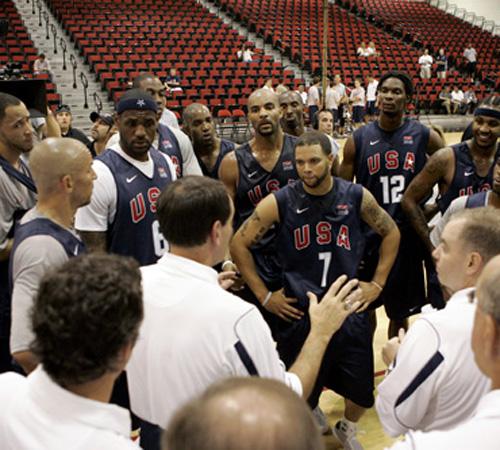
Sooner or later, people will stop measuring every U.S. Olympic basketball squad against the Dream Team.
U.S. coach Mike Krzyzewski is hoping it’s sooner.
“There’s only one Dream Team,” said Krzyzewski, an assistant coach on that fabled squad. “That was ’92. The mistake that our American people make is calling every team after a ‘dream team.’ This isn’t Rocky I, II, III and IV.
“It’s Dream Team I forever – and then the next teams have to get their own identity,” he said. “This team will work at developing its identity.”
A lot has happened in 16 years. Michael Jordan, Magic Johnson, Larry Bird and friends have moved on. More important, the world has caught up to the United States in the game it invented.
Get The Daily Illini in your inbox!
In its last three major international competitions, the U.S. has brought home two bronze medals.
To put that in perspective, consider that Lithuania won the bronze in 1992. The Americans beat the Lithuanians by 51 points in the semifinals.
The 2004 U.S. Olympic team lost three times on its way to third place. The Americans had lost two games, total, in the previous 14 Olympics.
That’s not a dream, it’s a nightmare.
The mission for this team as it goes to Beijing? Simple. Restore what Americans believe is their rightful place atop the international hoops podium.
“It is redemption,” said guard Dwyane Wade, one of four holdovers from the 2004 Olympic squad. “That’s what it is: a road to redemption. 2004 was a hurt year for a lot of us – not for just the players but for the world. A lot of people were hurt by it. So this is a redemption year. This is to let our fans (know) that we’re the best in basketball still.”
It’s one thing to say it. It’s another to prove it.
“They’re expecting us to just walk on the court and just win the game,” said forward Carmelo Anthony, another 2004 Olympian. “We’ve got to work at it. Nothing’s going to come easy for us.”
The Americans lead the world in sneaker commercials. But when it comes to international (read: team) basketball, they have slipped into the pack.
And let’s define “pack” as Puerto Rico, Greece, Argentina and, yes, Lithuania, all of whom have defeated the U.S. in major tournaments in the last four years.
The U.S. taught the world basketball. Now, in a bit of irony, it is trying to learn from the top international programs, which have long stressed continuity and roster stability.
That’s why USA Basketball managing director Jerry Colangelo, the former Phoenix Suns owner, demanded a three-year commitment from players when he took over in 2005. He knew the U.S. approach – drafting an all-star team, getting fitted for uniforms and then heading into competition – no longer worked.
“I have always been a firm believer that basketball is the ultimate team sport and that the more you play with one another, the better you can become – and that a good team can beat a group of all-stars,” Colangelo said.
Greece made that painfully clear in the Americans’ most recent major international competition, when it defeated the U.S. 101-95 in the semifinals of the 2006 world championships in Japan.
“I think we showed everybody that maybe we’re not very good athletes like them, but we know how to play the game,” Greek guard Theodoros Papaloukas said afterward.
That loss taught the Americans a couple of valuable lessons.
First, they realized they needed more shooters. The Americans shot 50 percent from the floor that night, but only 32 percent from beyond the arc.
The U.S. believes it addressed that problem with the addition of Michael Redd, a career 44 percent 3-point shooter in international play, as well as Kobe Bryant, who shot 45.9 percent from beyond the arc in last year’s Olympic qualifying tourney.
Second, the Americans realized they needed to defend the screen-and-roll, a staple of the international game. The Greeks used the play to create wide-open lanes to the bucket and wide-open looks on the perimeter, shooting a stunning 63 percent from the floor.