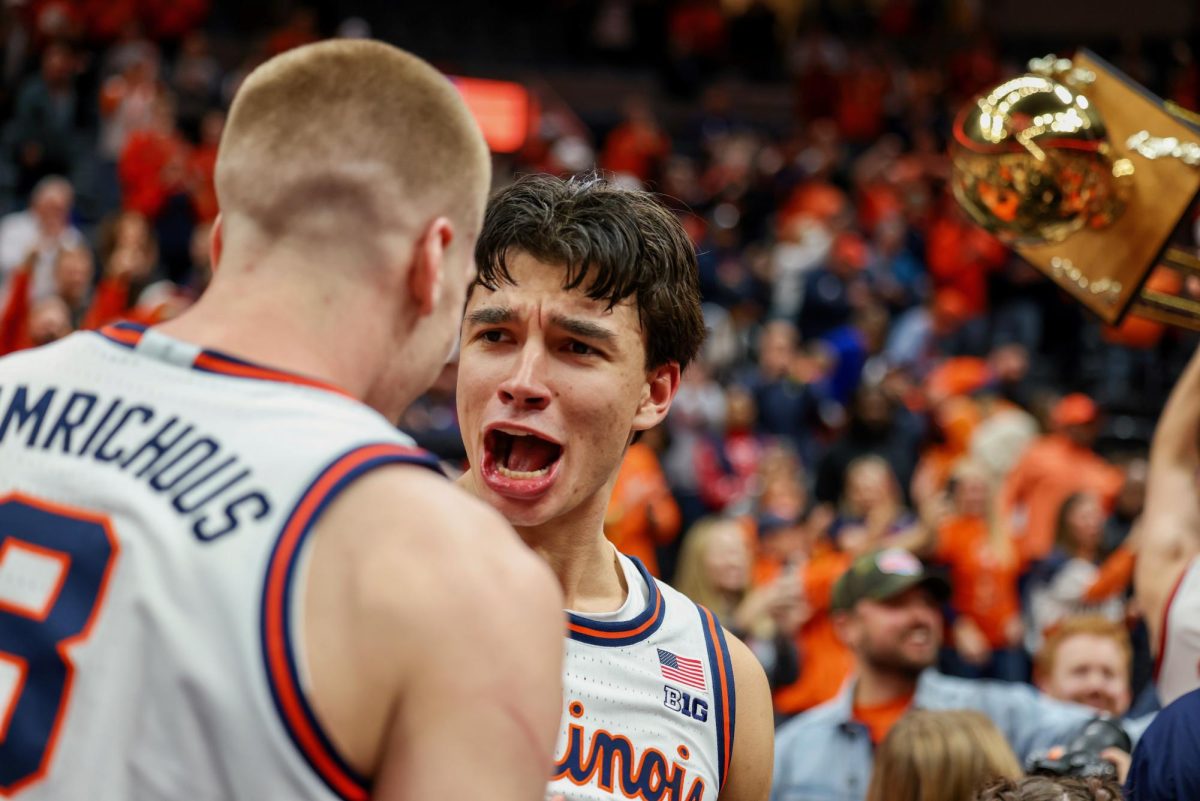
Twelve men and 12 women typically stand in orange and blue rooting for Illinois at basketball games, football games and other events. They chant “ILL-INI” for everyone to hear, run an Illinois flag through the Assembly Hall at basketball games and do push-ups for every point at football games.
The cheerleading squad is a staple for Illinois sporting events, though there is one thing they always need more of: male cheerleaders.
“We always have an equal number, and sometimes it can be hard,” head coach Stephanie Record said.
During February, the squad is holding open clinics to promote the squad and give students — males in particular — the opportunity to see what the cheerleading team is all about.
“A lot of guys are intimidated, they are just scared to try out,” assistant coach and former cheerleader Drew Sullivan said. “When they come here they aren’t committing to anything. You can bring friends, just come and see what it’s like. You can come once and never come back again.”
Get The Daily Illini in your inbox!
The clinics take place on Tuesdays during February — one was held last Tuesday and the next two will be held on Feb. 15 and 22 from 6:30 to 7:30 p.m. in Huff Hall. Those interested need proof of a sports physical in the last sixth months.
Sullivan and junior Max Wichmer, who is in his second season as a cheerleader, each became interested in joining the squad after attending clinics.
“Going into college, I never imagined that I’d be a cheerleader,” Wichmer said. “My whole town was surprised, but they got used to it.”
During the clinics, participants meet the current cheerleaders and see what being a team member entails. The males get to work stunting — holding up or tossing the female cheerleaders — and everyone gets to see if their skills are up to par.
The females who participate have usually only been on non-coed squads, where three women are used for stunting. In a coed squad, one male lifts one female up.
“It’s different cheering with males because the body placement is different and you need to learn a different technique,” said Staci Clabough, a sophomore in LAS who is planning on trying out for the team. “Going to the clinics helps you for tryouts because it’s not as intimidating and you can learn some skills before you try out.”
During last week’s clinic, two males attended but did not have the correct physicals to participate. Record hopes to get more participation in the coming weeks because she said the clinics are the best chance for someone to decide whether cheerleading is a worthwhile opportunity for them.
“There’s no commitment to just coming in and seeing what it’s all about,” Record said. “There are a lot of stereotypes associated with being a male cheerleader but when the guys get in here, they see that it is something athletic and challenging. Once they get in here, they usually get hooked.”
Sullivan said most of the male cheerleaders never cheered before but are instead former athletes who were looking for a way to stay fit or have a good seat for the Illini games. Sullivan, for example, had plans to walk on to the football team.
When that didn’t work out, he decided to become a cheerleader.
“It’s pretty hard athletically because it’s just you and the person you’re throwing,” Wichmer said. “At first you’re scared you might drop someone because you don’t really know how to catch. But once you get the muscle memory and get a little more experience, if somebody falls you usually can catch them pretty safely and set them down lightly.”
One reason the need for male cheerleaders is so large is that Record hopes to up the team’s skill level so it can return to competition — something the squad has not done in several years. Because competing is expensive, Record said she would like a larger squad, having up to 16 pairs.

“We want to get a full team and we’re constantly in the rebuilding phase,” Record said. “We want to get the team built back up so we have the people that can go and compete.”
Members of the squad receive many perks of being a Big Ten athlete, such as apparel, funding for time with the events and access to Irwin Academic Center. The time commitment is three practices a week and three times lifting weights each week.
The team cheers at all home football games and men’s and women’s basketball games, as well as at some away games. The team travels to postseason games, such as the 2010 Texas Bowl.
“Being on the sidelines for some of the biggest moments in Illinois sports has been awesome,” Sullivan said. “I got to be right there when Illinois beat Arizona in the Final Four run and when we went to the Rose Bowl. These are opportunities you wouldn’t get any other way.”
Official tryouts for the squad are held April 9-10, and people who attend the tryout weekend are usually committed to being on the squad for a full year.