College basketball is in an ever-changing state right now. The latest development: NBA G League players in the NCAA. Santa Clara junior guard Thierry Darlan and BYU sophomore center Abdullah Ahmed each played two seasons in the G League, while London Johnson – a three-year G League veteran – will play next season for Louisville after redshirting this year.
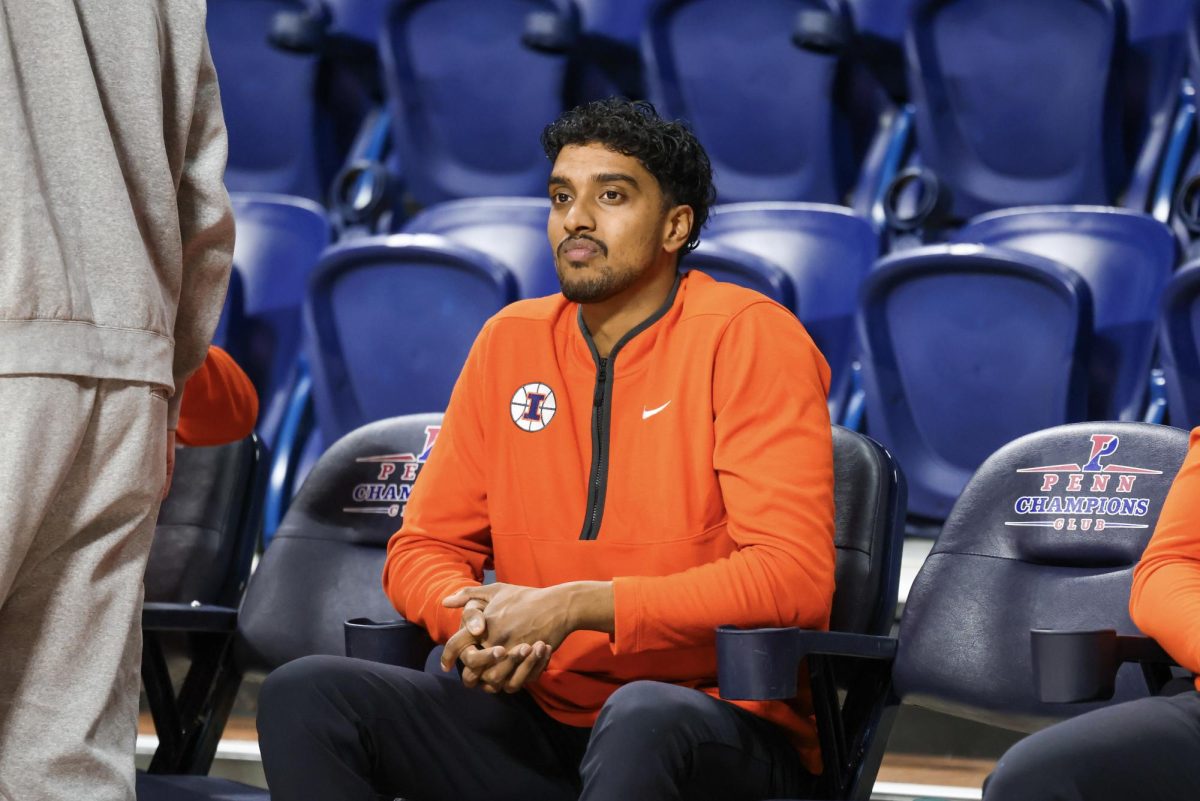
While these new developments are unprecedented, Illinois is uniquely prepared for the situation because of its general manager, Neel Ganta. Ganta previously worked in player development for the G League’s Grand Rapids Gold and in the scouting and analytics department for the Denver Nuggets. The influx of G League players into the NCAA is not something Ganta expected, but it’s quickly becoming the new norm that college programs have to adjust to.
“It’s pretty crazy to me that we’re talking about guys or agents are reaching out to me about guys that I remember scouting four years ago (in the G League),” Ganta said.
Illinois head coach Brad Underwood has made his position clear on the subject: He thinks “it’s wrong.” However, Underwood acknowledged that if this is the new reality, he may be forced to adapt and look into it just to stay competitive with other teams. Ganta is approaching the issue with that same mindset: If it’s legal, it has to be considered.
“I think it’s definitely important to cast the widest net possible,” Ganta said. “So, for me, if it’s possible, it’s something we should look at. Not necessarily looking at the ethics of it, whether it’s right or wrong, whether we like it or not. Is it possible or not?”
Get The Daily Illini in your inbox!
As of now, the NCAA has only drawn one line: any players who have signed an NBA contract, of any type, will not be allowed to play college basketball. That is currently being challenged by former Alabama center Charles Bediako and former UCLA star Amari Bailey, who are in legal battles with the NCAA to become officially eligible for college again. Both players have spent the last few years in the G League, but they’ve each signed a two-way contract, and Bailey has actually played 10 NBA games.
These developments follow the NCAA granting eligibility to the 31st overall pick in the 2023 NBA draft, James Nnaji, because he hadn’t been in college before and played in Europe instead of signing any NBA contracts. Whether it’s former G League players, NBA draft picks or players who have signed NBA deals, these cases represent the gray area that Ganta is preparing for – where the question of eligibility is not about ethics, but legality.
Ganta will only look at players if they are deemed eligible. However, that does not mean he will necessarily end up pursuing those players. At the end of the day, he wants to find pieces that will help Illinois be the best it can be. Many of these former pros, especially those who have played in the G League, may not be the best pieces to impact winning at the collegiate level in Ganta’s eyes.
“To me, I think my concern is more about (the players) having been in the G League,” Ganta said. “The biggest difference between the G League and college is the incentive to win basketball games. I think it’s very non-competitive in that sense. I don’t think it really matters to players there if you win or lose. It’s about your personal development, getting to the NBA. So, to me, I don’t think it translates very well.”
Although it’s a relatively small sample size, with G League players only being active in college starting this season, Ganta may be right. The initial results of G League players in college basketball have been far from standout.
At Santa Clara, Darlan is averaging 6.3 points and 4.1 rebounds while coming off the bench. At BYU, Ahmed is averaging only 2.4 points and 4.1 rebounds while also mostly appearing off the bench. Although he never played in the G League and only competed overseas, Nnaji is only putting up 1.4 points and 3.3 rebounds at Baylor. Many thought he would provide an unfair advantage – because an NBA team believed he was good enough to draft – but that has not been the case.
There haven’t been enough G League players in college yet to see if any will translate into high-impact pieces. However, more American pros continue to show interest in the college route, so that answer may come sooner rather than later. Multiple other former G League players, including Kok Yat, Kyree Walker and Zaire Wade, have also been in contact with college programs. It was also recently revealed that current G League star Dink Pate has rejected two-way contract offers to preserve his NCAA eligibility for a potential move to college after this season.
Even if one of these players does become a star, traditional pathways are still producing players that dominate the game, and that won’t go away. Just last weekend, three freshmen – BYU’s AJ Dybantsa, Illinois’ Keaton Wagler and Houston’s Kingston Flemings – scored 40-plus points on the same day, which underscores the value that recruiting high school players still offers.
Ganta’s mindset is all about winning. If G League players will impact winning, he will look at them. If it’s true freshmen or international players, he’ll approach them. It’s a business. Ganta will consider whoever can give Illinois the best shot at competing for a national championship, as long as the NCAA legally allows that player to compete.
“The question is, what is the market for these players?” Ganta said. “Do they make sense for us? Will they impact winning for us? That’s how I look at it. If the answer is no to those, they wouldn’t help us; they wouldn’t impact winning. I’m just moving on, but I’m definitely not ignoring it. It’s another potentially untapped market of players.”
Illinois is no stranger to having pros on its roster. The Illini have been a leader in tapping into the European market of players. They brought junior center Tomislav Ivišić, sophomore guard Mihailo Petrović and freshman forward David Mirković to Champaign from Europe after they all had professional experience.
Because of schools like Illinois that have bolstered their lineups with international pros, many have argued that bringing in G League pros is no different. Ganta is not focused on the separation between the two from an eligibility standpoint; that is up to the NCAA and the legal system. Again, he is more focused on the impact of those players, and he believes that the European system produces players who are more conducive to winning college games.
“Players from Europe or overseas, they’re playing in leagues where winning is incentivized,” Ganta said. “I think the G League is still coming along with the Showcase Cup and stuff like that, but it’s not all the way there in the real life. Winning matters.”
Even with all of the negativity directed towards these new cases from fans, the media and coaches alike, Ganta believes that there is a positive that will arise from the situation. G League pros who are choosing to come to college are doing so because their careers haven’t reached the level they had either hoped or expected. Now, at an older age, they are coming back to college – whether that’s for additional development or financial reasons – which reinforces the idea that turning pro so young is not always the best avenue. Staying in school and getting more experience is becoming more attractive, which, in turn, helps college teams develop continuity.
“With the Nuggets, what we did, we prioritized guys, usually older guys, who showed an ability to win,” Ganta said. “Christian Braun (is) probably the biggest example. First round pick for us was three years in college, won a national championship, won in high school. … College players develop and get better in college. They can show they can win. In the current CBA and the NBA, they don’t have long runways. They need to hit on players immediately. … I don’t think we’re seeing as many guys rush themselves into the league early for no reason now. I think guys would be incentivized to stay in school, which helps everybody, right?”
All in all, there is no easy answer and no consistent set of rules for judging any pro-to-college situation. Each one is different and provides a new wrinkle to debate. Illinois senior guard Kylan Boswell summed it up simply when asked his opinion on the issue.
“That s—’s crazy, I’m not going to lie,” Boswell said.
@sahil_mittal24