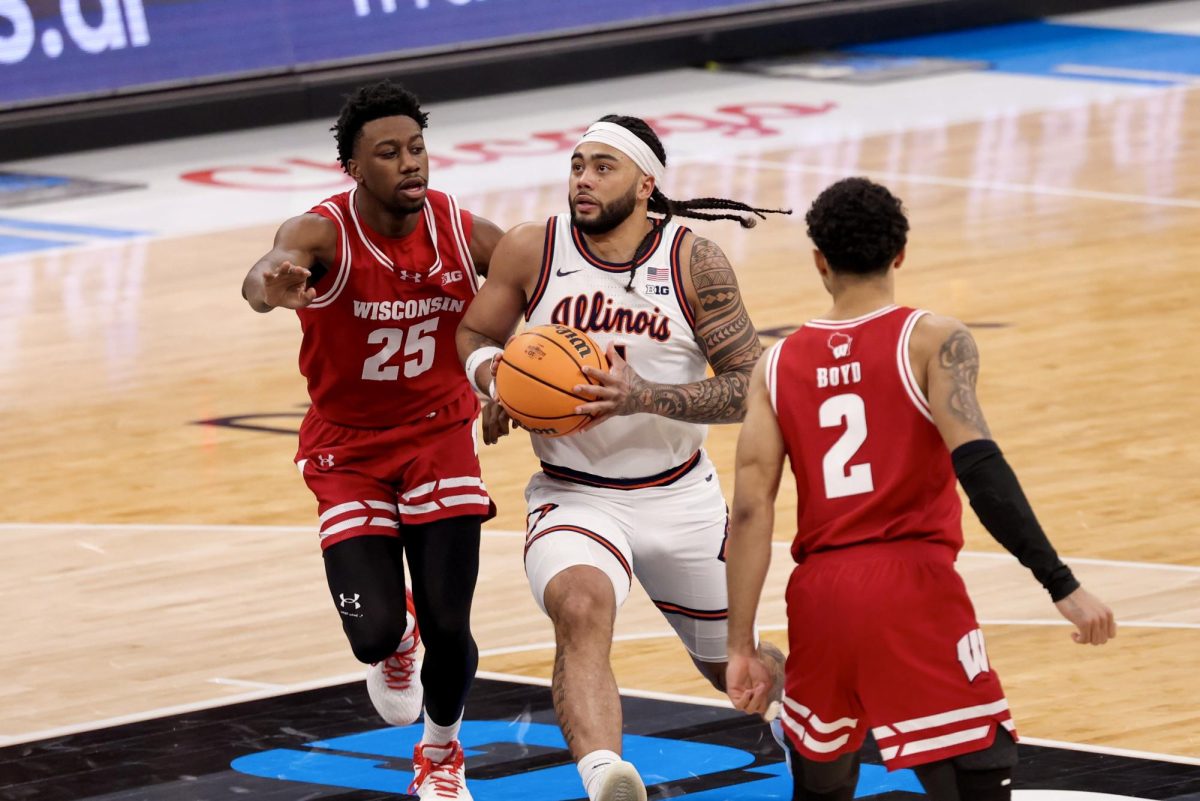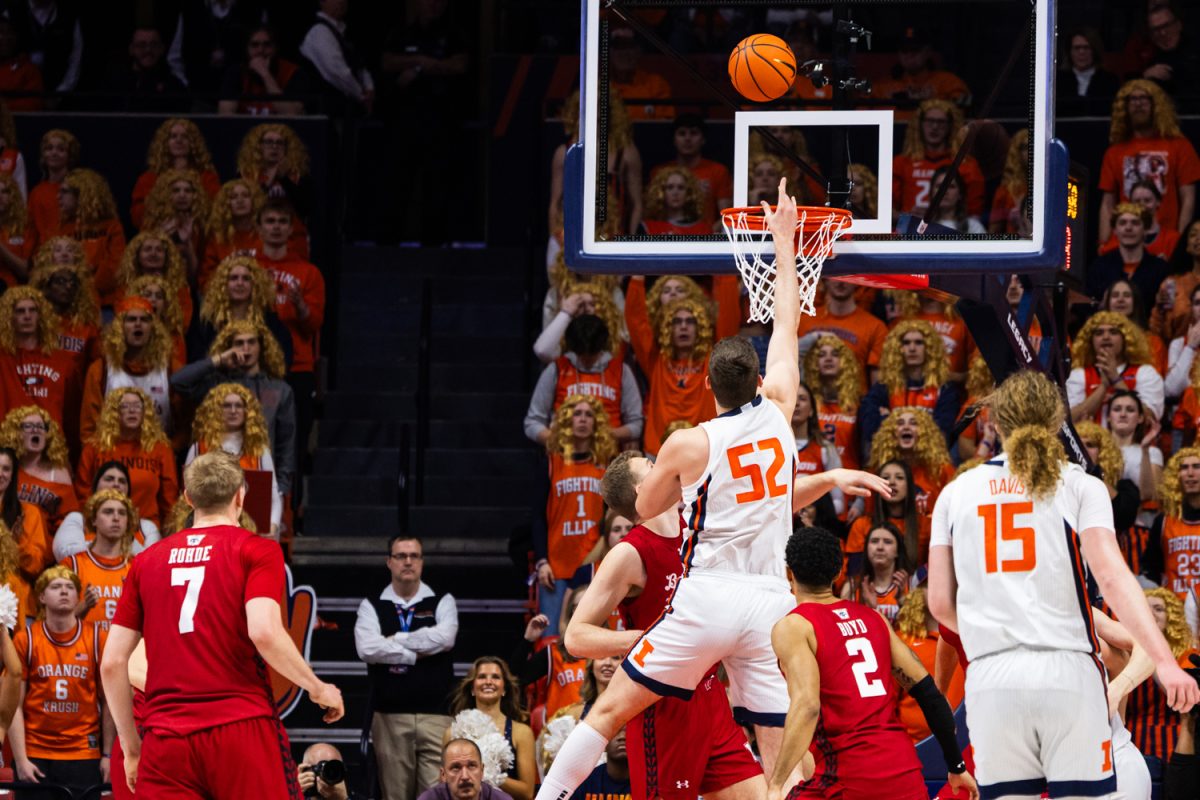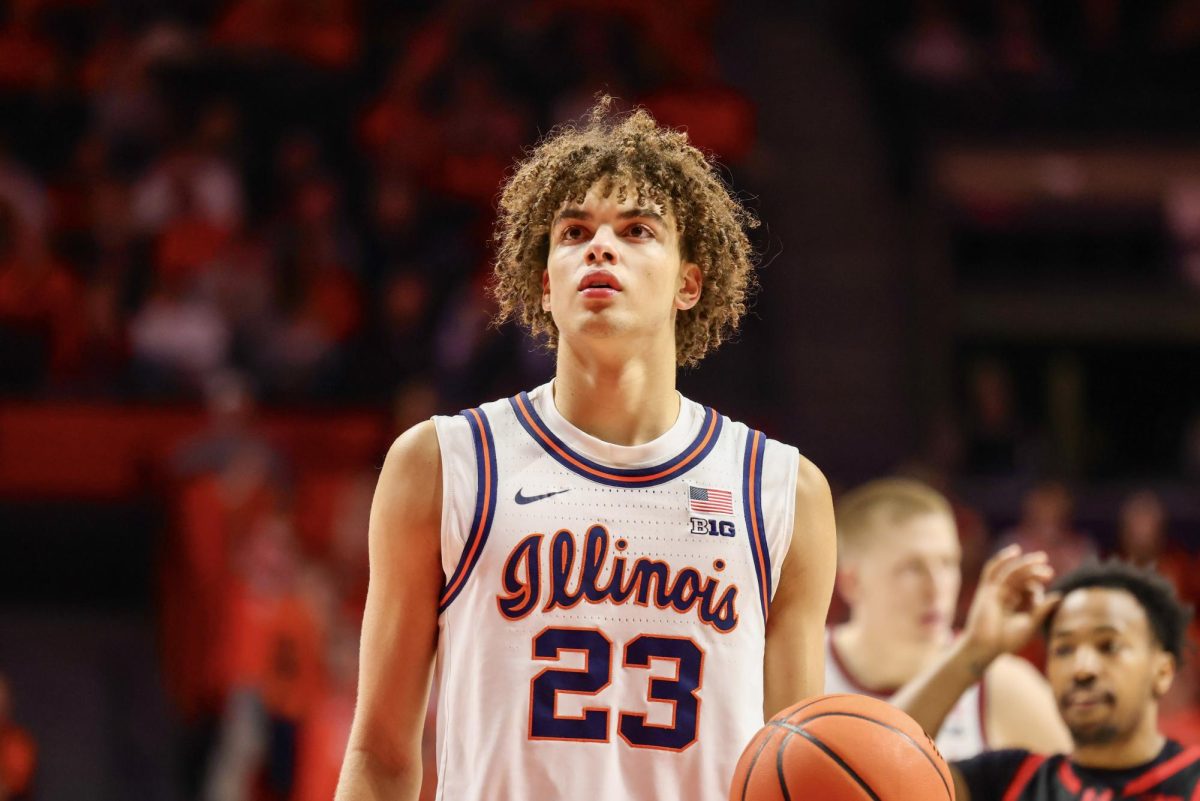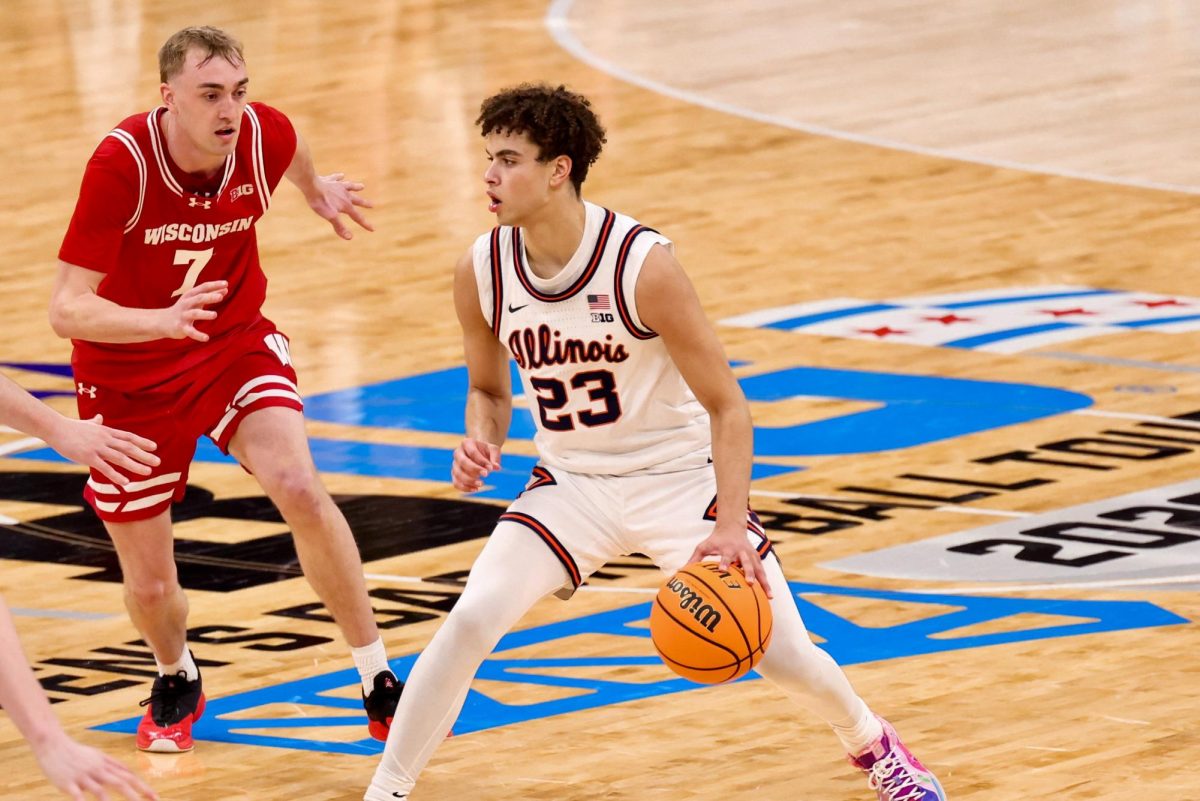
No. 9 Illinois’ (24-8, 15-5) Big Ten tournament quarterfinal loss to No. 23 Wisconsin (24-10, 14-6) was eye-opening to say the least. The positives and negatives were evident throughout the afternoon, showing some much-needed improvements the Illini need to make before the NCAA tournament begins next weekend. There is no guaranteed next game from here on out, and the early conference tournament exit proved that complacency has no place in postseason play.
“I still think we’re one of the best teams in the country,” said head coach Brad Underwood. “Yet you’ve got to find somebody to make those shots, get that stop, and it’s not a combination of a lot of things. It’s a combination of a very few small things.”
Stay: Stojaković’s aggressive mentality
With senior guard Kylan Boswell picking up two quick fouls less than a minute in, junior wing Andrej Stojaković got on the floor earlier than expected, and he made the most of it. Just three minutes after checking in, Stojaković recorded a block, defensive rebound, steal and his first points of the contest on a second-chance driving layup. Clearly, Stojaković didn’t waste any time in playing aggressively on either end of the floor, and the Illini benefited. After Stojaković’s first made field goal, he scored the next six points and sparked Illinois’ 23-3 run.
As he has been all season, Stojaković is tough to slow down in the open floor as he gets downhill quickly when he’s engaged in the game. When Stojaković does this, it catches defenses off guard. It also gives other Illini chances to run the floor, as Stojaković found junior forward Jake Davis at one point in the second half, and Davis lobbed it up to junior center Zvonimir Ivišić for the dunk.
Get The Daily Illini in your inbox!
After leading all scorers at the end of the first 20 minutes with 12 points on 4 for 6 shooting, Stojaković slowed down in scoring to start the second half. However, he still finished the game as Illinois’ third-leading scorer with 17 points on 6 for 13 from the field. Stojaković’s aggressive mentality didn’t apply to just scoring, though. In a game where the effort on the glass wasn’t there from the Illini, Stojaković was a bright spot. He was Illinois’ leading rebounder, alongside Ivišić, with seven rebounds.
Overall, Illinois’ best basketball of the afternoon was when Stojaković was involved in the action on both ends of the floor. Stojaković continued to respond to Underwood’s message for him to be an aggressive defender and rebounder on Friday. Defense leads to offense for Stojaković, as he can get going in transition when he is an active rebounder on the defensive glass. When Stojaković does this consistently, Illinois builds leads, showing that he will clearly benefit his team in the NCAA tournament if he continues to play with high energy.
Stay: High-quality shot selection
Despite the loss, the offensive end was never the problem for the Illini on Friday. Illinois shot 50% from the field, including 29% from three-point territory in the game. Three Illini, Stojaković, freshman guard Keaton Wagler and freshman forward David Mirković, also all finished in double-figures. During the Illini’s long run in the first half, hunting down quality shots and focusing on ball movement led to success.
As Illinois got touches from multiple players, Wisconsin’s defense was forced to move. Then, when the Illini got into their pick-and-roll action and isolation situations, driving lanes were more open, allowing Wagler and Stojaković to finish in the paint with ease. If the Badgers took away the drive every so often, screeners such as Mirković, Zvonimir or junior center Tomislav Ivišić were open for threes on the pop. The options were all there throughout the afternoon, and for the most part, Illinois did a solid job in choosing the right ones.
“Tonight, when we did what we do, we got basically whatever we wanted,” said graduate student forward Ben Humrichous. “So, continuing to commit to the process, taking great shots, offensive rebounding.”
Yet, sometimes knocking down a string of threes and tough shots gets the Illini in trouble. When Illinois struggled defensively, it tried to get itself back on the other end by settling for three-point attempts off of one pass or quickly into the shot clock, which made the offense stagnant. Along with other defensive deficiencies, this allowed the Badgers to go on their runs and even tie the score with the Illini, especially when the shots weren’t falling.
“(The offense) does get stagnant at times during the game,” Stojaković said. “We just have to keep trusting each other. This period is where we trust each other like no other, and we have to stay consistent in that.”
To avoid this, Illinois can’t let its offense get stagnant moving forward. Repeatedly throughout the season, the Illini thrived on contributions from all the players in their arsenal and used them to dominate games in the Big Ten. Illinois knows how to find good, high-quality shots because it did that during its runs against Wisconsin. Now, it’s about not falling off that standard.
Go: Lack of effort on the glass
It’s no secret that rebounding, or a lack thereof, was a contributing factor in Illinois’ quarterfinal loss. The difference in the effort on the glass between halves was evident. In the first half, the Illini out-rebounded the Badgers, 21-15, but in the second, they only grabbed nine total rebounds before overtime started. Illinois’ failure to grab a defensive rebound even led to Wisconsin sending the matchup to overtime in the first place. Wisconsin junior guard John Blackwell grabbed an offensive board, drew a foul and knocked down free throws to tie it up.
“You go back, and you evaluate all your close losses and your overtime games, and it’s not the stop,” Underwood said. “We’ve gotten stops in almost every one of those games. It’s the damn rebound, and it’s finishing the possession … It’s not a trend, it’s about the one possession that you have to have, and the one play.”
While the Illini offense benefited from their offensive rebounding, they only grabbed one in the second half, and in turn, let the Badgers get five. Even with Wisconsin’s starting junior center Nolan Winter out, Illinois fell off on the glass fast in the second half. There was no effort to crash the boards, leading to the Badgers getting a plethora of defensive rebounds and pushing the pace in transition with their quick guards.
The Illini are the tallest team in the country, but Friday proved that height means nothing for rebounding if the grit and effort aren’t there. Wisconsin sophomore forward Austin Rapp and freshman forward Aleksas Bieliauskas combined for 18 rebounds, while the Ivišić twins totaled just nine together. No Illini grabbed more than two second-half rebounds either.
For Illinois to make a deep run in the NCAA tournament, a rebounding performance like this one can’t happen again. A lack of effort to make the small hustle play and keep opposing teams from second chance opportunities is the difference between moving on and going home. With the time off that the Illini have before heading off to the first weekend of the Big Dance, they need to use that time to find their desire to do the little things it takes to win once again, and that starts with rebounding. If they can’t do that, then another early exit might be on the horizon.
“We’ve just got to learn from this,” Wagler said. “We’ve got to be focused on what wins games, which is defense and rebounding. We got outrebounded tonight. We can’t let that happen if we want to win games.”
Go: Defensive lapses
Wisconsin’s backcourt, Blackwell and senior guard Nick Boyd, dominated the first matchup between the two teams in Champaign and did it again on Friday in Chicago. The pair combined for 69 points on 21 for 37 shooting from the field. The next highest scorer for the Badgers was Rapp with 8 points on 2 for 9 shooting. Illinois knew the backcourt duo was going to do it all for Wisconsin, especially with Winter sidelined, but Blackwell and Boyd still dominated, and Illinois didn’t force other Wisconsin players to score.
It didn’t help the Illini when Boswell went to the bench with the two fouls, as he was supposed to be the primary defender on Boyd. Boswell’s limited minutes allowed Boyd to face other defenders, and he used that to his advantage by driving right to the rim past them. There was no help from Illinois’ front court in protecting the paint either, as Blackwell and Boyd shot right over the top of the interior defense.
Illinois’ run hurt it as it became content on the defensive end, and Wisconsin took advantage by drawing fouls when Illinois wasn’t focused. The Badgers shot 18 free throws in the second half alone, 16 of those attempts coming from Boyd and Blackwell, and shot 100% as well. For a team that doesn’t make those types of mistakes defensively, the Illini were out of sorts. They didn’t know how to defend Boyd and Blackwell, and that lost them the game.
“We talked about not giving reject ball screens to John Blackwell, and first or second play of the second half, he gives up a reject ball screen,” Underwood said. “That’s stuff we didn’t do one time in the first half. Those are the mental lapses and mental mistakes that are just driving me nuts.”
The grit and “nastiness” that Underwood continually says Illinois needs to have on the defensive end weren’t there once again on Friday. It’s the same comment Underwood made after the loss to the UCLA Bruins in late February, and the Illini are still struggling to find it. In the NCAA tournament, when teams are playing to continue their seasons, Illinois can’t be complacent on the defensive end, even when it has a lead. Those mental mistakes are the ones that end a season, and the Illini must take the week to rediscover that mentality that should fuel their defense.
@evy_york2