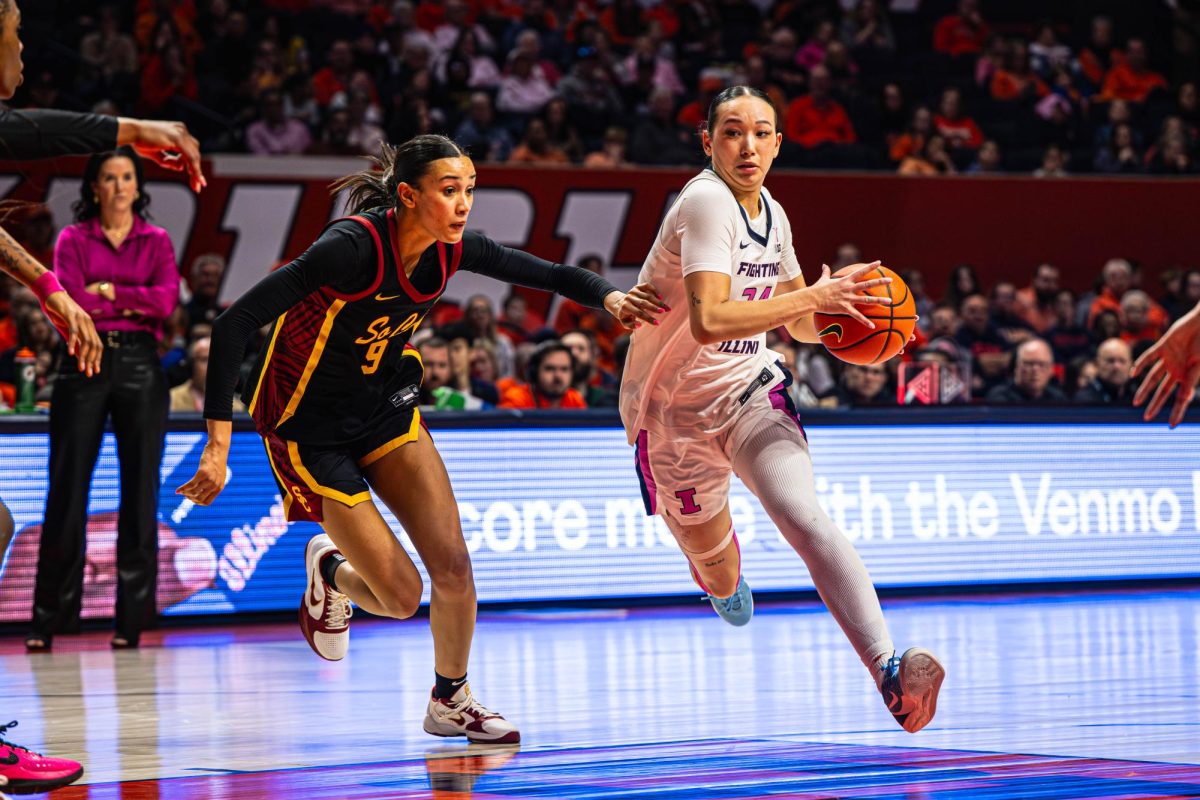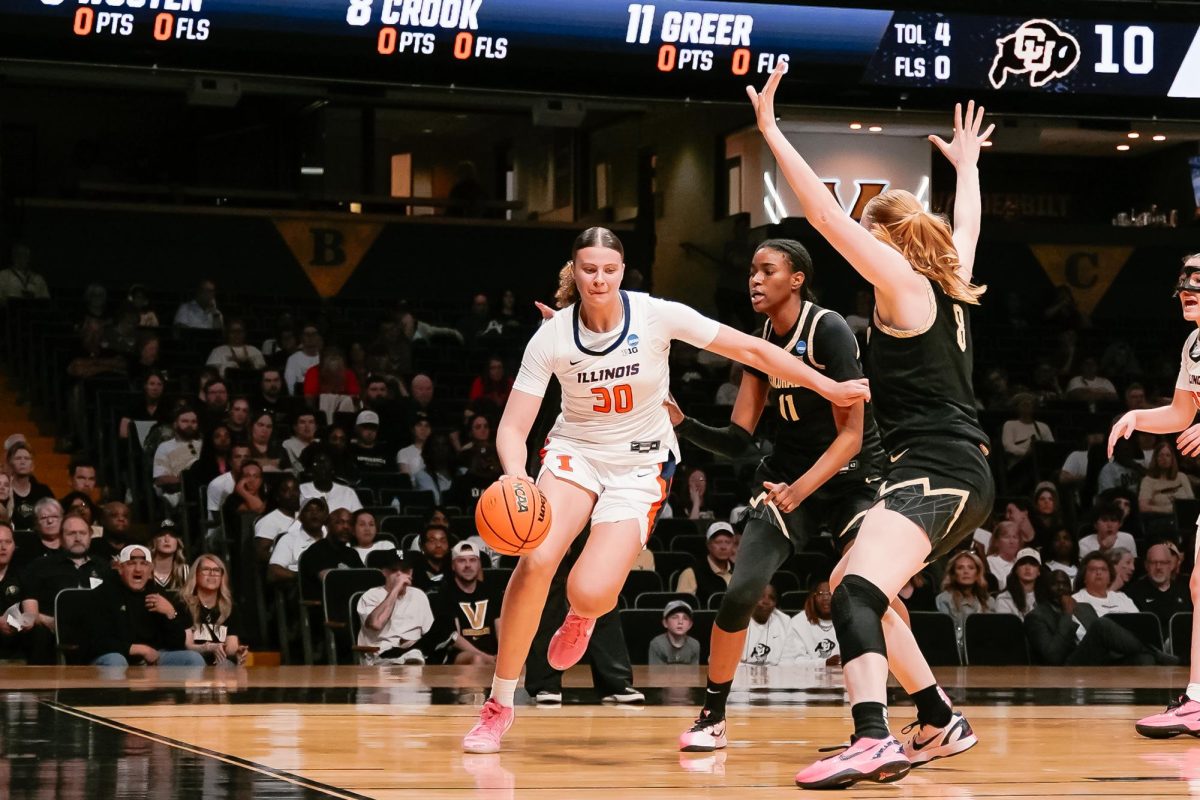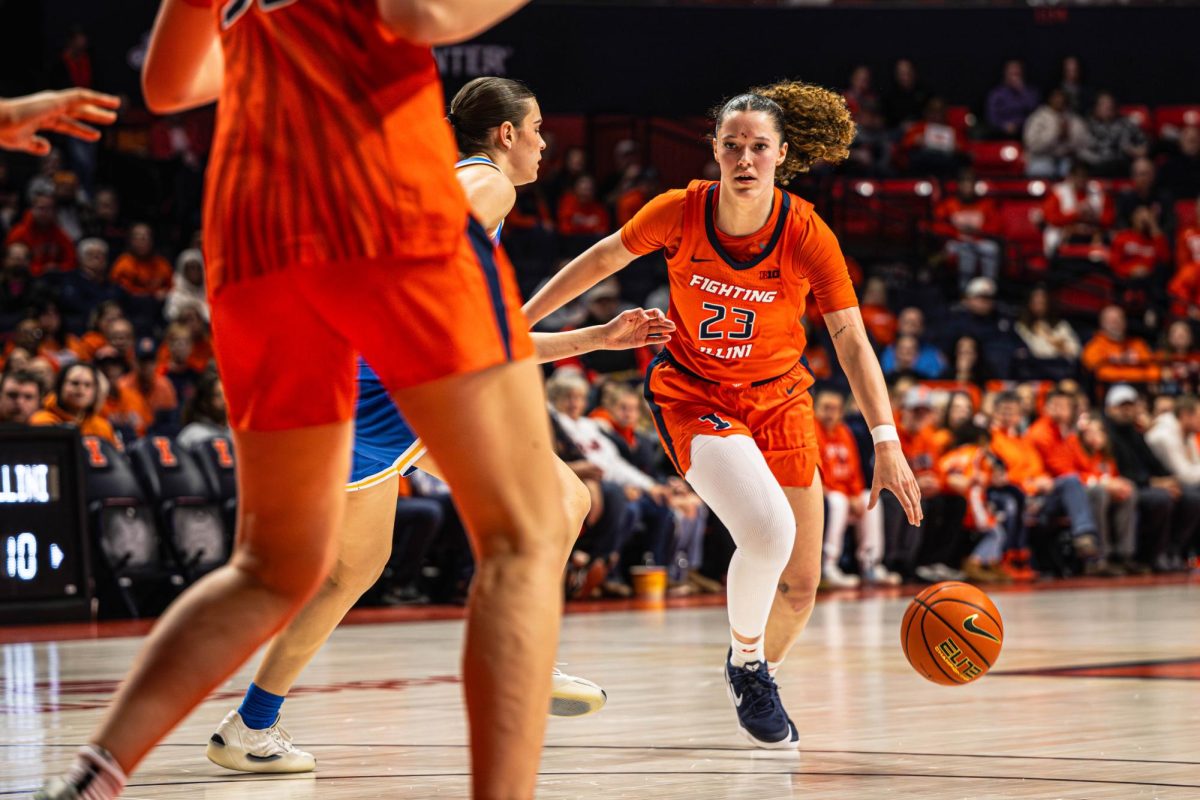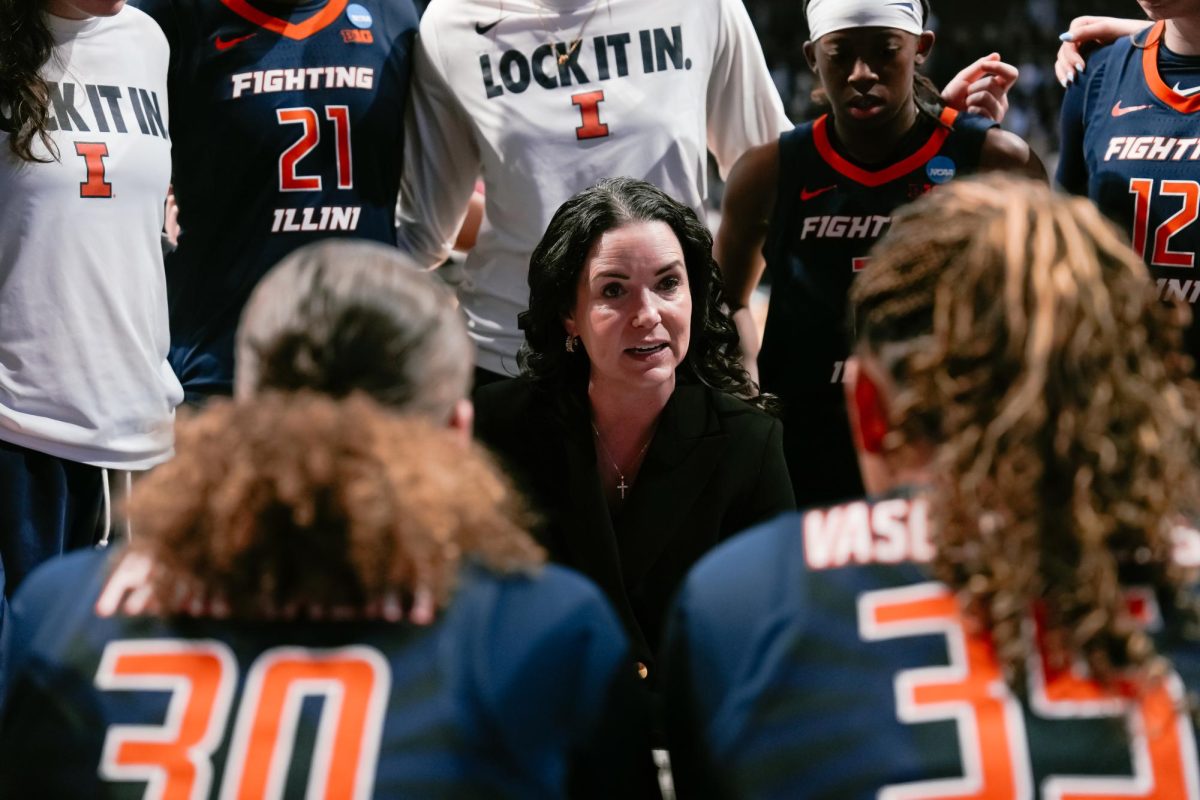
No. 7 Illinois’ (22-12) season officially came to an end Monday night after a tough 18-point loss to No. 2 Vanderbilt (29-4), 75-57. Despite narrowing the deficit to less than 10, a messy first 10 minutes caused the Illini to dig themselves too deep a hole to crawl out of with 30 minutes to go.
“I told them in the locker room, we need to be really proud of this year,” said head coach Shauna Green. “It didn’t end how we wanted. Obviously you want to win, you want to get to the Sweet 16, but in the big picture for such a young team with so many new guys, to do what they have done this year – all the big wins, winning another (NCAA tournament) game, two times back-to-back – hasn’t happened at Illinois, I think, in 20-something years.”
Even with their loss, the Illini achieved numerous AP top 25 wins, a 20+ game season, a trip to the Big Ten tournament quarterfinals and advanced to the second round of the NCAA tournament. This season showcased the true potential Illinois has in the future with its young core.
While on paper, the Commodores and the Illini seemed to be playing at the same level, the Illini’s mistakes and messy play on both ends ultimately led to their season coming to an end in Nashville, Tennessee.
Slow and steady doesn’t win the game
Get The Daily Illini in your inbox!
For Illinois, a recurring theme has been slow first-quarter starts. Similar to their games against the Michigan Wolverines, USC Trojans and Iowa Hawkeyes in the Big Ten tournament quarterfinals, the Illini were down by double-digits against the Commodores in the first quarter. Just like in these three games, Illinois was unable to make a comeback that resulted in a win.
The Illini fell so far behind in the first quarter that, even with a comeback, they were too deep in the hole they had dug for themselves. After trailing 21-8 in the first 10 minutes of the game, Illinois knew any hope for a win would be difficult.
“Went on a run, got it down to nine, then gave up those threes in the third,” Green said. “So I thought our first quarter just — the first and the end of the third kind of got us.”
While Illinois outscored Vanderbilt in the second and fourth quarters, the first and third quarters were much worse than their two good quarters. In the first and third quarters, Illinois scored 24 points in comparison to Vanderbilt’s 45. However, in the other two quarters, the Illini went for a combined total of 33 points and outscored the Commodores, who had 30.
“Our start wasn’t good,” Green said. “They got too many — we gave up too many, 21 in the first, and then we made that run in the third, and we went boom, boom, boom, and they scored, and we were not scoring.”
The Illini had the potential to upset the Commodores if they played more consistently throughout the four quarters, but they were not able to hang around for a full 40 minutes
Messy offense and defense cause more problems than one
The Illini were a messy group on both ends of the court Monday night. They struggled when it came to efficient possessions and shooting, which hampered their offensive performance. Illinois has struggled to consistently find its footing and confidence when it comes to handling the ball. The Commodores took advantage of the Illini’s lack of focus and forced 16 turnovers. Vanderbilt then used this to its advantage to score 17 points off of Illinois’ errors. Despite the Illini forcing more turnovers, they weren’t able to produce as many points off of them.
If turnovers weren’t enough of an issue for Illinois, it had a hard time with efficient shot selection. The Illini managed to take more field goals than the Commodores, but made significantly fewer. Illinois went 21 for 71, 29.6%, from the field, whereas Vanderbilt went 28 for 64, 44%. Mistakes like this kept piling up for the Illini, eventually causing their season to come to a crashing stop.
As for the other end of the floor, Illinois’ struggle with playing clean defense meant that several players were in foul trouble and were getting subbed in and out of the game. This resulted in many players like freshman forward Cearah Parchment, freshman point guard Destiny Jackson and sophomore guard Aaliyah Guyton struggling to find their rhythm. Those three accounted for 10 of Illinois’ 17 rebounds. The only Illini to not earn themselves a player foul was redshirt sophomore Lety Vasconcelos. While Vasconcelos is known to foul, her smart and clean defense made her stand out from everyone else.
On top of that, the more fouls Illinois racked up were just more chances to send Vanderbilt to the free-throw line for easy points. The Commodores went 8 for 11 from the free-throw line, giving them 8 easy points added to their final score.
Offensive efforts miss the mark
“You can’t come and upset someone on their home floor shooting 13 percent from three and 29 percent from the field,” Green said. “It’s just not going to happen.”
Illinois’ offense was not at its usual standard Monday night. The Illini shot below their season averages from all three levels. Illinois shot 29.6% from the field, 13% from beyond the arc and 80% from the free throw line. Illinois’ season averages before playing Vanderbilt was 45.7% from the field, 35.9% from the three and 81.5% from the free throw line. Other than the Illini’s performance at the stripe, they faced adversity with their field goals and from beyond the arc.
Several individual performances impacted this poor shooting result. Jackson, who had a standout performance Saturday night, went 0 for 7 from the field. Guyton, who has had a streak of low-scoring games, saw a similar story, going 1 for 6 from the field.
Junior guard Maddie Webber saw her lowest scoring game since playing at Carver Hawkeye Arena on Feb. 26. Webber only scored 5 points, going 2 for 12 from the field and 1 for 6 from three.
Sophomore forward Berry Wallace was the Illini’s leading scorer with 18 points. However, she just shot 35% from the field and 22.2% from the three, going 7 for 22 and 2 for 9, respectively. The Ohio native saw a similar story to the rest of her teammates, shooting below her season averages against Vanderbilt.
“They are handsy and physical, but we missed point-blank lay-ups,” Green said. “We’ve never shot 13 percent and 29 percent I don’t think all year. It’s just a bad time to not shoot it well. So I think it was a mix of both. But you’ve got to hit shots; simple as that.”
At the end of the day, shooting is what cost the Illini a trip to the Sweet 16 and what ended their season.
Despite their loss, Green has hope to keep her core together for better things next year. Illinois is only currently losing one player – graduate student forward Gisela Segura. While the transfer portal will most likely shake things up, Illinois has the potential to keep its entire starting lineup next year.
“But with a young team, there’s a lot of optimism,” Green said. “We talked about it in the locker room, we’re going to learn from this year. There’s a lot of great learning opportunities for us, and we’re going to come back, and I told (them) they can, let’s run this back and take everything and use this feeling as motivation going into next season and keep this core group together.”
@lauram0131