Health has been a major storyline for Illini football in 2010. From safety Supo Sanni to cornerback Terry Hawthorne, multiple players have missed significant time already this season. But during last Saturday’s game against Northern Illinois, fans, players and coaches alike were reminded of just how insignificant these injuries really are.
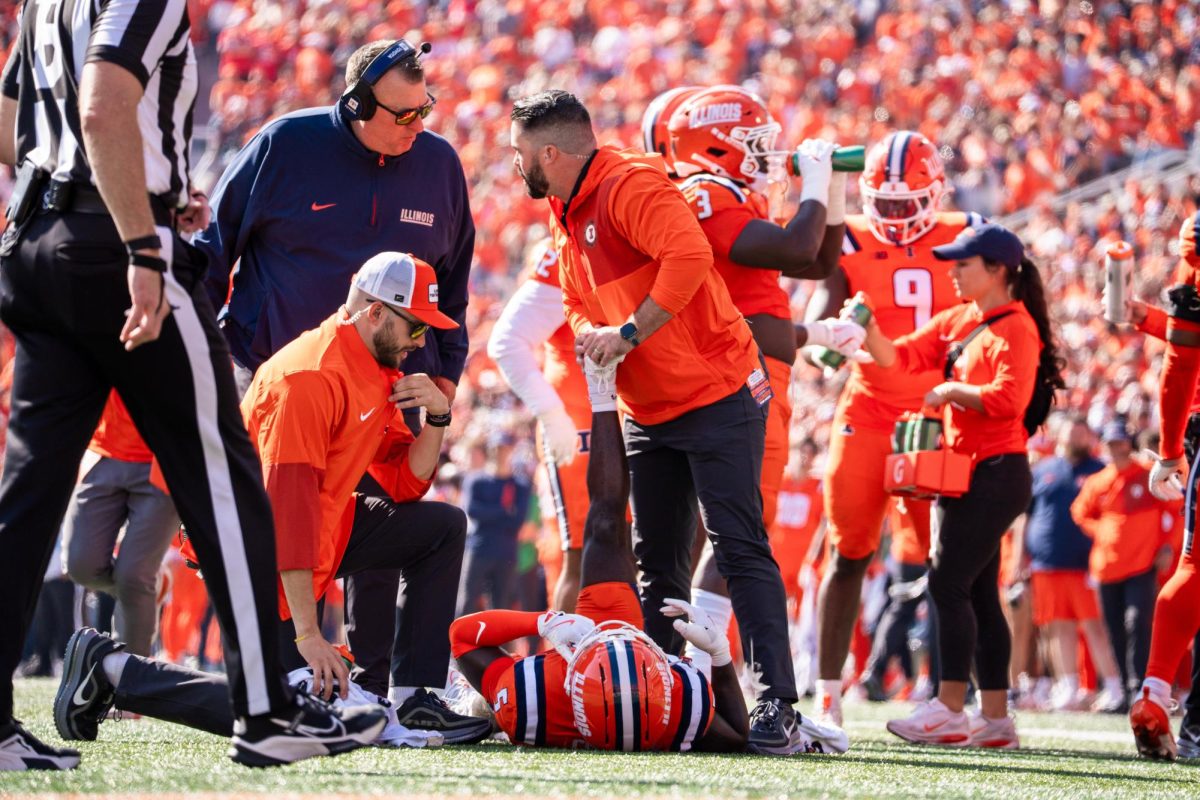
Late in the third quarter of Illinois’ contest, sophomore offensive lineman Hugh Thornton had to be carted off the field after suffering what appeared to be a neck injury while attempting to complete a block. After lying on the field for several minutes, the lineman gave the crowd a thumbs-up as he left the field.
“(When I saw Thornton on the ground) I just prayed for a second, and I just prayed for him to move. He wasn’t moving for a while. That was my first concern, to see if he could move his limbs,” tackle Jeff Allen said. “Once I saw him give the thumbs up, I was really relieved.”
It was later announced that Thornton had been taken to a local hospital and diagnosed with a strained neck. While the injury was not as severe as originally thought, the incident once again brought to the forefront the discussion of serious injuries, especially those involving the neck and head.
With concussions and brain injuries also being a topic of national concern, Illinois head football athletic trainer Nick Richey said policies are in place should such an injury occur.
Get The Daily Illini in your inbox!
“The NCAA encouraged the conferences to develop their own set of guidelines,” Richey said.
“We felt it was in our best interest to actually develop a policy so that we would be able to protect our student athletes and ourselves from any future problems,” he added.
The current guidelines involving MTBIs, or Mild Traumatic Brain Injuries, start with baseline testing for every player before he even practices. These tests measure cognitive abilities such as reaction time and memory, as well as physical attributes such as balance. Should a player be diagnosed with a concussion, the athlete is given those same tests again using the original results as a benchmark.
“What we do is we look for those scores on both of those tests to balance back out to within a normal range compared to their baseline test,” Richey said. “Once that happens, we can then work on progressing them back into non-contact activity. Because sometimes even though they clear both of those other tests … sometimes those symptoms may come back, and that’s a pretty good indicator of whether or not their body is actually ready for that yet.”
The most important thing to remember, though, is that each injury must be handled differently, Richey said.
“No concussion is the same. There are a lot of signs and symptoms that each person might have, but that doesn’t mean that each person will have the same symptoms every single time,” Richey said.
“We treat each case on an individual basis and evaluate each young man on an individual basis,” he added.
Since each concussion could present itself differently, Richey said the training staff has gone to great lengths to educate players about such injuries, as well as encourage them to speak up if they feel like something is wrong.
And while there are many reports of players hiding serious injuries for fear of losing playing time or a starting job, Richey doesn’t see that as an issue at Illinois.
“I think that, by and large, the student-athlete population is smart enough to understand the implications of hiding information like this,” Richey said. “The one thing that we like to emphasize with our kids is that their brain is their biggest investment for the future, whether they’re going to play football or whether they’re going to be a banker.”
Running back Mikel Leshoure thinks players now are being smarter with their bodies than players in the past.
“Guys are smart now. They know it’s a physical game, and I don’t think any guy is going to try to play through something too bad that’s to the point where they need to come out,” Leshoure said. “Anything serious, like a concussion, that’s obvious, I don’t think any guy is going to be crazy or dumb enough to try and play through those type of things.”
Despite all the new developments in the diagnosis and treatment of concussions, some players still believe the final say should be in the players’ hands, not the trainers’.
“It may be too much. I guess it’s the rules, but sometimes they keep players out longer than they should be out,” Allen said. “It’s a gray area in between. They’re trying to keep us safe, but at the same time they’re kind of overprotecting us. I mean, we should be given the last say if we want to go in. It’s your body; if you want to do it, go ahead.”