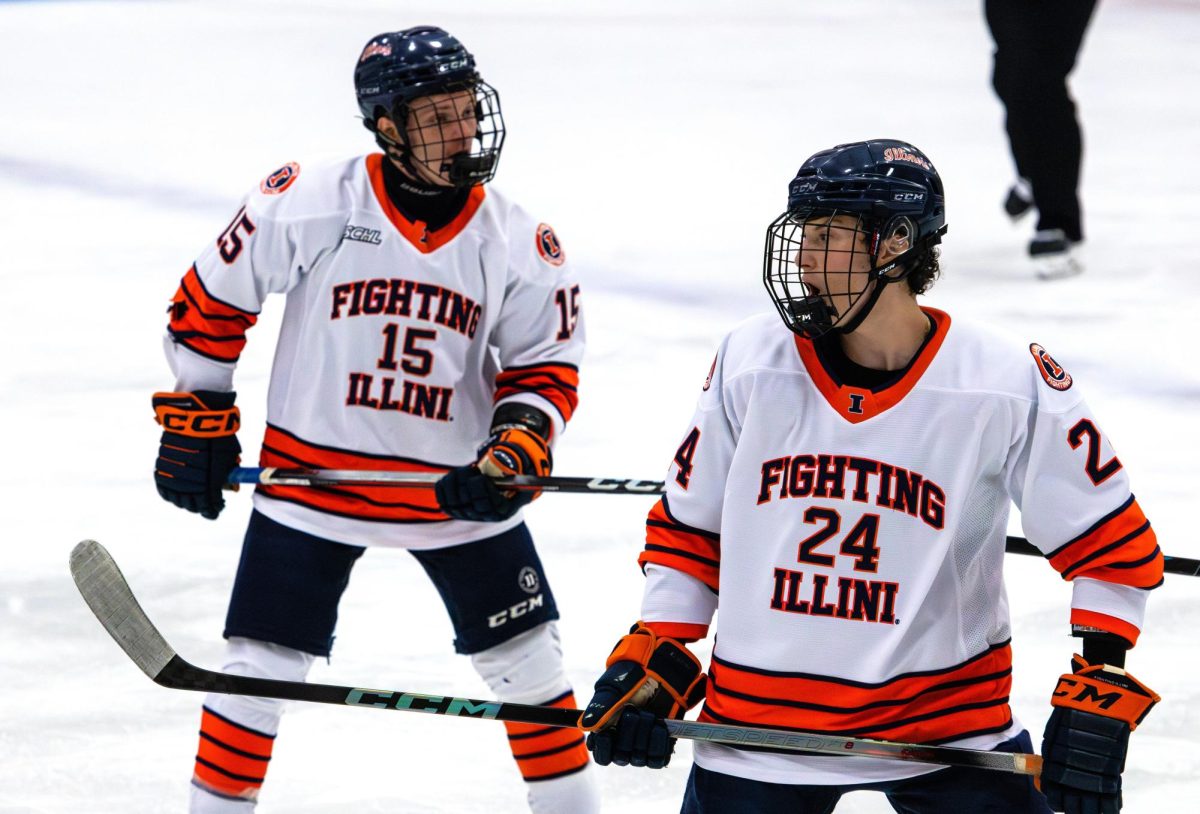
Come to the Illinois Ice Arena, or the “Big Pond,” as it is called, on a weekend and you will see the loyal fans of the Harassing Illini and a packed house to cheer on Illinois hockey. One would expect from seeing the spectacle that the team is quite successful.
On the ice, the statement holds true, as the Illini own two of the last seven ACHA National Championships. But off the ice, the club struggles financially, barely making ends meet each month.
The Illinois hockey team is not an NCAA team. In fact, it has no affiliation with the Department of Intercollegiate Athletics at all and therefore receives no financial aid from millions the department made last year.
“It is frustrating,” said junior center and captain Austin Bostock. Because the team is a club sport, it operates like an RSO; Bostock was elected treasurer of the team. “It’s frustrating when we win the national championship in 2005, go undefeated and win the national championship in 2008, and the school still doesn’t see it appropriate to take steps in a new direction for Illini hockey.”
The new direction Bostock references is the creation of the Big Ten hockey conference at the start of the 2013-14 season, which includes Michigan, Michigan State, Minnesota, Ohio State, Penn State and Wisconsin. Penn State, a club sport just last year, made the jump that the Illini covet, taking a $102 million donation from Terry and Kim Pegula to make the Division I ranks.
Get The Daily Illini in your inbox!
For that to happen at Illinois, the Big Pond would have to be replaced with a regulation-size rink, not to mention the funding for equipment, scholarships, travel and other expenses that the club takes care of right now.
So sending Illinois to Division I — and the pretty penny it would cost — isn’t at the top of the list of priorities for alumni and the DIA, especially for a sport that just barely gets by as it is.
On the other hand, becoming a varsity sport would help bring in a lot more revenue than the sport generates now. There would be money from the Big Ten Network for televised games as well as the potential for greater interest from fans.
“If Illinois was a Big Ten hockey school, there would be no reason why it wouldn’t just take off,” Bostock said.
Currently, players pay $800 per semester in fees to participate in hockey in addition to paying for their own meals while traveling and the majority of their equipment, though the club tries to bear some of the costs.
“I had to write a check for $10,000 for equipment because we had so many new guys,” Bostock said. “We’re not going to make guys who already pay $800 a semester buy another $2,000 in equipment. We try to make things like that work.”
The team pays $1,600 a year in membership fees to the ACHA, as well as fees for individual tournaments. For the ACHA Showcase, where Illinois had its best showing of the year, the team had to shell out $550. Bostock said the entire road trip to Indiana on Dec. 7-8 will cost the team around $2,000, which is generally how much they make on an average weekend for home games, which number 24 for the 2012-13 season.
There is an alternative, however, to putting together millions they would need to go to Division I. The DIA could follow the example of many of the Illini’s peers in the ACHA. Although the likes of Robert Morris University and formerly Penn State are just club teams, they are funded by their schools.
“There are teams we play in the ACHA, not even winning teams, that don’t pay a dime to play,” Bostock said.
For players like freshman forward John Olen, the opportunity to play Division I hockey once existed. During his high school hockey career, Olen received a scholarship offer to play for Ferris State, an offer he held out on pending additional offers.
“The academics at Ferris State weren’t there,” Olen said. “At the time, I figured I’d be getting more and more offers because I was still only 16, so I didn’t pursue that because the academics weren’t there and the campus didn’t really wow me either.”
As Olen’s high school career came to an end, the only offers left were from Division III programs, which didn’t offer scholarships.
Olen instead decided to take the jump into junior hockey, hoping to draw attention from another Division I program. Junior hockey is the next level of development for hockey players under 20. Taking two years off from school, Olen finished his junior hockey career with the Janesville Jets of the North American Hockey League. His next destination was Illinois, where he is among one of the team’s leaders in points as a 20-year-old freshman.
Although he would pass up the offer from Ferris State if he had to again, Olen said he still thinks he should at least see some benefits for the amount of work he puts into his craft.
“It kind of stinks,” he said. “It would be nice if clubs sports could get money toward tuition or scholarships. I knew that I wouldn’t be getting anything going in to college and it kind of sucks, but it is what it is.”