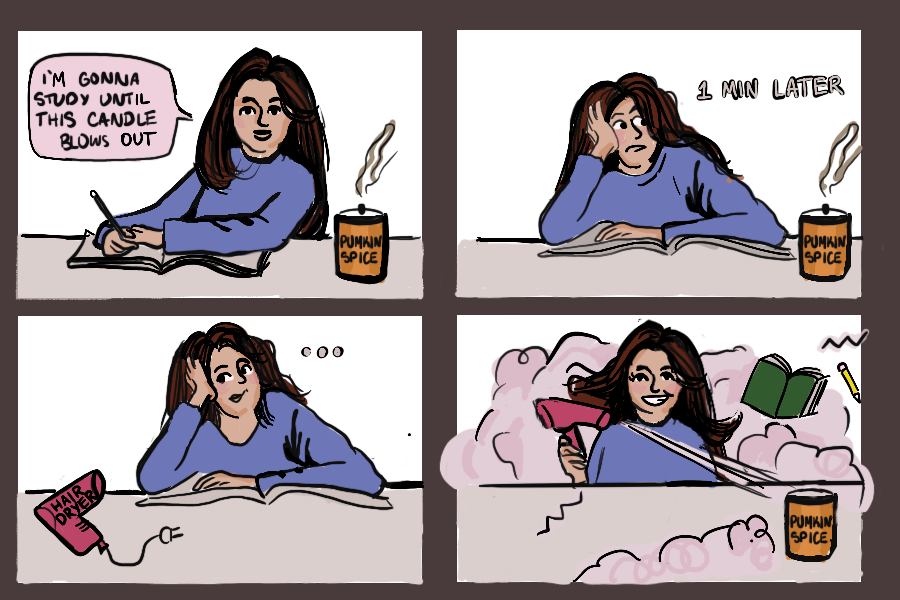
Turns out a little hard work can hurt; as you’re pulling your all-nighters in preparation for finals, think about the 10,000 Japanese citizens who die each year from overwork.
It’s called psychoneuroimmunology — the study of the silent killer of not just Japanese but also highly-motivated students and professionals everywhere: stress. The cure? Rest. Relaxation. Not working so dang hard. Sounds great, right? But try to get a little R&R when deadlines are approaching. The real world doesn’t stop to balance your stress levels. If you don’t take a deep breath and step away from the study guides, your body may pay the price in the long run from stress-induced heart disease, osteoporosis, arthritis and delayed wound healing. Or you could just spend several years developing unhealthy ways of bottling stress until you explode like a badly shaken bottle of soda.
According to the theory of psychoneuroimmunology, a now-recent branch within scientific medicine, there is currently a controversy in mind-body therapy over whether there is a connection between the brain and the body. Despite the debate, physical ailments induced by stress are widely recognized. Certainly you’ve heard of the phrase “mind over matter,” but what’s the matter with certain people’s minds?
Stress due to overwork is the sort of damage, according to scientists and physicians who back psychoneuroimmunity theory, that develops over time. Fear not — you probably won’t be driven into cardiac arrest if you have one or two stressful final exams. But if you develop the harmful habit of powering through every work challenge without relieving your body’s pent-up tension, well, then you’re experiencing exactly what Japan is fighting so hard to combat.
Long work hours are a part of life in Japan. And an unfortunate reality that comes from employees putting in over 60 hours of work in the average week is something called karoshi, “death by overwork.”
Get The Daily Illini in your inbox!
As reported in The Economist, overwork at Toyota took Hiroko Uchino away from his wife and two young children back in 2002. Uchino was 30 years old when he collapsed at work, later to be pronounced dead from karoshi. It was 4 a.m., and Toyota was where he spent most of his time — on the production line. And when he wasn’t on the clock, Uchino was going for overtime, but not as incentive for a bonus or to help fellow employees out in isolated times of need, but just because it’s the culture. Japanese workers put in close to 1,780 hours a year, according to the article, and that’s not including overtime. And those hours are actually slightly less than what U.S. workers put in at 1,800 work hours a year.
In fact, American college and graduate students have suffered from overwork for centuries.
William T. Parker Jr., a student at Harvard, went crazy in the middle of his Constitutional law exam. He was “waving his hands wildly, (he) cried out a number of unintelligible sentences,” and died several days later of “an abscess on the brain caused by over study,” according to The New York Times.
The year was 1900 — there was no Internet. The sort of studying Parker did may have looked a lot different from our version of preparing for semester-end projects and final exams. He probably spent his time in the halls of Harvard’s historic libraries instead of being mesmerized by the glow of a computer screen. Something else Parker didn’t have was modern medicine to help him during his time of extreme distress. Maybe there were other issues going on in Parker’s personal life that a counseling center could have help him cope with.
Perhaps there was something physically wrong with Parker’s brain that countless hours fixated in front of textbooks and court records only aggravated. Or maybe Parker just worked too hard.
What we can learn from instances like Parker’s or those who reportedly died from documented cases of psychoneuroimmunology is not to slack off. For motivation isn’t itself deadly, and striving for success either academically or in the workplace is what sets students and employees apart. Overachievers will inherit the earth, if they haven’t already. But we workaholics can only advance our empire of productivity if we take a tip from those friends and foes who poke fun at our conscientious ways: We need to chill out. Take a break. Do something completely outside of the world you are used to. This is hardly the prescription we want, but it’s the medicine we have to take before we too throw up our hands in insanity. Don’t let finals or the end of the job crunch get the best of your brain or your body — you worked too hard to let that happen. Give yourself the pre-holiday gift you really need; for at least a few minutes once you’re done reading this, do nothing at all.
Renée is a senior in Media. She can be reached at [email protected].