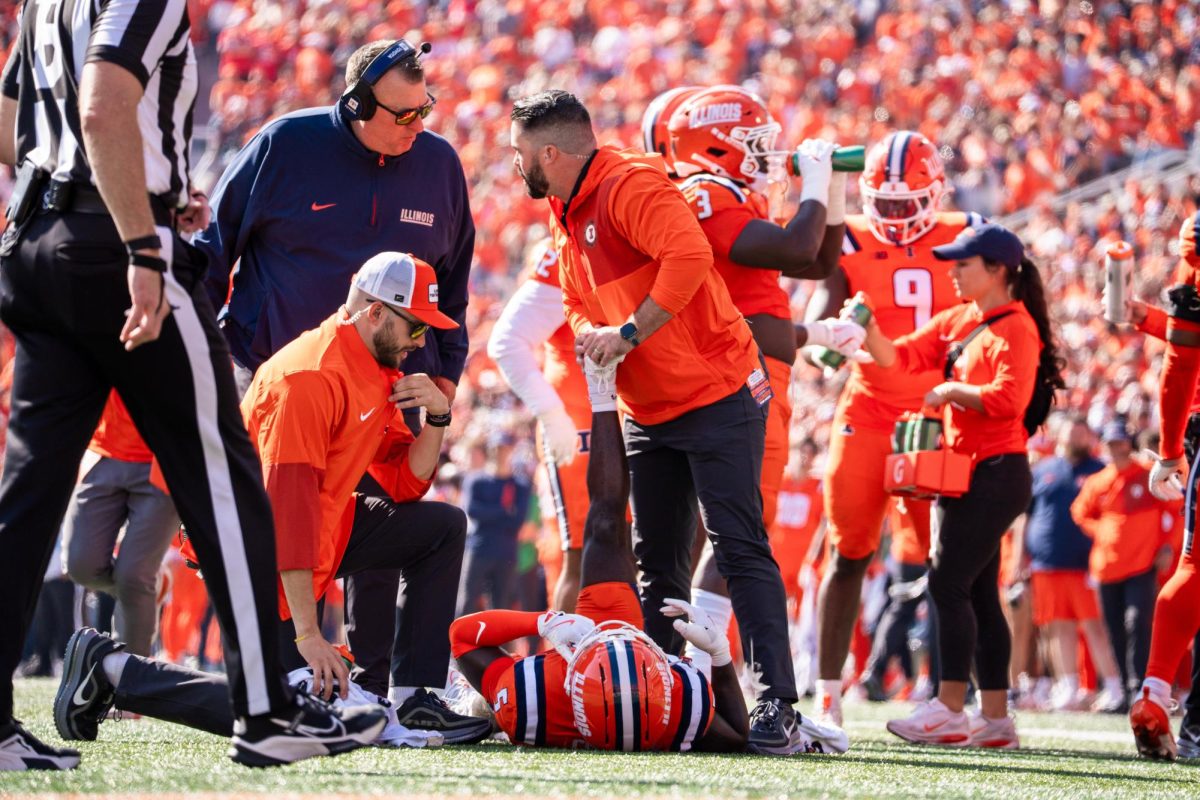
It was an injury waiting to happen.
Two weeks ago at Kenney Gym, C.J. Maestas was perfecting the addition of air flares to his floor routine — just one more skill to add to his already expansive repertoire. After finally landing the skill, Maestas, not yet satisfied, requested one more go-around.
The decision proved devastating, as he planted on the ground after his right arm lost stability. He looked down at his elbow, bent the opposite way.
Maestas, sophomore standout for the preseason No. 1 Illinois men’s gymnastics team and the reigning Big Ten Freshman of the Year, had torn his tricep, an injury that will require him to miss the entire 2013 season.
Maestas described the immediate effects as “an instant burning on my arm. The worst pain of my life.” He received surgery on the elbow Nov. 20. The recovery process is expected to take between four and six months.
Get The Daily Illini in your inbox!
“We’re not the same team anymore,” Illinois head coach Justin Spring said. “Every guy who was seventh in an event is now in our lineup.”
Maestas’ title in the NCAA’s still rings last season as a true freshman aided in the Illini’s first national championship in 23 years. He was slotted to anchor five of Illinois’ six events this season.
Spring referred to Maestas as irreplaceable, adding that the entire team will be responsible for helping fill Maestas’ void if the Illini are to repeat as national champions. He pointed to senior Yoshi Mori, who finished sixth in the all-around in April’s NCAA Championships, as someone who will need to step up in Maestas’ absence.
“I mean, he’s our No. 1 contributor,” Mori said of Maestas. “He’s our No. 1 all-around, he’s ranked No. 1 on rings in the nation. I’m going to start taking a lot more responsibility with other events, so that puts more pressure on me.”
Spring said the severity of the injury can be attributed to an incident Maestas went through before attending Illinois. Maestas initially injured his right elbow while sitting atop his friend’s shoulder in high school before falling from his friend’s 6-foot-2 frame and striking the tip of his elbow perfectly onto a concrete surface. Maestas never sought medical attention following the fall, which led to scar tissue rather than healed bone.
Working on the air flares, Maestas said, was one of countless exercises that could have triggered the tear.
“There are times where I just stare at the floor and think, ‘What if?’ But you can play the what-if game all day,” Maestas said. “What if I hadn’t made that last turn? What if it had happened on something else? What if I hadn’t come to practice that day? Whatever the case is, I still would have gotten hurt. There are hard times, but the good always outweighs the bad.”
As an athlete accustomed to playing a prominent role in his team’s success, spending the 2013 season as a spectator won’t be an easy transition for Maestas. His role as a vocal leader, however, should help. Maestas served as one of the loudest members of last season’s national championship-winning team, providing moral support and securing his status as one of the more selfless members of Illinois’ roster.
Now that he’s limited to the sidelines, Maestas said, his voice will serve an even more prominent role.
“I’ve always been a leader on the team,” Maestas said. “Whether I’m on the floor or not, I’m going to push these guys. I’m not going to isolate myself. This is my team, these are my guys. You could put me in a full-body cast and I’d still be wheeled out to be with them.”
Melissa Brungard, athletic trainer for the men’s gymnastics team, said that while all six events employ the use of the tricep, the vault, floor excise and still rings specifically require peak arm strength. Maestas, along with several other Illini gymnasts who will miss Illinois’ season opener against UIC on Jan. 12, won’t be at a loss for motivation during the rehabilitation process.
“This team, specifically coming off a national championship, they’ve got targets on their back to be back-to-back champions,” Brungard said. “Every single one of these guys is going to want to get back as soon as possible to contribute to the lineup this season, if not the future.”
If there is a positive to Maestas’ injury, it’s that his absence from the 2013 season will allow for his training to smoothly lead into a potential appearance in the 2016 Summer Olympics in Rio de Janeiro. Maestas would have had to train in an environment arguably less conducive to success had he finished his collegiate career free of injury in 2015.
With 2013 now serving as a gap year, Maestas’ senior season will take place in 2016, with the Olympic trials starting shortly after the end of the NCAA season.
“You don’t have a lot of opportunities to get in and compete and raise your hand in front of a real judge for it to count very often once you’re out of the collegiate ranks,” Spring said, “because there’s not a lot of meets throughout the year domestically.”
Maestas has set his return goal for this summer’s World Championships, which, barring complications, should provide ample time for the injury to heal.
“I guess you could say I got hurt at the perfect time, you know,” Maestas said. “I don’t like to say that, but I still got three more years until the Olympics.”
The loss of Maestas in 2013 is sure to hurt Illinois’ chances of repeating as national champions and will at the very least diffuse the Illini’s No. 1 preseason ranking. Spring pointed to the support Illinois’ depth provided its heavy hitters at last season’s NCAA Championships, when both Maestas and Paul Ruggeri were unable to secure key points on the high bar. Maestas, ever the optimist, expressed confidence that Illinois’ quest to repeat as national champions is still intact.
“I have so much faith in my team,” Maestas said. “They’re amazing, amazing athletes, and I hope my spirit is still in the gym. I know it is.”
Jeff can be reached at [email protected] and @jkrish91.