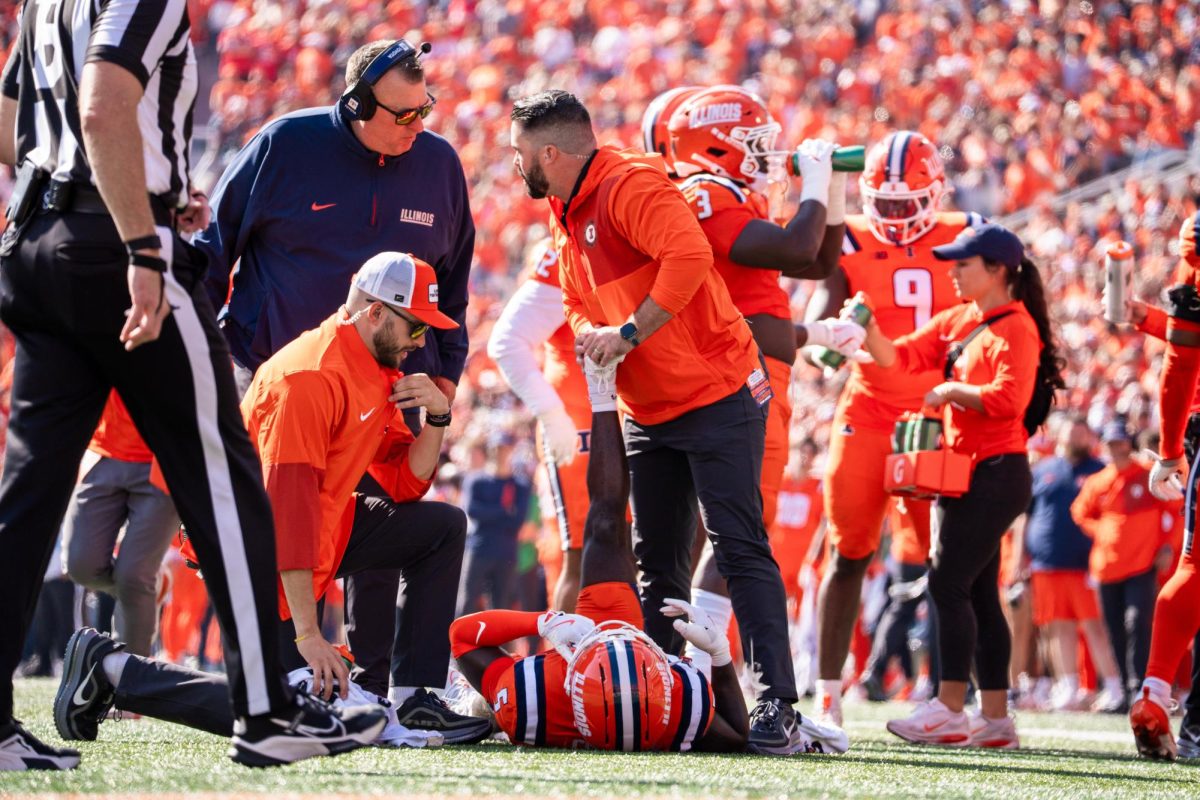
Concussions and other head injuries aren’t an exact science.
Consider this example: A football player takes an 80g hit and shows concussionlike symptoms. That same player next week takes a 120g hit, but he’s fine.
So what gives?
Given the brain’s complexity, athletic officials say the conversation between trainers and athletes is more important than the technology when dealing with such injuries. A new device initially developed at the University attempts to start that conversation by providing more reliable results and simplifying the data it spits out.
It’s called CheckLight, a gadget that measures the level of the head impact through flexible sensors that lay gently in the skullcap, not inside the helmet. The LED output sits on the back of the neck and is attached to a Reebok-manufactured skullcap. An accelerometer and a gyroscope embedded in the skull cap work together to convert complex algorithms into three simple LED lights that indicate the severity of an impact to the head: red, yellow and green.
The brainchild of this product is John Rogers, a material science and engineering professor who recently was named a Swanlund Chair, the highest endowed title at the University. He is also the co-founder of MC10, the Cambridge, Mass.-based company that develops this product and other cutting-edge electronics.
Over the last 10 years, Rogers’ research group, a collaboration among graduate and undergraduate students and postdoctoral fellows, has been interested in developing technology that is different from electronics that integrate with the human body today, many of which are rigid and brittle.
This is what gives CheckLight an advantage over an ever-growing number of competitors, Rogers said. The idea is not to attach the sensors to the helmet, something helmet-producer Ridell and others have done. This is because the helmet’s motion can sometimes differ from the head’s, said Isaiah Kacyvenski, a former NFL linebacker who suffered in multiple concussions in his career.
The skullcap is fitted with rotational and multidirectional accelerometers. Kacyvenski, who now works with MC10 as its sports segment director, said the idea is that force and the duration of that force will give athletic trainers a better indication of the energy applied to the head.
“It’s not a fully developed science in terms of how to connect the physics to the physiology,” Rogers said. “That linkage will, in fact, vary from individual to individual. … So what we’re doing is embedding intelligence in the device that matches the very state-of-the-art knowledge.”
A red light indicates that the hit was above a threshold that usually leads to concussionlike symptoms. But here’s the caveat: A red light doesn’t mean the athlete has sustained a concussion or any other type of head injury of the many possibilities.
Neither CheckLight nor its competitors were designed to diagnose concussions. Rather, they were meant to start a conversation between players and athletic trainers — one that sometimes does not occur on the field, especially in the NFL, a league in which a warrior culture leads some players not to disclose when they’re hurt.
“It’s up to me whether I want to come to the sidelines, and nine times out of 10, almost every single time, it’s like no. Don’t say anything. Stay in there,” said Kacyvenski, who in 2008 agreed to donate his brain upon death to the Center for the Study of Traumatic Encephalopathy. “Shake it off. Stay in and move on. That’s my own experience. That’s the exact thing I’m trying to address.”
The simplicity of the reporting system helps address that issue. It allows not only personnel on the sidelines to provide a rough assessment on the level of injury but also allows the players on the field to do the same. But there is no way to correlate concussions with the amount of G’s applied to the head.
“I don’t think anyone is going to be able to use just biomechanics as a diagnostic tool,” said Steven Broglio, a former University professor who now is the director of the Neurotrauma Research Laboratory at the University of Michigan’s flagship campus in Ann Arbor.
The specific development efforts for this device began in early 2009. The device and its functionality were solidified about half a year ago. Since then, MC10 has been busy beta testing in preparation for the product’s coming-out party at the 2013 International Consumer Electronics Show and expected launch in early March, subject a final contractual issue, Rogers said.
Editor’s note: A subheadline on the cover of the print issue incorrectly stated that the CheckLight technology can help stop concussions. CheckLight can’t stop or diagnose concussions nor was it meant to. In addition, the article incorrectly stated that sensors lay on the forehead. In fact, sensors lay in the skullcap that is over the forehead. Also, the LED output sits on the neck, not the actual device, as originally stated in the article. Also, the article incorrectly stated that there are additional impact location and impact duration sensors, when there are not. The Technograph magazine regrets these errors.