Nick Fabbrini has probably burned a hole in Route 57 by now.
For the last nine years, Fabbrini has been making the trip between Chicago and Champaign to follow where hockey is taking him.
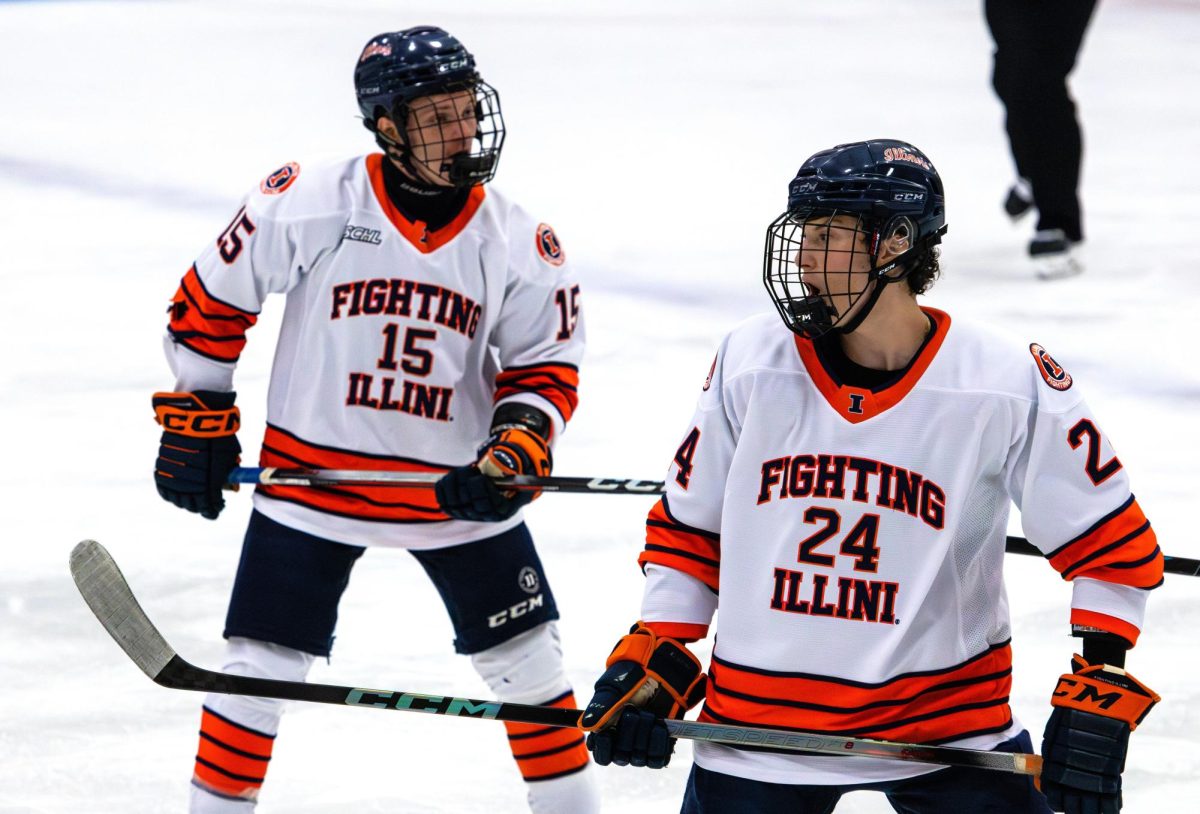
The current Illinois hockey head coach has a knack for returning to his alma maters and has experienced success so far at both the playing and coaching levels. He won the state championship as a player at Fenwick, two national championships as a player at Illinois and won the CSCHL conference championship in his first year coaching for Illinois last season.
***
When Nick Fabbrini graduated high school, he didn’t have much of a plan.
Get The Daily Illini in your inbox!
Back in the summer of 2004, Fabbrini was trying out for junior hockey teams after he deferred admission to Illinois. After Fabbrini, a forward from Fenwick High School in Oak Park, Ill., didn’t make either of the junior teams, he thought he was stuck.
Two days after classes started in the fall of 2004, Fabbrini called the University to see if there was still an open spot for him at the school.
“Apparently they never got my deferral letter, so they were wondering where I was,” he said. “They still had a spot for me and everything. It turned out really well for me.”
It would get better.
Fabbrini earned a spot on the club hockey team as a forward and the team won the ACHA national championship in his first season in Champaign. It was the first in program history.
While at school, Fabbrini majored in accounting — his assessment, “It really sucked,” he said through a laugh — but focused on hockey, and the program kept winning. Fabbrini’s senior year was the best of any team in Illinois hockey history: a perfect 38-0-0 record and second national championship banner to hang in the Ice Arena.
“It’s a special place to play,” Fabbrini said. “With all of the great support we get from our fans, the place really gets rocking when we have a full house.”
When his four years of eligibility expired, Fabbrini decided to join the Illini coaching staff as an assistant in the fall of 2009 while he took classes to polish off his degree, despite not having aspirations to go into coaching at the time.
After getting his first taste of coaching experience, however, Fabbrini returned to his hometown in and coached 13- and 14-year-olds for a year before accepting a position at Fenwick to coach the junior varsity team and become an assistant on the varsity staff.
***
After coaching the Fenwick High School junior varsity team for just two years, Illinois hired Fabbrini in the spring of 2012 to replace Hall of Fame coach Chad Cassel. Fabbrini made bold predictions from the outset, saying that the team’s three season goals were to win the CSCHL regular season championship, the CSCHL tournament championship and the ACHA national championship.
“For a first-year coach, those were pretty ambitious goals,” captain Austin Bostock said. “But with the guys we had, they were pretty realistic. … We had the same goals going all the way back to June.”
Those goals were especially ambitious after an extremely disappointing 2012 season when the Illini finished below .500 and lost in the first round of the national tournament. The preseason rankings reflected these thoughts and had the Illini ranked 13th in the nation and fifth in the CSCHL.
“I thought (the ranking) was way too low, it was a slap in the face,” Fabbrini said. “I took it more personally than some of the guys did.”
The Illini would prove the national doubters wrong by blasting then-No. 2 Ohio 5-0 at the Big Pond in November. Illinois would tread water for the rest of the semester before ripping off seven consecutive wins right after the semester break in January. By sweeping Robert Morris in the last conference weekend of the season, the Illini completed one of the three goals established by their new head coach and captured the CSCHL regular season title. Illinois posted an 11-6 mark on the season against conference foes and ended with a 26-12-2 record for the season, a vast improvement from 16-17-1 in 2012.
The other goals would be out of reach, though. Illinois was upset by Iowa State in the CSCHL Tournament and lost 3-1 to No. 2 Arizona State in the ACHA quarterfinals.
“I want to say that it’s a good start, being for a first-year coach,” Bostock said. “But no one who is coming back is content. … We’re going to have the same goals every year.”
***
Being a club hockey coach isn’t the most glamorous job in the world.
Although Fabbrini is able to stick around the game that he loves and give back to a program that gave him an opportunity, the perks of the job aren’t great. His coaching salary is paid by the club — by definition a registered student organizatioån — which although it doesn’t lose money, doesn’t have an excess of money.
This past fall and winter, Fabbrini had to help teach ice skating classes at the Illinois Ice Arena to truly be a Campus Recreation employee and gain access to facilities such as the ARC.
While the season is long by sports standards, starting in August and running through March, it still leaves five months of unemployment. To fill the time, Fabbrini has been aggressively recruiting for the team, a team that graduated just five seniors, but all of whom played meaningful shifts throughout the year.
He’s worked out his familiar drive up and down Route 57 to see players in Chicago, then back down in Champaign for school visits and around to persuade high school players to don the orange and blue.
When not out recruiting, Fabbrini is a substitute teacher in the Champaign area, teaching anywhere from kindergarten to 12th grade. The teaching gig is merely a temporary measure, as he’ll be back up in his hometown of Forest Park this summer to host ice time and run hockey camps while bouncing around living with his parents and former roommates in the Chicago area.
Fabbrini is content for now at Illinois, although he said he would want to move up to an NCAA job if given the opportunity, depending on what happens with the program at Illinois. Taking a job in the NCAA would require a master’s degree, which presumably would be in coaching, a program that CSCHL rival Ohio University offers.
Fabbrini still doesn’t have an exact, clear plan to follow, which is nothing new for him.
“The plan is to stay here for the next four or five years and see what happens here and go from there,” Fabbrini said. “I would hope building a good program here would open some doors for me. But right now, I’m more thinking about next year.”
Stephen can be reached at [email protected] and @steve_bourbon.