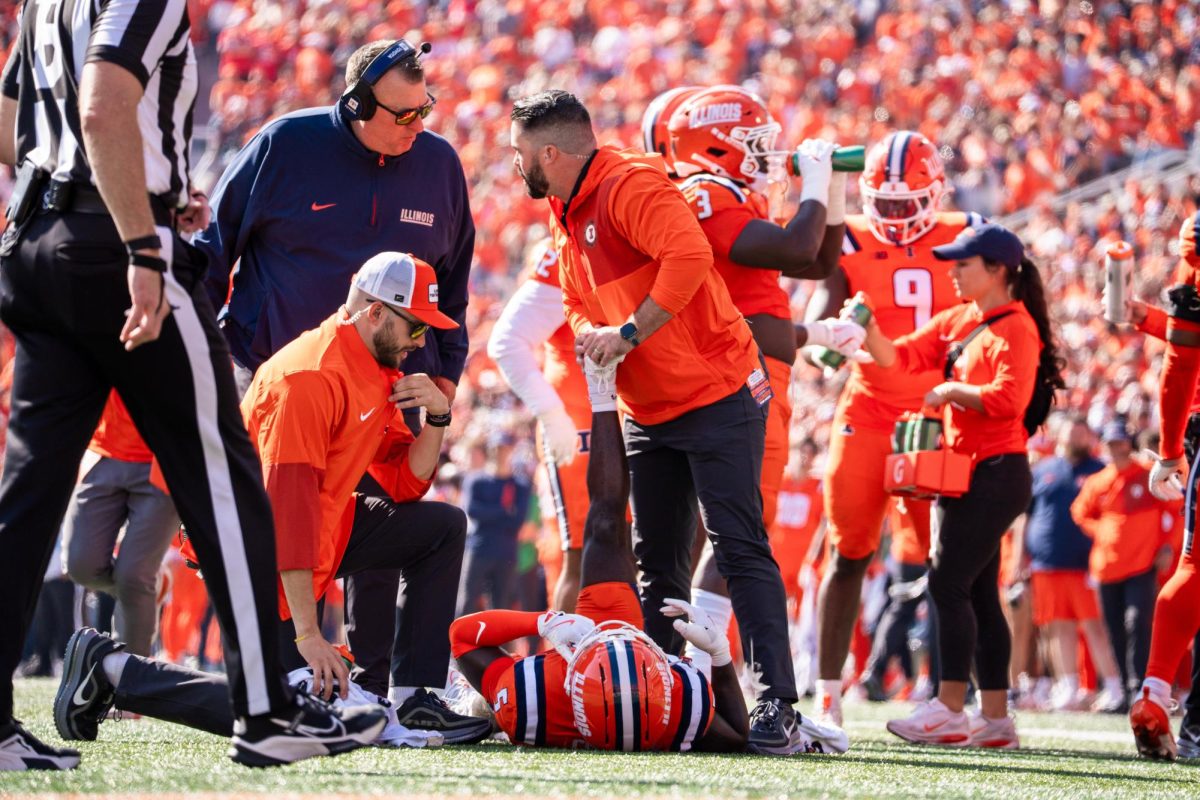
Scanning the sideline during the nationally televised football game against Wisconsin on Oct. 6, the ESPN cameras found Tim Beckman with a small brown can in his left hand. At first glance it didn’t seem to be significant, until the Illinois head coach dived his right hand into the Skoal chewing tobacco for everyone to see.
Twitter broke out immediately with television screenshots of Beckman, and within a few minutes people started questioning whether a coach could chew tobacco on the field.
Major news outlets, including USA Today, said Illinois would self-report the incident as an NCAA violation, and Beckman used his postgame and Monday press conferences to apologize for the incident.
The use of tobacco is a Level II secondary violation. There was no penalty from the NCAA, but Illinois sent a letter of admonishment to Beckman and said it would address the issue with all sports staff at the next coaches meeting.
Violations are common in college athletics, and most are not seen on national television. The football team had seven other violations in 2012, the most since 2008, when it had seven.
Get The Daily Illini in your inbox!
Many violations are self-reported by the school’s compliance office to the conference and NCAA. The NCAA typically receives 3,500 to 4,000 secondary violations and 20 major violations cases annually.
Ryan Squire, associate athletic director for compliance at Illinois, said the increased number of violations is not necessarily a negative.
“It’s always a positive sign when the institution, the university, discovers it on our own,” Squire said. “It shows that we’re monitoring at a high level. That’s always what I try to reassure people on campus about.
“If we’re doing 25 to 35 reports a year, that’s actually a good thing. As long as they’re the small kind of violation, right, because it shows that we’re properly monitoring ourselves.”
Squire said the compliance office monitors the 19 varsity sports on campus. He said close to half of the violations are from football and men’s basketball, which are monitored more frequently.
“The volume of the recruiting that they do and the pace at which they go, sometimes mistakes just happen,” Squire said.
Of those two or three dozen violations per year, all have been secondary violations for the past seven years. According to the NCAA, secondary violations are incidental, isolated and unintentional. Typically, they deal with recruiting rules or eligibility.
Within the secondary there are two levels. Level I violations are reported directly to the NCAA and Level II to the conference. Squire said there isn’t much of a difference other than how they are processed.
The mistakes most people read about are major violations. They are the ones that receive a public announcement and when the NCAA enforcement staff gets involved.
Illinois has not had a major violation since 2005, when a football booster provided a student athlete with gifts during his recruitment and as a player.
When the violation was discovered the compliance office launched its own investigation. The football team received a one-year probation after Illinois self-reported it to the NCAA. Squire was an assistant director of compliance at that time and dealt heavily with the case.
“There were no additional penalties because they felt that we handled it properly, and it was somewhat of a minimal violation where you had one booster, one recruit,” Squire said. “I think it always helps to show that you’ve got control over your program, that you’re monitoring your program.”
The kinds of violations vary, some committed by athletes, others by coaches. One football player sold portable speakers he was awarded after participating in the Kraft Fight Hunger Bowl. When it was discovered he sold the speakers for $180 on eBay, the compliance office self-reported it. The player wrote a letter to the NCAA acknowledging his wrongdoing, and he donated the money to the Junior Diabetes Research Foundation.
Last year the men’s basketball team reported five violations, four of which dealt with recruiting. The punishments for any violation can be anything from reducing the team’s number of recruiting days to just a letter of admonishment from athletic director Mike Thomas.
When a violation is discovered, it can take a month or longer to report it. If the compliance office receives a tip or finds the violation itself, it takes a few weeks to investigate and determine the necessary steps.
Sometimes a violation can take longer to report. One violation concerning former men’s basketball assistant coach Jerrance Howard occurred in September and October of 2011, but it was not reported until April 2012. The rule he violated prohibits a coach from sending any prospective student-athlete any electronic correspondence other than email and faxes.
The NCAA did not issue any punishment, but Illinois said in the report that it would prohibit any staff from contacting that recruit.
Squire said the violation might have taken so long to discover because the compliance office typically monitors phone and text message records only after the recruiting season is over.
On most violations, Squire said, many of the coaches or student-athletes don’t even realize they are violating an NCAA rule.
“The interesting thing about the whole system is 99 percent of your violations are going to be reported by the institution,” Squire said. “Sometimes its self-discovered, sometimes it’s information that comes to us.”
Samantha can be reached at [email protected] and @SammieKiesel.