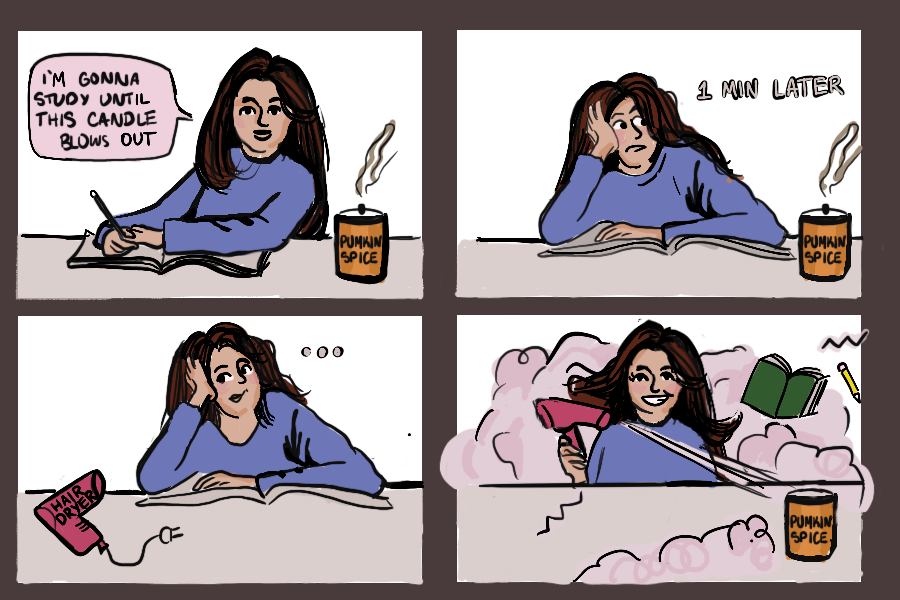
There are rare instances when 50 people roll their eyes simultaneously. One of those instances is during presidential debates; the other is when a professor gives a pop quiz.
Some professors are fans of giving pop quizzes over the assigned readings for lecture. But I think the eye rolling is justified because this teaching method is inefficient.
So why do professors give pop quizzes over readings?
To see who is reading on schedule, who is reading the text thoroughly and who is retaining the information from lecture.
Pop quizzes train students to study the readings based on what they think the professor wants them to hear. This forces students to cover all the material, ready to answer questions about any miniscule detail from the readings. If a student does not, his or her grade will probably suffer.
Get The Daily Illini in your inbox!
The solution professors and teaching assistants would suggest to this problem is to just read. Then students will not lose points. But there’s still a problem with that solution.
Pop quizzes over readings test whether students can memorize material. Students are expected to memorize various details from a single reading, which is long enough that professors feel the need to administer quizzes about them. But many of these details are arbitrary. The professor can literally ask about any detail in the reading — and who knows from what section.
However, details do help explain the bigger picture. Broad concepts are easier to remember, as these concepts are the overarching themes of the readings. Specific details from every reading cannot be memorized forever. Not everybody has a photographic memory; we are not all Sherlock Holmes.
In learning, memorization is not the most important. Memorization typically only lasts until a course is over. However, knowing where to look for the answers is important.
There is a reason why the University has one of the largest public university libraries in the world. One is to show students that no one knows all of the answers. What is important is that students know where to look for the answers and how to search for solutions.
That is what it means to be smart: to admit both that you do not know everything and that you need to clarify facts by finding the answer elsewhere. Then you have the material to back up your claim.
And that’s where resources come in, because as we all know, there is not enough time to learn everything. It is impossible. Just consider a breakdown of a typical college student’s week.
The general rule is that for every hour spent in class, a student is expected to spend two to three hours out of class studying. Most classes are three credit hours, meaning students are expected to spend nine hours out of class per week for a three credit hour class.
Students are required to take between 12 and 18 credit hours to be considered a full-time student, and the course load is 15 credit hours. That means students are expected to spend 135 hours a week outside of class, in addition to the 15 hours a week spent in class. That totals to 150 hours a week spent on school work, meaning that out of the 168 hours in the week, 18 are left for leisure, extracurricular activities, work and sleep.
This is impossible.
Knowing that, students need to be smart — about school work and time management. To be smart about school work, a student needs to know where to look for answers, whether that is from a textbook, library, notes or an instructor. To be smart about time management, a student needs to allocate his or her time for the best results.
My freshman year, I took Anthropology 271, which studies the linguistics aspect of anthropology. A handful of lengthy texts were assigned for each class. But my teacher’s assistant explained something important that all college students should understand: Students need to learn a text’s main points. That does not require a student to remember every single word. It requires students to be smart in their studies, focusing on introductions and conclusions for the central argument, then skimming through the body for supportive details.
College requires students to be efficient, to be smart in their studying and time management to and to be successful.
Pop quizzes over readings aren’t the best way to help students achieve that goal.
Rebecca is a junior in Media. She can be reached at [email protected].