National Eating Disorders Awareness Week: ‘I Had No Idea’
Feb 23, 2015
When Gina Lorenzi was five years old, she was told she had a “beer belly.”
The now 38-year-old social worker based in Chicago recalled her gymnastics coach’s statement, which started her 20-year fight with eating disorders. Lorenzi began over exercising and restricting her diet at 18 years old, and while each pound’s loss scared her, she felt her weight was never low enough.
“I knew I was hurting, but I didn’t know how to get help,” the Dominican University graduate said. “Nobody really recognized that I was crying out for help.”
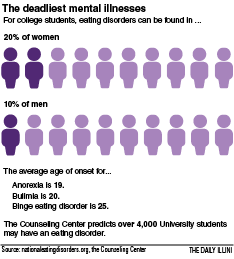
Thirty million people in the United States will be affected by an eating disorder at some point in their lives, according to the National Eating Disorders Association.
Of those 30 million, more than 4,000 could be a student at the University, the Counseling Center reported in a video for the 2015 National Eating Disorders Awareness Week, “I Had No Idea.”
Get The Daily Illini in your inbox!
As this year’s theme suggests, eating disorders are often overlooked, said Bethni Gill, health education nutritionist at the McKinley Health Center.
“There’s not just one single person that an eating disorder targets,” she said. “We want to raise awareness on campus that it can happen to anyone, and we want students to know the resources on campus.”
Both the McKinley Health Center and the Counseling Center provide free services for students. Appointments can be scheduled with dieticians, psychologists, psychiatrists and clinicians Monday through Friday, 8 a.m. to 5 p.m.
Such treatment incorporates both mental and physical professional care and is essential for helping those with eating disorders, said Jenny Conviser, CEO, founder and licensed clinical psychologist at ASCEND Consultation in Health Care — a health center located in Champaign-Urbana, Chicago and Northbrook.
“The number one misconception is the thought or belief that they can get over it without intensive medical, psychological care,” she said. “They cannot stop it once it’s a disorder; any disorder is not just going to go away without intense treatment.”
It wasn’t until Lorenzi was 25 years old when she felt like she was “part of life again.”
It was a conversation with a 20-year-old girl at the gym, who had dealt with an eating disorder before, that helped Lorenzi to reach a breakthrough.
Lorenzi then joined support groups and eventually spent two weeks at The Renfrew Center Eating Disorder Treatment Facility in Florida — a place where hope for recovery can be found, said Jancey Wicksom, licensed social worker and site director at The Renfrew Center in Chicago.
”Recovery is possible. You may feel alone, but you’re not,” she said. “An eating disorder is not something you can conquer on your own. With help, which is absolutely available, you can fully recover.”
Such was the case for Lorenzi.
“I was honestly isolated in my own world,” she said. “But the eating disorder doesn’t have to take control of you. As much as it doesn’t feel like it, you have control of it.”
Stephanie can be reached [email protected].