The darker side of Paris: A look at les Sans Domicile Fixe
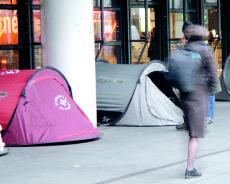
A man walks past the Medecins du Monde tents of the sans-abris lining the east wall of the Centre Pompidou, Paris, Friday, Jan. 13. Lisa Xia
Mar 10, 2006
On the street-side of Paris’ best-known modern art museum, you will not find a Picasso or a Pollock facing the passers-by. There will not be a sign announcing that the restaurant on the roof of the 150-foot Centre Pompidou offers beautiful distant night views over the Ile Saint Louis and the Notre Dame.
No, what you will find underneath the massive network of steel bars and oversized, bright blue tubes lining the building’s exterior, are a row of flimsy, dome-shaped tents that are non-descript green. They huddle against the center’s east wall, emblazoned with the white cross and matching lettering of M‚decins du Monde.
It is not the image that one conjures up when envisioning the City of Lights, so famous for its haute couture and notorious for its snobbery. The tents are a new addition to the city’s d‚cor with thus far, according to MDM, about 260 distributed around the capital in the last few months.
Despite having over 3,900 places in the city’s emergency accommodations, there is not nearly enough to go around, with the number of homeless estimated to be between 10,000 and 15,000 by the National Institute for Statistics and Economic Studies. And still there remain those who prefer the streets to the shelters.
The people who have come to call these little tents home are the sans-abris or les Sans Domicile Fixe. Next to the Metro Rambateau exit, they number 11 in nine tents, although they say their number changes daily.
Get The Daily Illini in your inbox!
Didier
On Saturday afternoon, the air is abnormally dry, although the temperature is only several degrees above freezing. The majority of the tents are tightly zipped closed, their weak structures billowing in what wind is not sheltered by the building. The street is quiet, less the sporadic roar from a passing vehicle and occasional murmurs from passing tourists, careful not to look in their direction. No one stops.
A man in his mid-thirties, his unkempt brown hair covered tightly by a black beanie, is bent over a messy tent. Stopping only occasionally to adjust the glasses above the black bandana bandaged over his left eye, he meticulously uses his right hand to sweep onto a piece of cardboard the tobacco and dirt collected at the bottom of his home, dusting it off into the street.
He calls himself Didier. He is not a tall man, slightly hunched over in a green coat that seems to swallow his thin body. He mumbles when he speaks, frequently looking down at his smoldering cigarette; his French trails into the wind. Originally from the central French countryside, he has been homeless for four years, wandering from city to city until he arrived in Paris just one year ago.
He survives on food provided by churches and humanitarian organizations, such as Restos du Coeur and Coeur de Paris. Other expenses, like cigarettes, he says, are covered by his monthly government handicap allocation. He has been in front of the Centre Pompidou only since MDM came with the tents.
He is comfortable, he says, but alone. Didier quietly mutters that he had once had a life, a family, a girlfriend, but had lost everything when the accident happened.
“It is very complicated,” he repeats, uncomfortably adjusting his glasses over his injured eye. “Everything just went away.”
He does not say more.
Chantal
The silence is brusquely interrupted by a woman with frizzy orange-gray hair who approaches from several tents down, yelling for Didier to pick up his mess. Her crazed blue eyes and wild gestures betray her 49 years and meek 5-foot-1 stature. Her name is Chantal.
Originally from Champagne, she has been living on the streets nine years, of which the last two she has spent with six others by the Centre Pompidou. She says, pointing at the neighboring tents, that they are all either RMIstes or SMICards. The RMI (Revenue Minimum d’Insertion) is similar to welfare, the requirements including French citizenship or legal residency for at least five years and active job-hunting.
In 2004, over 1 million people received money from the RMI, although the most a single person can receive is 433 euros, about $518, a month. The SMIC (Salaire Minimum Interprofessionnel de Croissance), the minimum wage, is about 8 euros an hour according to INSEE. With cap of 35 hours for the French workweek, however, a SMICard (one who receives the SMIC) can make only slightly over 1,200 euros, about $1,430, a month. With the average cost of a two room Paris apartment estimated by the French Embassy at 760 euros, or $910, a month, many SMICards and RMIstes alike are forced onto the streets, she said.
Employment contracts
Pulling a mandarin orange and a paring knife out of her tent, she sighs, saying she once had a different life as well: a job, a boyfriend, a home. But with the passage of new and controversial French employment contract laws for those under 26, such as the Contrat Premiere Embauche, First-Hire Contract, and Contrat Nouvelle Embauche, New-Hire Contract, she believes that it became impossible for older people like her, who were finding temporary work through job agencies, to be hired.
These new contracts make younger candidates more desirable to companies because they mandate a two year trial period during which these workers may be fired anytime without employer justification.
The tents are not a solution. And they are not meant to be. According to a statement by MDM, the tents are not the solution but rather a symbol that one does not yet exist.
“I’m a song writer,” she said, eagerly pulling out a solidarity brochure distributed by the town hall. “I just need to find a place in here that will help people like me record tracks for free. Then I’ll make it out.”
The day is coming soon, she says. She only needs to wait a little bit longer. But for now, the air remains quiet. The tents of her neighbors are largely vacant on this particular afternoon.
“Look around you,” she says. “Everyone’s gone now. I have to stay and watch over the tents. How can I move?”