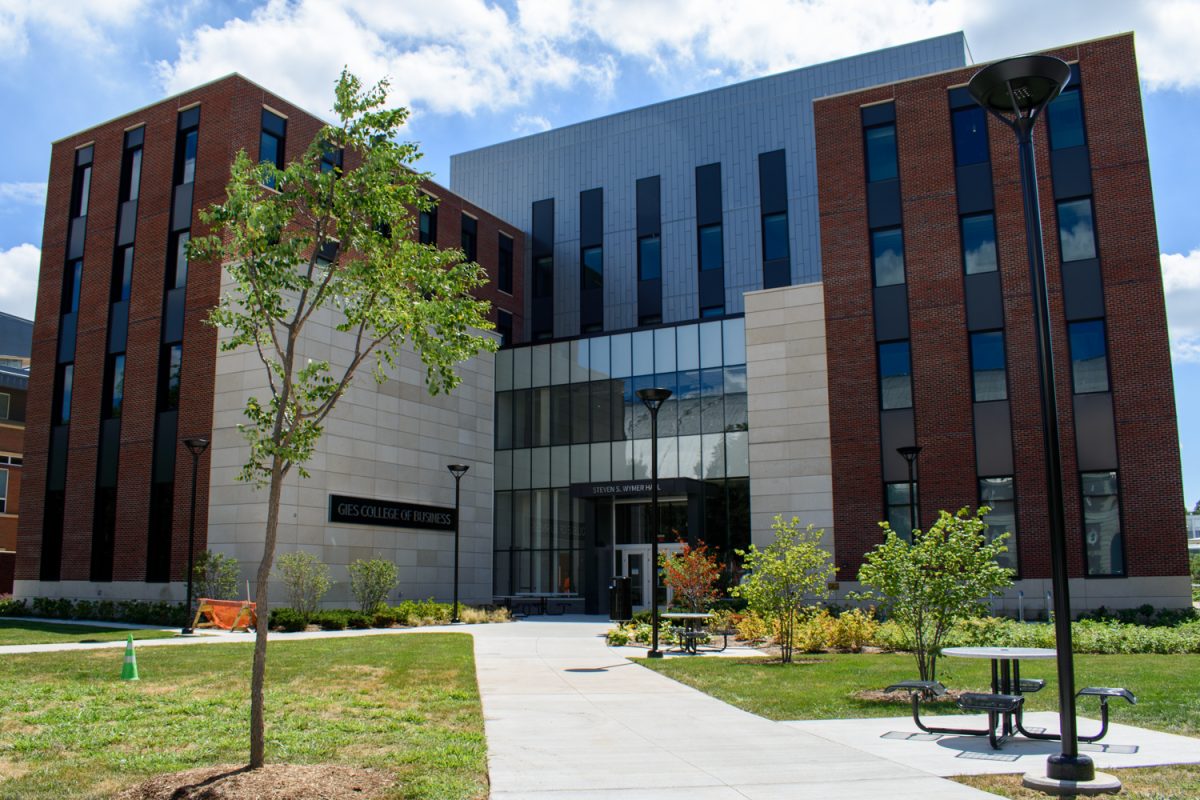
Wymer Hall officially opened its doors to students and University staff. The highly anticipated project has been under construction for two years and possesses multiple unique features that students and community members haven’t seen on campus before.
Located just west of the Business Instructional Facility and near the Main Library, Wymer Hall is placed in a strategically central spot on campus for all students. The decision to build Wymer Hall came out of necessity. Enrollment at the University has continued to rise, online programs have grown and demand for collaborative spaces has increased across campus.
From the outside, the red-brick and glass exterior blends modern design with traditional campus architecture, surrounded by green space and walkways populated by students. Inside, the two-story atrium greets visitors with clean lines, natural light from skylights and a wide staircase that connects the main floor to the second.
Students who have visited the Campus Instructional Facility or BIF would be familiar with the open seating arrangements and utilization of natural lighting that Wymer Hall incorporates. These open areas are also complemented by a 200-seat lecture hall, dozens of flexible classrooms and over 80 offices for faculty and staff.
“Gies College of Business, and the University in general, is growing,” said Arlene Vespa, senior capital planning and project manager for the building. “We are interested in democratizing education and reaching as many learners as we can.”
Get The Daily Illini in your inbox!
The building itself was designed with learning styles and a collaborative atmosphere in mind. The lecture hall allows professors to teach without a microphone thanks to engineered acoustics, and the aisles are laid out so instructors can move through the room and interact with students.
Seats are movable, making group work easier. The smaller classrooms on the second floor can also be reconfigured, and the building includes plenty of open spaces, study nooks and lounges for students to use between classes.
On the first day of class, students from across the University came to visit. Some snapped pictures of the wide atrium and modern lecture hall, while others used a complementary map to explore the new features of the building.
Eric Larson, professor in Business, took a class-wide selfie to commemorate the first class in the brand new building. Two graduate students studying human resources, Dorcus Tuan and Esther Seol, stopped by to check out the building and shared their first impressions.
“It wasn’t what I expected,” Tuan said. “The first floor is very open, which surprised me, but it’s a nice, modern space.”
Seol added her thoughts after visiting the auditorium, saying, “It’s open, but not so big that you can’t see the professor. The screen is large enough that you can follow along from anywhere. It feels like a good learning space.”
Sustainability is another defining feature of Wymer Hall. With a $500,000 contribution from the Student Sustainability Committee, the building runs completely on geothermal energy, making it the first on campus to provide both heating and cooling this way.
The project also helped the college become the first net-zero energy college at the University. For students like Tuan and Seol, learning about this effort changed their view of the building.
“I don’t know much about geothermal, but if it’s better for the environment. I’m proud the University invested in it,” Tuan said. “For a building this size to run on geothermal is really cool, and it shows the University is willing to put resources into sustainability.”
Steven Wymer, an alum of Gies College of Business, donated a large sum of money to the project. This was done in tandem with numerous private donors, public funds and corporate companies. In total, the building costs fell in the area of $105 million.
“This gift is a continued return on investment to Gies from the partial academic scholarship I received as a student,” Wymer said.
For Vespa, the most rewarding part of the project was the teamwork it took to make Wymer Hall possible. Donors, developers, architects, students and faculty all contributed to achieve the final product.
“You can’t build a building of this caliber in this short time without everyone working in lockstep,” Vespa said.
Even though the signage highlights business, Vespa stressed that Wymer Hall is a campus building. Its location, design and purpose reflect a vision of inclusivity and collaboration. Classes in Wymer range from data analytics to the science of soil, and students are sure to run into others with different backgrounds than their own.
“That ability is what allows relationships to be built across campuses,” Vespa said. “It is one of the strongest features of this building.”
With its mix of modern architecture, sustainability and student-centered design, the space is more than just another building. Wymer sets the precedent for future buildings on campus, and its foundations lie far beyond its newly constructed walls.