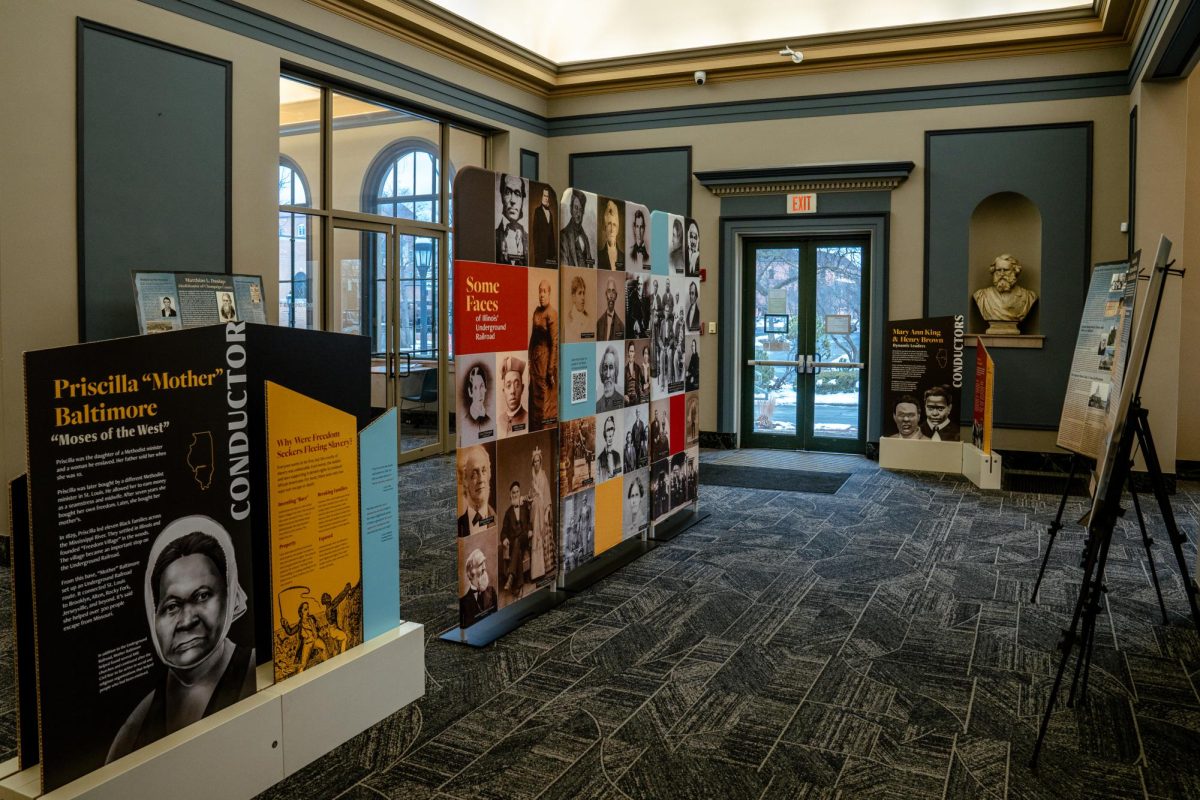
In line with its mission for learning and growth, the Urbana Free Library will host the “Journey to Freedom: Illinois’ Underground Railroad” exhibit until March 29.
Put together by the Abraham Lincoln National Heritage Area, the traveling exhibit compiles stories of conductors and freedom-seekers risking their lives while moving through the Underground Railroad.
Although the bulk of the exhibit focuses on the Underground Railroad’s network in Illinois at large, Pat Cain, manager for the Champaign County Historical Archives, wanted to highlight Champaign County and east central Illinois’ instrumental roles in aiding people’s journey to freedom. Cain recruited Robert White, trail manager for the Champaign County African American Heritage Trail, and historians Angela Rivers and Barbara Suggs Mason to help.
“There’s this myth that there was not much activity in east central Illinois when it comes to the Underground Railroad,” Cain said. “We’re trying to bring those stories to light … to say that our own backyard was involved in a major historical event.”
According to both White and Cain, few primary sources of the Underground Railroad in Champaign County and central Illinois actually exist, but that shows just how successful the local network was.
Get The Daily Illini in your inbox!
“If all of these freed and runaway slaves made it to Chicago and other Northern states, they had to come through Champaign,” White said. “You have to think, though, that they were very successful … It’s reflective of the resilience of the community that the evidence we have is pretty minimal.”
Using a combination of notes, diaries, secret codes and oral histories, the team pieced together many of the hidden histories of freedom-seekers and their benefactors in Champaign County.
Mathias Lane Dunlap, a farmer and abolitionist, allegedly made his home in Savoy a station along the Underground Railroad. Benjamin Franklin Nash Sr. used his position as a porter along the Illinois Central Railroad to hide his efforts to move freedom-seekers North. The exhibit shows that newspapers reported an individual named Nash being arrested for his efforts.
Champaign also used an actual railroad rather than a metaphorical one and remains one of the few stops along the journey to do so. White shared that in order to hide freedom-seekers on their journey, conductors would place them between lumber transported through the state on the Illinois Central Railroad, one of the driving forces for the founding of Champaign-Urbana.
Despite their efforts, the secretive and overall successful nature of the Underground Railroad in the county means that many of the stories will stay hidden or become lost over time.
“The biggest thing is actually the desire to do it,” White said. “If you’re looking for it, it’s usually there. If you look for it.” Both Cain and White hope the exhibit will instill that desire in all who see it: the desire to actively seek out these stories and put the puzzle pieces together.
Some visitors, like Cedric Dumas, a visiting scholar from France at the Carle Illinois College of Medicine, stopped at the exhibit to take it all in. Before coming, he had never heard of the Underground Railroad, much less about Champaign’s influence in it.
“There’s barely a trace of this history,” Dumas says. “If you don’t look into any books or this kind of exhibition, there’s a chance you’d have no idea about what happened in Champaign-Urbana.”
Though the exhibit is up and running, the team at Urbana Free Library continues to create opportunities for people to learn about the Underground Railroad’s presence in Champaign. This includes a guided walk-through of the exhibit and a bus tour to some of the locations where these stories took place, scheduled for late March.
These opportunities aim to connect the community with its history. The organizers’ efforts make it clear that these events did happen, and that these people and their journeys were real. It just takes people like Dumas to stop, search and take the active steps to make sure these stories are found and remembered.