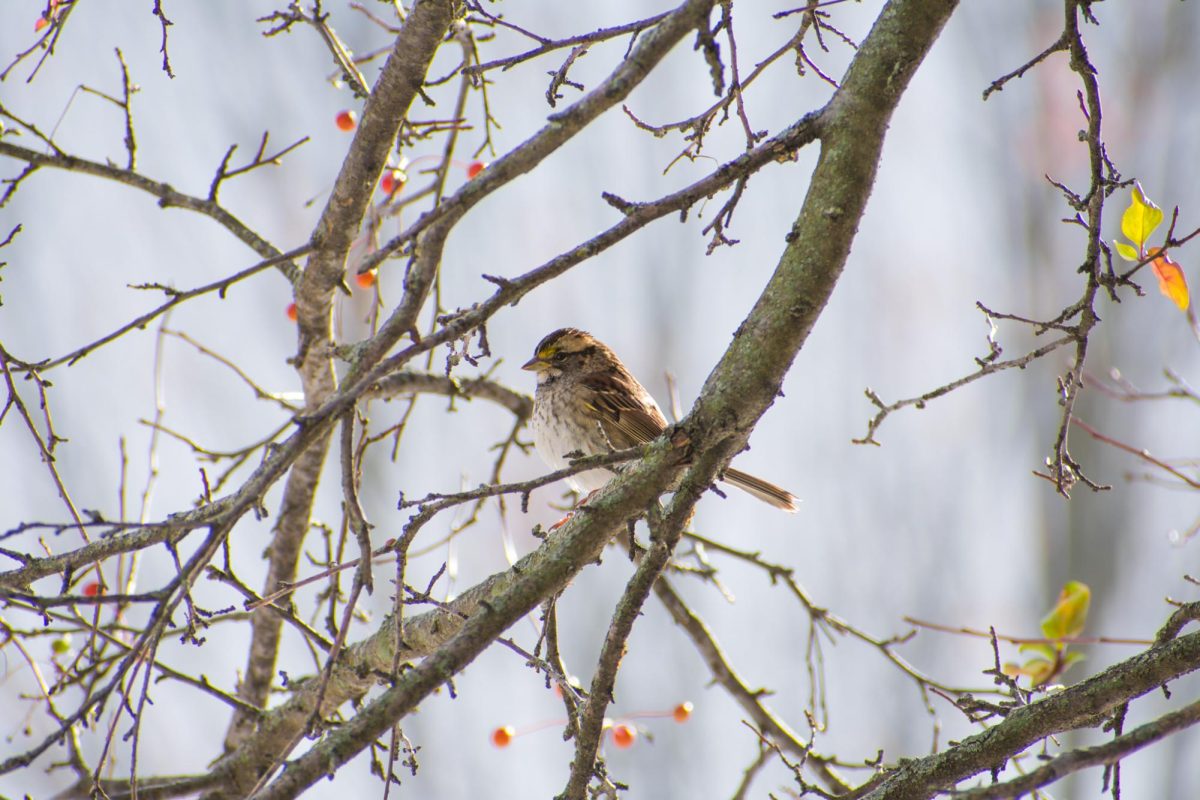
Millions of birds pass through and above the Champaign-Urbana area on their way to warmer southern regions during the fall and winter migration period. At its peak, migratory numbers over C-U are in the millions. As winter approaches, many species will use the University campus and C-U area as a launch pad for their journey to warmer climates.
Benjamin Van Doren, professor in ACES who specializes in migratory birds, spoke on the importance of maintaining these migration habits. The professor explained that the skies above campus are far busier than most students realize.
“We’re in Illinois on a major migratory flyway,” Van Doren said. “On many nights of the year, millions of birds are literally flying overhead.”
While geese flying in V-formation are the most visible migrants, Van Doren said the vast majority of species, especially small songbirds, travel at night. These birds may be journeying from as far as northern Canada or as close as Wisconsin before making their way south toward the southern United States, Central America or even South America.
However, a change in natural ecosystems has posed issues for the traditional migratory routes. Much of central Illinois, including C-U, was once more heavily forested than at present. Today, the region is dominated by agriculture, creating large areas of open land that offer little shelter or food for birds traveling long distances.
Get The Daily Illini in your inbox!
The Corn Belt is a huge obstacle for migratory species traveling further south. Because of that loss of habitat, even the smallest natural areas on campus have become essential rest stops for migrating species.
One study showed that migratory songbird species are dying out with a loss of 28% over the past five decades due to loss of habitat. A lack of food and roosting areas has caused birds to perish due to starvation and exhaustion, with some falling out of the sky on their migratory path.
“Any little patch that has the right kind of habitat can host migratory birds,” Van Doren said. “Even a few trees on the (Main) Quad or the woods at Crystal Lake Park become really important places for them to rest and refuel.”
Sofia Doris, junior in LAS, noted a visible influx of birds during these peak migration periods. Doris said that sometimes the geese on the quad can become aggressive, especially during peak migration times.
Migration across campus is not without danger. There has been an increase in reported conflict between Canadian Geese and University students. This has led to some measures being taken against them, including destroying goose eggs or limiting food sources.
“Sometimes the geese can get very close to you,” Doris said. “I try to get out of their way if they start honking at me.”
Another issue is migratory species colliding with buildings on the C-U campus. The University’s Bird Strike Survey, a student-run project, documents birds that die after colliding with the glass windows of campus buildings. These birds are often migratory species that are unfamiliar with the built environment of the University and mistake the glass for an open plane to fly through.
“Some of the birds that die hitting windows have come from as far as Peru or Argentina,” Van Doren said. “They were headed for places like Minnesota, Ontario or Alaska. It’s heartbreaking that their journey ends at a window on campus.”
To mitigate this issue, there has been a push to install anti-bird strike infrastructure on campus. For example, the newly built Wymer Hall installed dotted windows that prevent bird strikes due to their nonreflective features.
Anika Brahmbhatt, junior in Business, noticed these changes on the new building.
“I think that it’s super cool that a student group helped make these changes,” Brahmbhatt said. “I hope that less birds are dying due to that.”
As millions of birds continue to pass through C-U, Van Doren hopes students will appreciate the natural spectacle happening just above them — and the responsibility that comes with living along a major migratory route.
As C-U continues to grow and change, its landscapes remain part of an important route for migratory wildlife. Researchers, students and campus planners have noted the value of maintaining small green spaces and considering wildlife-friendly design in new construction.
With millions of birds passing through the region each year, these areas function as practical stopover points that support the migration activity documented across central Illinois.
“Even small choices we make here matter far beyond Illinois,” Van Doren said. “These birds connect us to the rest of the continent.”