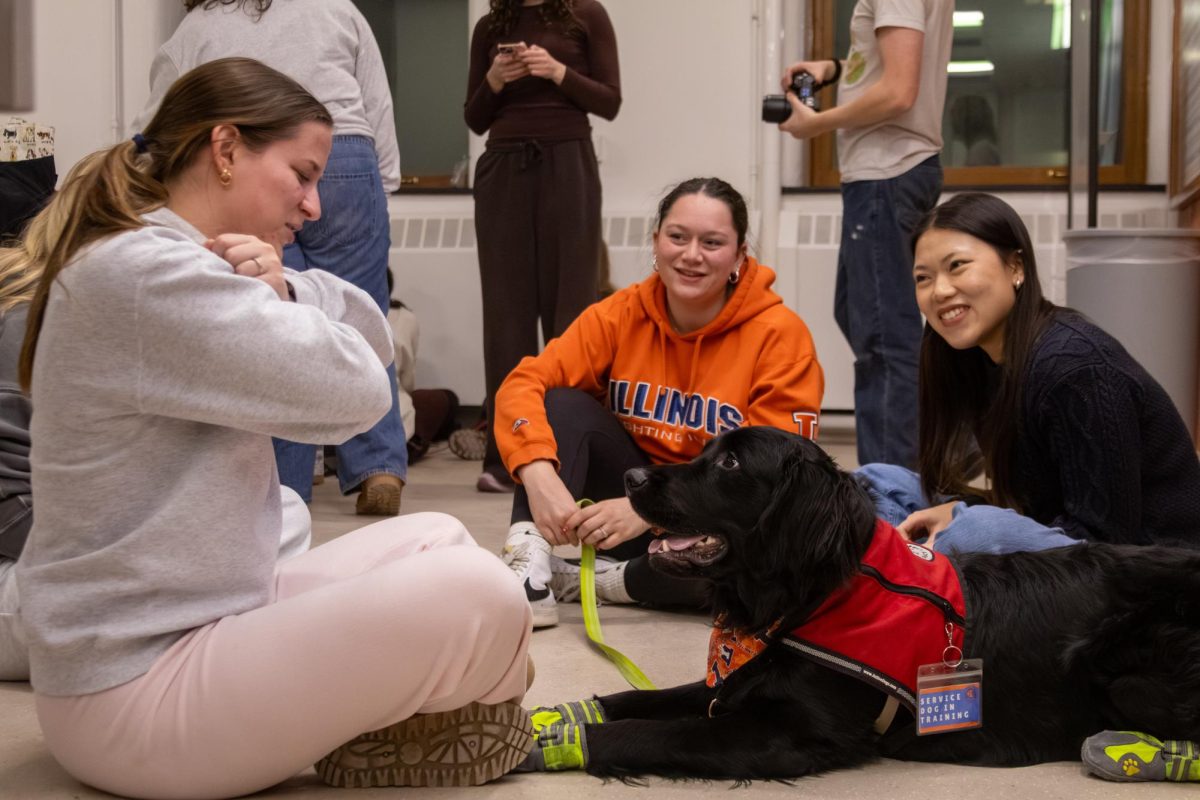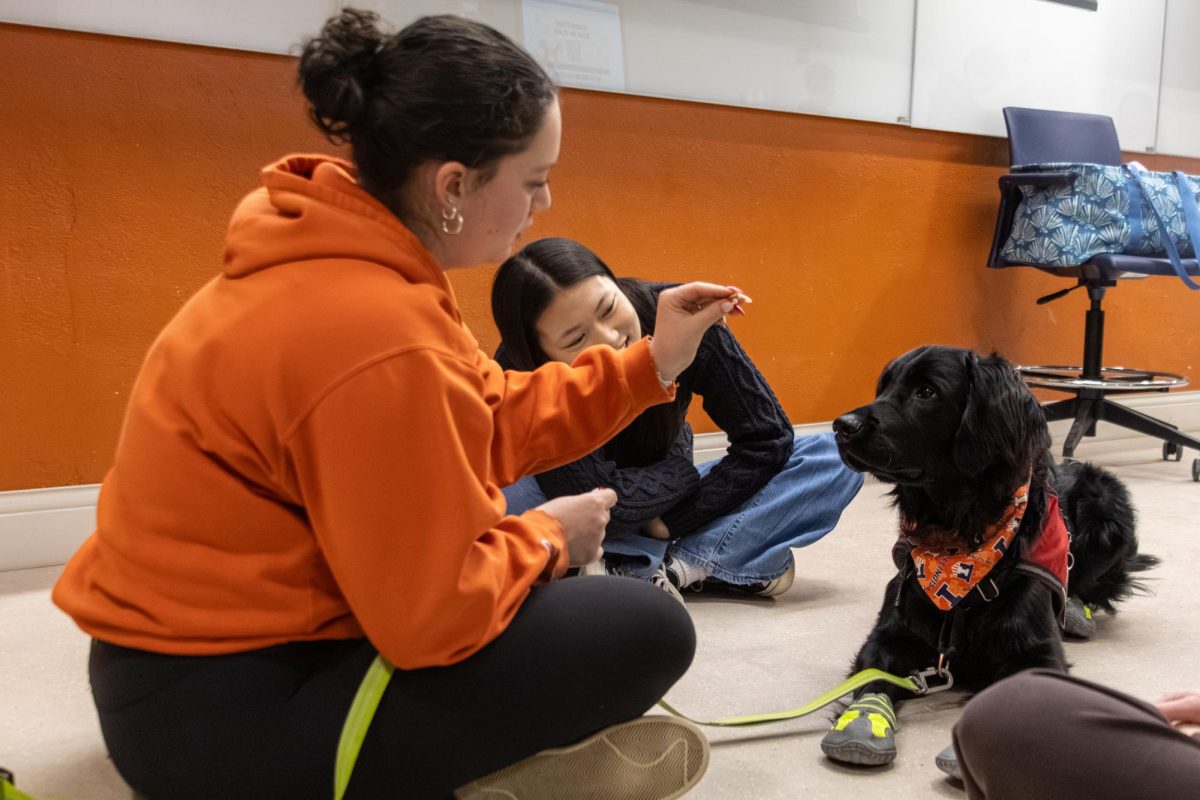
Across campus, you can find students walking and playing with their adorable dogs, but for some of these furry friends, the University is just a temporary stop before they find their forever home.
The RSO 4 Paws for Ability is a nationwide organization geared towards training service dogs for placement with children, adults and veterans with disabilities. The group relies heavily on volunteer work, especially from students at the 14 college-based chapters in the Midwest.
While 4 Paws for Ability originally started in 1998, the University’s chapter wasn’t founded until 2017. Since then, volunteers on campus have helped train dogs and raise awareness about service pets.
Emily Panczyk, senior in LAS and president of 4 Paws, originally heard about the organization through members at other colleges, piquing her interest.
“I really fell in love with the organization (in high school),” Panczyk said. “Then, when I decided to come to Illinois, I found out they had a chapter, and I had to get involved.”
Get The Daily Illini in your inbox!
According to Panczyk, there are different levels of involvement within 4 Paws; the first is a general member who attends events to meet the dogs. However, students looking to be more involved can become certified as primary or secondary handlers who undergo multiple training processes before being certified through the 4 Paws headquarters in Ohio.
Upon certification, primaries are then paired with a service dog to complete basic training and socialization. Secondaries serve a similar purpose, but instead of fostering a dog, they act as “puppy-sitters” who can look after the pets if a primary needs assistance.
On campus, 4 Paws currently fosters eight dogs in training, one of them being Fossey. Fossey is a golden lab cared for by Yanelli Carrasco, a graduate student studying public health and the 4 Paws collaboration chair. Carrasco is a full-time primary, meaning wherever she goes, Fossey goes, but that’s one of her favorite parts of the job.
“I love taking her to cafes because she always gets a pup cup, and the cafe workers find it hilarious, and it brings a smile to their day,” Carrasco said. “Besides that, I love taking her on long hikes; the dogs really do enjoy a good hike or even sports games.”
The role of a primary is more than just quick cafe outings and games on campus, though. Carrasco is from Chicago, and as a full-time primary, Fossey accompanies her over breaks.
While Carrasco has fun bringing Fossey to Chicago, it’s still a lot of work. However, it’s worth it because she loves spreading awareness and helping service dogs reach those in need.
“With my first foster, it broke my heart when I had to give her up, and she completed her training,” Carrasco said. “But now she’s paired with a kid who has autism, and I think that’s super important. We’re bringing awareness to service dogs, and these dogs are literally life-changing for individuals. It’s so heartwarming.”
Dogs-in-training don’t spend their entire time with primaries on campuses. In fact, they are only with a primary from when they leave headquarters, as early as eight weeks old, to when they are about one and a half to two years old.
After their foster time, the dogs begin working with professional trainers who, according to Panczyk, help the dogs-in-training learn specific tasks for different disabilities. After completing the advanced training, the dogs graduate and eventually get placed in their forever homes.
Though each dog follows its own timeline, Panczyk loves watching them grow from when they start on campus all the way to graduation.
“Every dog’s path is different, but watching how they can overcome some of the challenges that they’ve had at the beginning is really special,” Panczyk said. “It makes you feel good about what you’re doing, because you started with something that could barely walk up the stairs, and now they’re completely life-changing to someone.”
The dogs aren’t just healing for those they go on to help; they are also special to members who come in contact with them. Tom Remi, sophomore in Engineering and 4 Paws public relations chair, joined the club because he missed his dog at home.
All it took was a few meetings for Remi to fall in love with the philanthropy aspect of 4 Paws, and what started as a way to see puppies has now turned into a passion.
“I like giving back to communities that are in need,” Remi said. “I would say one of the biggest things that keeps me here is the energy and motivation that not only the general members but also the exec board brings to every meeting.”
While 4 Paws is focused on volunteer work, that isn’t the only way they give back to the community. This semester, the group decided to fundraise for a little girl in need of a service dog.
Getting a service dog can be a financial burden for families. According to Panczyk, they can cost nearly $40,000. Therefore, 4 Paws found a family looking for a service dog in the Chicagoland area to fundraise for.
While having fun with puppies is a big part of their involvement, 4 Paws members go above and beyond with their volunteering and fundraising efforts. This fosters a caring and dedicated community that Panczyk is sad to leave behind when she graduates.
“We’ve really grown an awesome community here because you’re literally parenting a dog, and caring for a living being, so it really has brought all of us together for a really great cause,” Panczyk said. “I’m really sad to be graduating, because I’ve been involved with the organization for four years now, and it’s definitely become a huge part of my college experience.”
Luckily, Panczyk and other board members’ work ensures a passionate community remains to continue the 4 Paws mission. Remi never expected to serve on the executive board when joining, but now he’s found a community he loves.
“I just missed my dog when I started here,” Remi said. “But you really fall in love with the community, you fall in love with the people and the dogs too.”